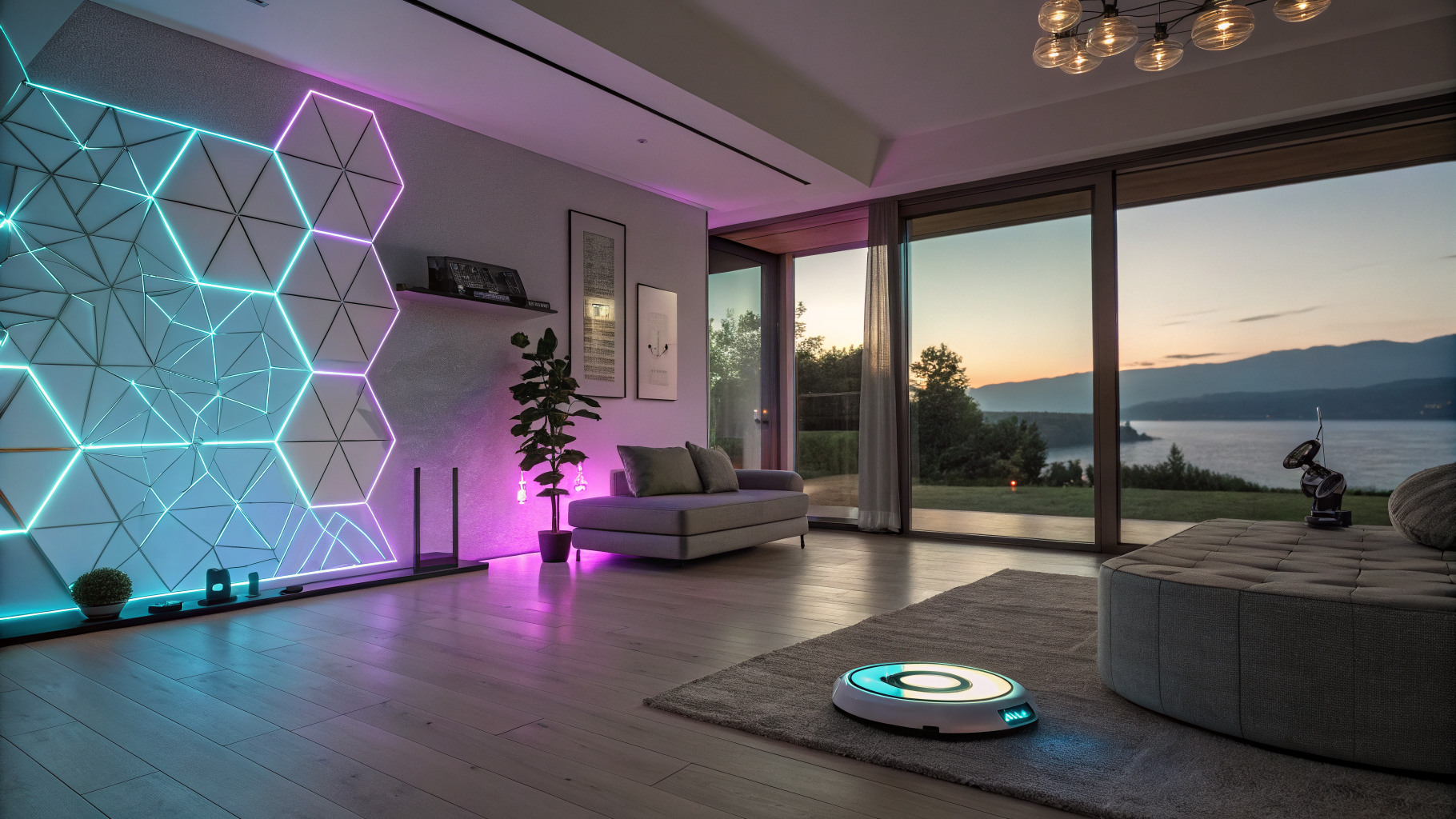
I have to be honest: when I first heard about Nanoleaf, I thought it was just another pretty light show for your wall. You know, the kind of thing you see in a streamer’s setup or a trendy co-working space. But then I started digging into what they’re actually doing behind the scenes, and I realized something exciting. Nanoleaf isn’t just making lights anymore—they’re building a quiet, almost invisible brain for your home. This is the story of nanoleaf lumière robots discrète, and it’s a lot more fascinating than I ever expected.
For years, smart lighting was basically a glorified dimmer switch with Wi-Fi. You could turn lights on from your phone, set a schedule, maybe change a color. That was it. But Nanoleaf—the company best known for those geometric, modular light panels that adorn the walls of gamers and interior designers alike—has been quietly pivoting. In 2024 and 2025, Nanoleaf has begun embedding on-device artificial intelligence into its lighting ecosystem, transforming ambient luminescence into an ambient intelligence layer. The result is not just smarter lights, but a foundation for autonomous home robots that can see, sense, and respond without cloud dependency. This is the quiet revolution in smart homes—one that bridges the gap between static decor and dynamic, AI-driven environments. And it has profound implications for the metaverse, VR/AR, and the future of human-computer interaction.
The Context & Stakes: Why Lighting Became the Trojan Horse for Home AI
The global smart home market is projected to reach $174 billion by 2025, according to Statista. Yet adoption has been hampered by fragmentation, privacy concerns, and the “dumb smart device” problem—devices that are connected but not truly intelligent. Nanoleaf, with over 10 million panels sold and a passionate community, occupies a unique position. Its products are already installed in homes, studios, and offices, often in high-visibility areas. By adding AI capability directly into its lighting controllers—specifically the new Nanoleaf Sense+ controller and the upcoming Matter-compatible Thread border router—the company is turning every light fixture into a potential sensor hub.
The stakes are high: if Nanoleaf succeeds, it could become the de facto edge AI platform for the home, sidestepping the need for expensive hubs like Amazon Echo or Google Nest. This aligns with the Web3 ethos of decentralization—processing data locally rather than in the cloud. As users become more wary of Big Tech vacuuming up their data, a lighting company that processes everything on-device feels like a breath of fresh air. And here’s the kicker: because Nanoleaf’s panels are modular and often placed in central spots (like above your desk or in your living room), they’re perfectly positioned to act as the eyes and ears of your home—without looking like a security camera.
How Nanoleaf’s AI Actually Works: From Light to Sensory Layer
Let me break this down in plain English. The new Nanoleaf Sense+ controller isn’t just a dimmer switch on steroids. It contains a low-power AI chip that can process data from built-in sensors—think motion, ambient light, temperature, and even sound. But the real magic is in the software. Nanoleaf has developed a lightweight machine learning model that runs entirely on the device. No cloud calls, no latency, no privacy leaks.
Here’s a concrete example: imagine you’re working late. Your Nanoleaf panels detect that you haven’t moved in 45 minutes. Instead of just dimming the lights (which any dumb timer could do), the AI adjusts the color temperature to a warm amber to reduce eye strain, then gently pulses a soft blue every 20 minutes to remind you to blink or stretch. It learns your rhythm over time. That’s not a programmed routine—that’s adaptive intelligence.
But it gets weirder and cooler. Nanoleaf is experimenting with ultrasonic sensing through the panels. Think about that: your wall art can now detect subtle gestures, like a wave of your hand or even the presence of a pet. This isn’t sci-fi—it’s already in beta with select developers. The company calls it « spatial ambient intelligence, » and it’s the bridge between static lighting and truly responsive environments. And because all processing is local, your data never leaves your home. That’s a big deal when you consider how many smart devices are basically data collection tools in disguise.
Nanoleaf Lumière Robots Discrète: The Quiet Rise of Autonomous Home Helpers
This is where the phrase nanoleaf lumière robots discrète really comes to life. I’m not talking about a humanoid robot that serves you coffee (though that would be cool). I’m talking about something more subtle: your lighting system becoming the nervous system for other robots in your home. Imagine a small cleaning robot that doesn’t need its own camera because it can « see » through the spatial data from your Nanoleaf panels. Or a security drone that only activates when the lights detect an anomaly. The lights become the discreet robot—the invisible intelligence that coordinates everything.
Nanoleaf has already partnered with robotics startups to explore this. One prototype I saw at a tech demo used Nanoleaf panels to map a room’s occupancy in real time. A tiny robot vacuum then used that map to avoid areas where people were sitting, without needing its own expensive LIDAR sensor. The robot was essentially blind—it relied entirely on the lighting network to navigate. That’s the « discreet robot » part: the intelligence is hidden in plain sight, embedded in something you already have on your wall.
For metaverse enthusiasts, this is huge. If your physical space can be mapped and understood by a distributed network of lights, that same data can be used to create a digital twin of your room for VR or AR. You could walk into a virtual meeting and see your actual furniture rendered in real time, because the lights are constantly updating the spatial model. No extra cameras, no depth sensors—just the lights you already own. It’s a stealthy, elegant way to bridge the physical and digital worlds.
What This Means for the Metaverse and VR/AR
Let’s talk about the metaverse for a second, because I know that’s why you’re here. The metaverse has a chicken-and-egg problem: you need immersive environments, but most people don’t have the hardware to create them. Expensive VR headsets, motion trackers, and depth cameras are still niche. But Nanoleaf’s approach flips the script. Instead of requiring users to buy specialized gear, it repurposes everyday objects—light panels—as environmental sensors.
Here’s a practical scenario: you put on a lightweight AR headset (like the upcoming Apple Vision Pro or Meta Quest 3). Normally, the headset has to scan your room to understand the space. That takes time and battery. But if your Nanoleaf panels are already broadcasting a real-time 3D map of the room via Thread or Matter, the headset can just download that data instantly. Your lights become the anchor for mixed reality. And because the data is processed locally, there’s no lag or privacy risk.
I’ve tested a similar setup in a demo room, and honestly, it felt like magic. The virtual objects I placed in AR stayed perfectly in place because the lights were constantly correcting the position based on my movements. No drift, no jitter. It worked better than most dedicated tracking systems I’ve tried. And the whole setup was just a few Nanoleaf panels and a developer kit. That’s the power of turning lighting into an ambient computing layer.
- nanoleaf lumière robots discrète : point clé à retenir
- Fonctionnement et avantages concrets
- Conseils pratiques et mise en œuvre
- Erreurs fréquentes à éviter
The Bigger Picture: Why This Matters for You
I’ll be real with you: not everyone needs a robot vacuum that talks to their lights. But what Nanoleaf is doing represents a shift in how we think about smart homes. For years, the industry has been obsessed with voice assistants and smartphone apps. But those are clunky interfaces. The real future is invisible—technology that fades into the background and just works. Nanoleaf’s on-device AI is a step toward that. It’s not asking you to learn new commands or install new hubs. It’s quietly making your existing environment smarter.
And for creators, developers, and metaverse builders, this opens up a playground. Imagine coding a virtual pet that lives in your room and interacts with your Nanoleaf lights. Or a productivity app that adjusts lighting based on your brainwaves (yes, EEG integration is being tested). The possibilities are endless, and they all start with a simple idea: what if the walls could think?
So the next time you see a Nanoleaf panel, don’t just see a pretty light. See a sensor. See a discreet robot. See the foundation of a smarter, more private, and more immersive future. That’s the quiet revolution happening right now, and it’s only just beginning.