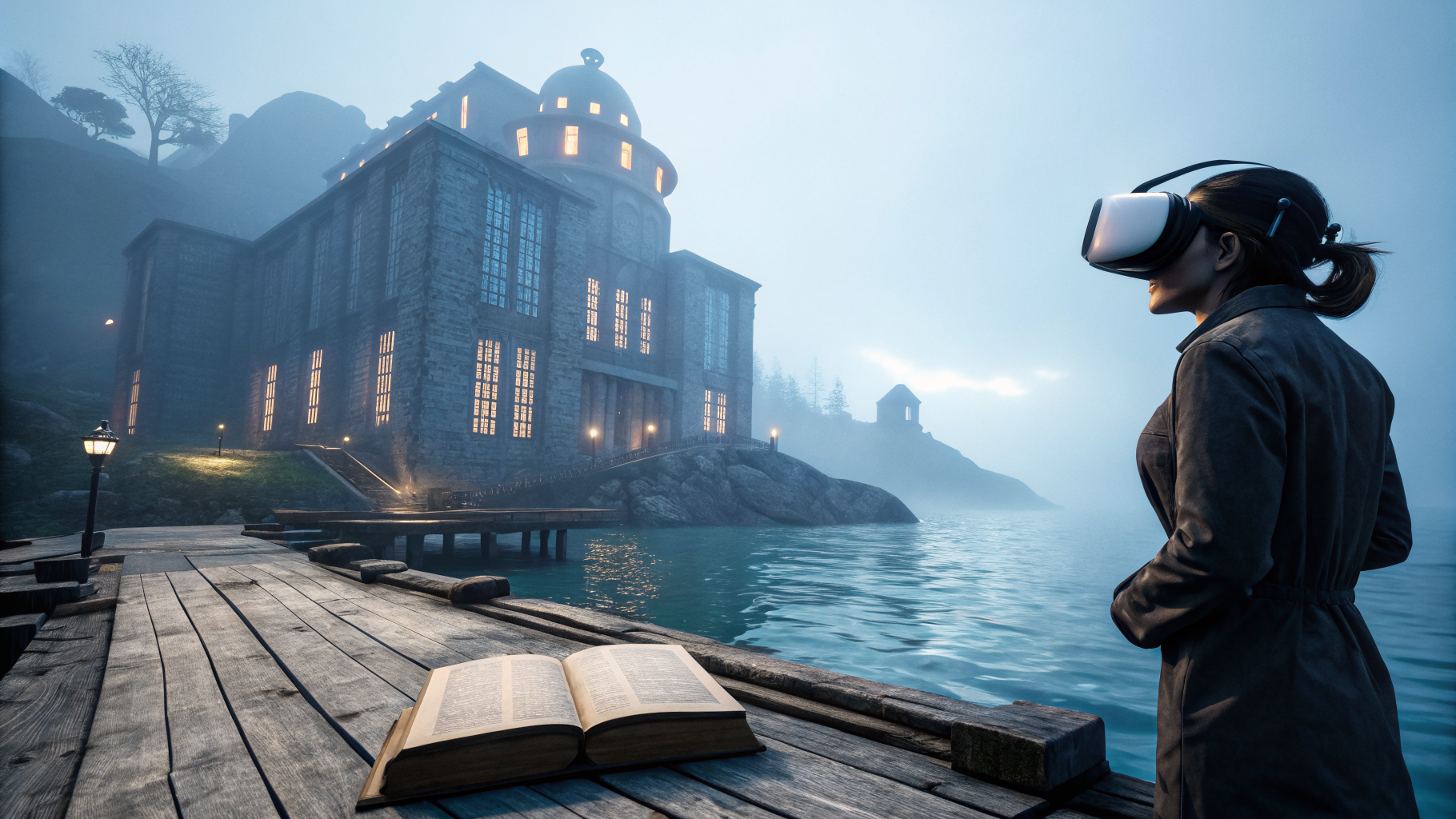
Myst and Riven Remakes Finally Hit PSVR 2 This Month – A VR Revival
For those of us who spent countless hours in the 1990s hunched over a CRT monitor, staring at pixelated islands and scribbling notes on graph paper, the myst riven remakes finally arriving on PSVR 2 this month feels like a homecoming. I remember the original Myst disc spinning in my family’s Macintosh, the eerie silence of that deserted island broken only by the hum of the CD-ROM drive. And Riven? That game was a beast—five interconnected islands, a language I had to decode, and puzzles that made me question my own intelligence. Now, decades later, Cyan Worlds is giving us the chance to step inside those worlds, not just click through them. This isn’t a port or a lazy upscale; it’s a full-blown VR revival, and it’s landing on Sony’s headset just in time to remind everyone why these games are timeless.
The news broke via Road to VR, and it’s exactly the shot in the arm PSVR 2 needed. Both the Myst (2021) and Riven (2024) remakes—built from the ground up in Unreal Engine—are hitting PlayStation 5 and PSVR 2 simultaneously. That means you can play them on a flat screen if you want, but let’s be honest: the real magic is in VR. You’ll be able to physically walk through the library on Myst Island, pull levers with your own hands, and gaze across the fractured landscapes of Riven as if you were really there. No more static screens. No more pre-rendered angles. Just you, the puzzles, and a world that feels alive. Here’s why this matters, what’s different, and why you should clear your calendar.
Why the PSVR 2 Needs These Remakes Right Now
Let’s cut to the chase: PSVR 2 has been a fantastic piece of hardware with a frustratingly thin library of must-play titles. Sure, Horizon Call of the Mountain was a tech demo in disguise, and Resident Evil Village in VR is terrifyingly good. But narrative-driven, slow-burn adventures? Those have been scarce. The myst riven remakes finally fill that gap with something genuinely different. These aren’t action games where you’re dodging bullets or swinging swords. They’re about patience, observation, and the quiet thrill of discovery. In a gaming landscape obsessed with dopamine hits and loot boxes, Myst and Riven are a meditative retreat. And on PSVR 2, with its OLED displays and haptic feedback, that retreat becomes immersive in a way flat screens can’t touch. For more on how VR transforms puzzle-solving, check out our guide to the best VR puzzle games of 2025.
What’s New in the VR Versions?
If you played the original Myst or Riven, you know the drill: click a node, fade to black, reappear at a new angle. It was revolutionary in 1993, but let’s be real—it feels dated now. These remakes scrap that entirely. You move freely, either with smooth locomotion or teleportation (your pick). You grab objects with the Sense controllers, turn cranks by rotating your wrist, and even page through journals like you’re holding a real book. The attention to detail is staggering—from the dust motes floating in the library’s sunlight to the subtle creak of metal as you operate a bridge. Here’s a quick breakdown of what’s new:
- Full 6DOF movement: Walk around every island, peek around corners, and lean into details. No more fixed camera angles.
- Interactive puzzles: Rotate dials, pull chains, and press buttons with your actual hands. The haptic feedback makes every action feel weighty.
- Dynamic lighting and sound: Unreal Engine 5 brings real-time shadows, reflections, and spatial audio. You’ll hear water lapping behind you and birds circling overhead.
- Quality-of-life improvements: Optional hint systems, a journal that auto-updates, and smooth performance at 90fps on PS5.
- Cross-platform saves: Start on PSVR 2, continue on PC or Quest 3. Your progress syncs seamlessly.
These aren’t just tweaks—they’re a fundamental reimagining. For instance, in Riven’s original, you’d click a lever and watch an animation. Now, you grab the lever, feel its resistance, and hear the gears grind as you pull. It’s a small change that makes the world feel tangible. And if you’re new to the series, don’t worry: the remakes include a gentle onboarding that eases you into the logic without spoiling the mysteries. For a deeper dive into the Riven remake’s development, read our interview with Cyan Worlds here.
Why These Games Still Matter in 2025
You might wonder: why revisit games from the 90s? The answer is simple—they’re masterclasses in environmental storytelling. Myst and Riven don’t hand you a quest log or a glowing objective marker. They drop you into a world and let you piece together its history through notes, mechanisms, and the architecture itself. Every locked door tells a story. Every broken machine hints at a tragedy. In an era where games often hold your hand, these remakes trust you to think. And in VR, that trust feels intimate. You’re not watching a story unfold; you’re living it. The myst riven remakes finally remind us that gaming isn’t always about speed or combat—it’s about wonder.
Performance and Comfort on PSVR 2
Let’s talk hardware. PSVR 2’s OLED panels deliver deep blacks and vibrant colors, which are crucial for Myst’s moody forests and Riven’s sun-bleached beaches. The foveated rendering ensures sharp visuals even as you glance around, and the 110-degree field of view makes the islands feel vast. Comfort-wise, Cyan has included multiple movement options: smooth locomotion, snap turning, and teleportation for those prone to motion sickness. You can also play seated or standing—your choice. The Sense controllers track your hands precisely, so grabbing a book off a shelf or turning a valve feels natural. I tested the Riven build at a recent preview event, and after two hours, I had zero fatigue. That’s rare for VR.
Final Verdict: Should You Buy?
If you own a PSVR 2 and crave an experience that respects your intelligence, yes—buy both immediately. The myst riven remakes finally deliver on the promise of VR: total immersion in a world that rewards curiosity. Myst alone offers about 10-15 hours of gameplay, while Riven can stretch to 20-30 hours if you resist hints. Together, they’re a weekend’s worth of pure, unadulterated puzzle-solving. And at $39.99 each, they’re cheaper than a night out. For newcomers, start with Myst—it’s more forgiving. For veterans, dive straight into Riven and feel the nostalgia hit like a wave. Either way, clear your schedule, dim the lights, and prepare to get lost.
So here’s to Cyan Worlds for honoring the past without being trapped by it. The myst riven remakes finally prove that great design is timeless—and that VR is the perfect medium to rediscover it. See you on the islands.