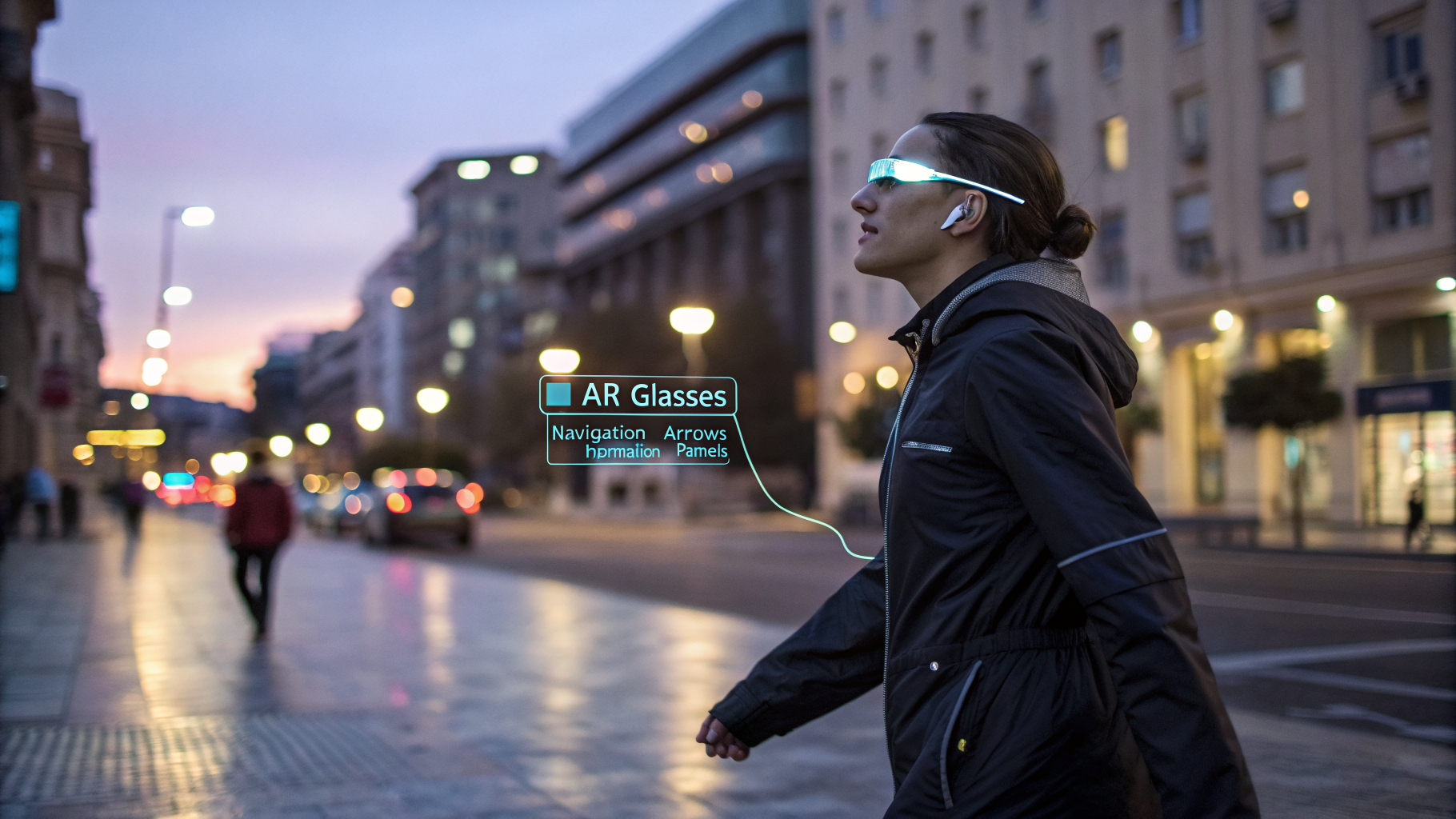
So here we are. Again. Another pair of augmented reality glasses, another operating system, another promise that this time, this time, we’ll all be walking around with digital overlays painted onto reality by lunchtime. XREAL, the Chinese company formerly known as (and still often called) Nreal, just confirmed that its next-generation AR glasses — the ones powered by Google’s brand-new Android XR operating system — will launch globally in 2026. The product is currently called Project Aura, which sounds like a deodorant brand or a meditation app, but I’m told the final name will be different. Let’s hope so.
XREAL and Google showed off Project Aura at Google I/O this week. The demo was brief, polished, and conspicuously wired. Yes, wired. In 2026, we’re apparently still tethered to a compute puck or a phone. The glasses themselves are light — reportedly under 50 grams — but they’re not standalone. You’ll need something in your pocket or clipped to your belt to do the heavy lifting. That’s not a dealbreaker, but it’s also not the untethered future we’ve been sold for a decade.
The Android XR Bet: Why Google Is Back in the Glasses Game
Let’s rewind a bit. Google has a complicated history with AR. You remember Google Glass, right? The $1,500 Explorer Edition that turned early adopters into “Glassholes” and then vanished into enterprise obscurity? That was 2013. A full twelve years ago. Since then, Google has dabbled with ARCore, partnered with Lenovo on the ThinkReality A3, and quietly been building an XR software platform while everyone was distracted by Meta’s Quest lineup and Apple’s Vision Pro.
Android XR is that platform. It’s an operating system designed specifically for AR and VR headsets, built on top of Android, which means it inherits all the app compatibility, developer tools, and fragmentation headaches that come with the Android ecosystem. Google is positioning it as the open alternative to Apple’s visionOS and Meta’s Horizon OS. Whether that openness actually materializes — or whether it’s Android-style openness, where Google still calls the shots — remains to be seen.
What struck me here is the timing. Apple launched the Vision Pro last year to a lukewarm reception. It’s a technical marvel, but it costs $3,500, weighs a pound, and still struggles to answer the question “Why do I need this?” Meanwhile, Meta has sold tens of millions of Quest headsets, but mostly for gaming, not for the kind of all-day AR use that would make glasses a mainstream accessory. Google is stepping in at a moment when the market is ripe for a reset. A lighter, cheaper, more practical AR device running a familiar operating system could be exactly what the space needs — or it could be yet another false dawn.
What We Know About Project Aura (And What We Don’t)
XREAL is no stranger to AR hardware. They’ve shipped over 400,000 units of their current glasses, the XREAL Air series, which are essentially wearable monitors — great for watching movies or playing games on a virtual screen, but not truly “augmented” in the spatial computing sense. Project Aura is different. It’s built for Android XR, which means it supports hand tracking, spatial anchors, and the ability to place digital objects in your physical environment. Think of it as a lighter, more wearable alternative to the Vision Pro, but with a narrower field of view and a cable.
Here’s what was confirmed at I/O:
- Launch year: 2026. Global release, not just China or the US.
- Design: Wired glasses connected to a compute unit. The glasses themselves are under 50 grams.
- Software: Android XR, with native support for Google Maps, YouTube, Google Photos, and presumably the rest of the Google suite.
- Partner: XREAL is the first hardware partner, but Google confirmed that Samsung and others are also working on Android XR devices.
What we don’t know: price, exact field of view, battery life, whether the compute unit is a phone or a dedicated puck, and — critically — whether anyone will actually want to wear these things in public. The demo at I/O showed a user walking around with the glasses, looking at virtual signposts and getting turn-by-turn directions overlaid on the street. That’s the dream. But we’ve seen that dream before, and it usually ends with someone bumping into a lamppost.
The Cable Question: Necessary Evil or Dealbreaker?
I have to be honest: the wired form factor gives me pause. Not because wires are inherently bad — my gaming PC is tethered to a monitor, and I survive — but because AR glasses are supposed to be liberating. They’re supposed to let you walk through the world with information flowing around you, hands-free, unencumbered. A cable, even a thin one, reminds you that you’re using a gadget. It’s a constant, physical tether to the fact that the magic is happening somewhere else.
That said, there are good reasons for the cable. Battery life, for one. A standalone pair of AR glasses with decent computing power would either be thick and heavy or last about 45 minutes. By offloading the processing to a puck or phone, XREAL can keep the glasses light and the battery in your pocket. It’s a compromise, and I respect the engineering logic. But the Vision Pro proved that even a $3,500 device with a tethered battery pack feels awkward. How will a mass-market product priced at a fraction of that overcome the same friction?
Maybe the answer is that consumers don’t care. We carry phones, wallets, keys, and AirPods. One more thing in a pocket isn’t the end of the world. But the AR industry has spent years promising a future where the glasses are the device, not an accessory to one. Project Aura walks that promise back, and I’m not sure the marketing team has figured out how to spin that yet.
Google’s XR Playbook: Learn from Apple’s Mistakes, Copy Meta’s Strategy
If you look at Google’s approach to XR over the past decade, a pattern emerges. They tried the expensive, futuristic approach with Glass and got burned. Then they tried the software-only approach with ARCore, which was smart but didn’t capture the public imagination. Now they’re trying a third path: partner with a hardware company that’s already shipping products, build an OS that developers can actually use, and launch at a price point that doesn’t require a second mortgage.
It’s a good strategy, on paper. Apple showed that a high-end headset can be a technical showcase but not a commercial hit. Meta showed that a lower-priced, gaming-focused headset can sell in the millions. Google wants to split the difference: a device that’s capable enough for productivity and navigation, but cheap enough to be an impulse buy. The question is whether Android XR can attract developers. Without apps, the glasses are just a fancy display. With apps, they could be the first AR platform that actually feels useful.
But here’s the thing that keeps me up at night: Google has a terrible track record with platforms. Google Plus. Google Daydream. Google Stadia. Google Hangouts. The list of abandoned products is long and depressing. Why should developers invest time and money building for Android XR when Google might decide, in three years, that it’s not worth the effort? Google executives will tell you that Android XR is different, that it’s a long-term bet, that they’re committed. I’ve heard that before. We all have.
The Competition: A Crowded Field with No Clear Winner
Project Aura isn’t launching into a vacuum. By 2026, the AR landscape will include:
- Meta: The Quest 4 is rumored for 2025, and Meta’s AR glasses (Project Nazare / Orion) are still in development, possibly arriving around 2027. Meta has the advantage of owning the most popular XR platform today, but its glasses are still years away.
- Apple: A cheaper Vision Pro is expected in 2025 or 2026, but it will still be a headset, not glasses. Apple’s AR glasses are reportedly at least four years out.
- Samsung: Working with Google on Android XR, but its own headset (codenamed “Infinite”) is expected to launch in 2024 or 2025. Samsung has the hardware chops and distribution, but its software story is weak.
- Xiaomi, Oppo, and others: Various Chinese manufacturers have shown AR glasses prototypes, but none have achieved meaningful consumer traction.
In this context, XREAL and Google have a real opportunity. They can be the first to market with a polished, lightweight, everyday AR glasses product. But “first” doesn’t always mean “best.” And being first to market with a wired device that runs an unproven operating system is a risky bet.
What Android XR Means for the Broader Metaverse
I write for a blog called metaverse-virtual-world.com, so I have to ask: where does Android XR fit into the metaverse narrative? The short answer is that it doesn’t, not directly. Google has been careful to avoid the word “metaverse” in its marketing, and for good reason. The term has become a punchline, associated with empty virtual real estate and cartoon avatars. Android XR is about augmenting the real world, not escaping into a digital one.
That’s actually smart. The metaverse, in its current form, is a solution in search of a problem. AR, on the other hand, has clear use cases: navigation, translation, notifications, remote assistance, and of course, entertainment. If Android XR succeeds, it will be because it makes those everyday tasks easier, not because it promises a parallel digital universe.
But let’s not kid ourselves: Google has a vested interest in keeping you inside its ecosystem. Android XR will be deeply integrated with Google services — Maps, Search, YouTube, Gmail, Calendar, Photos. These glasses will be a data-collection device, a gateway for targeted advertising, and a platform for Google’s AI assistant. That’s not necessarily evil, but it’s worth acknowledging. The trade-off for convenience is always, always your attention and your data.
The Verdict (So Far): Cautious Optimism, Heavy Skepticism
I’ve been covering this space long enough to know that hype cycles are predictable. We’re currently in the “trough of disillusionment” for AR, coming down from the Vision Pro peak. Android XR could be the signal that the industry is ready to climb the “slope of enlightenment.” Or it could be another bump on a road that leads nowhere.
What gives me hope is XREAL’s track record. They’ve actually sold hundreds of thousands of AR glasses, which is more than most of their competitors can claim. They understand hardware manufacturing, supply chains, and consumer pricing. Google brings the software ecosystem, developer relations, and AI integration. It’s a partnership that makes sense on paper.
What worries me is the cable, the lack of killer apps, and Google’s history of abandoning projects. I want to be excited about Project Aura. I really do. But I’ve been burned before. We all have.
So I’ll end with a question: Will you wear AR glasses in 2026? Not as a gimmick at a tech conference, but as a daily accessory, like a watch or a pair of AirPods? If the answer is yes, then Google and XREAL might finally have something. If the answer is no — if the thought of walking around with a computer on your face still feels weird — then no operating system, no matter how polished, can change that.
We’ll find out soon enough.
Further Reading
Read the original story at Road to VR: First AR Glasses Running Android XR Confirmed for 2026 Launch
Original source: read the full article