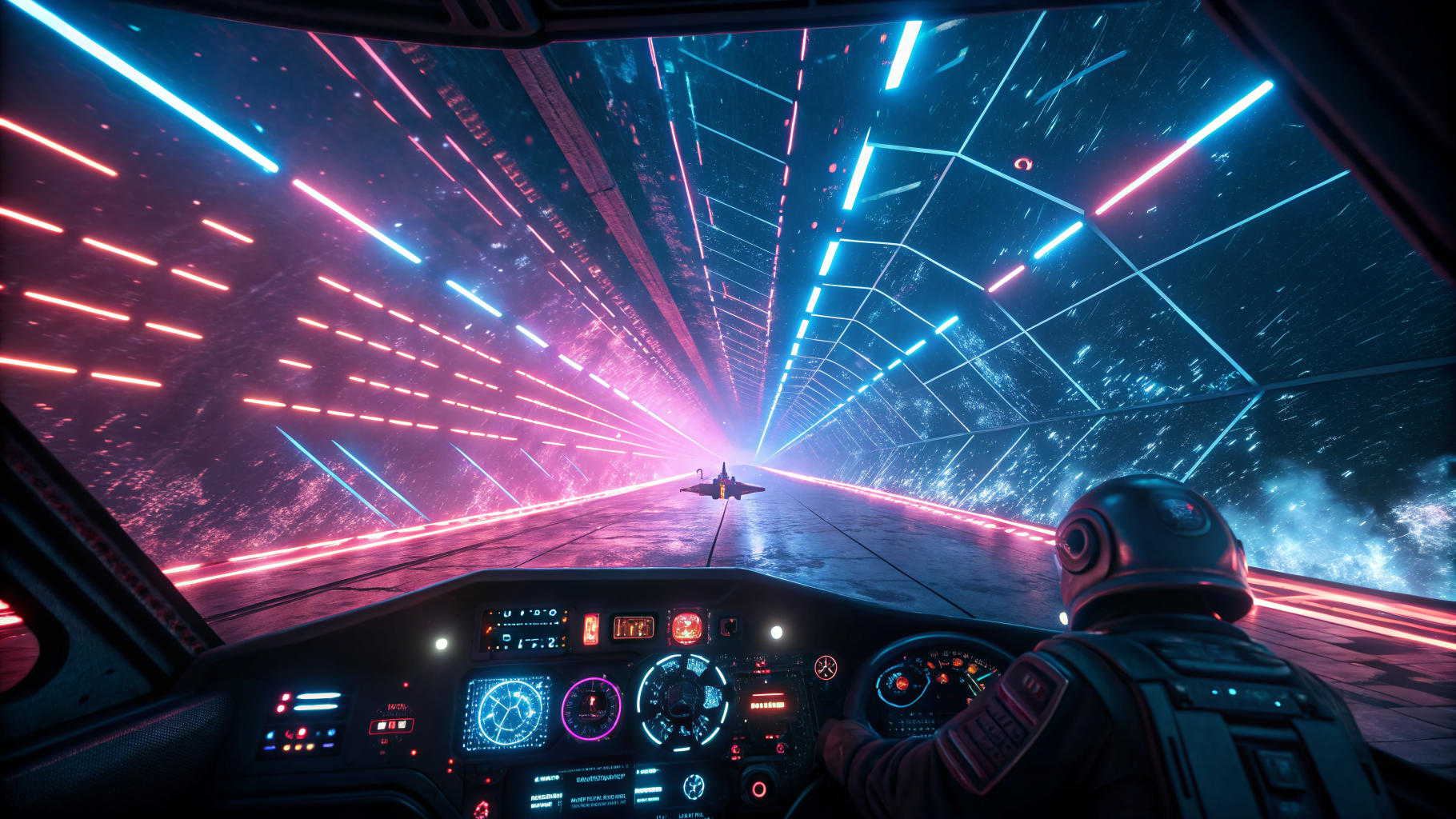
Let me be blunt: VR shoot-’em-ups are a crowded graveyard. Every few months, some plucky indie studio dusts off the ghost of Space Invaders, slaps on a stereoscopic renderer, and calls it a revolution. Most of them sink without a trace. So when I heard that Outblast — a high-speed shmup from the folks behind the VR rail-shooter Out of Sight — was hitting PC VR and Meta Quest this June, my inner cynic raised an eyebrow. Then I saw the trailer. And I’ll admit: my eyebrow stayed raised, but this time for a different reason.
This isn’t your dad’s bullet-hell. Outblast promises blistering velocity, neon-drenched arenas, and a control scheme that actually uses your head — literally. You steer by tilting your noggin, dodge walls of enemy fire by leaning in your chair, and unleash hell with both hands on the triggers. It sounds like a recipe for whiplash. But it also sounds like the kind of frantic, full-body dance that VR was built for.
What Is Outblast, Actually?
Developed by the aptly named Outblast Studios (a team of three, because of course it is), this is a “VS” shmup — versus shooter, in the tradition of Twisted Metal meets Geometry Wars. You pilot a small, fast craft through abstract, neon-lit corridors while waves of enemy ships try to turn you into a cloud of pixels. The twist? You’re not just dodging. You’re collecting energy orbs, charging up a screen-clearing blast, and chaining kills to multiply your score. It’s pure arcade dopamine, injected straight into your vestibular system.
The game launches with 12 levels, a boss rush mode, and online leaderboards. No story, no cutscenes — just you, the music, and a tsunami of particle effects. In my view, that’s exactly the right call. VR shmups don’t need lore. They need rhythm, feedback, and a difficulty curve that doesn’t make you hurl your headset across the room.
Head Tracking: Gimmick or Gamechanger?
Here’s where I get skeptical. Head-tracking for steering has a mixed track record in VR. Rez Infinite did it beautifully, but that game was a trance-like flow state. Outblast is a caffeine-fueled sprint. Can you really weave through a kaleidoscope of bullets just by nodding and leaning? I’ve tried similar mechanics in Thumper and Polybius, and while they worked, they demanded a level of precision that sometimes felt like fighting the hardware.
Outblast’s solution is twofold. First, the game uses a “dead zone” — a small area of neutral head movement where your ship stays still. Second, it maps acceleration to how far you tilt, not just direction. That means subtle movements for fine adjustments, and dramatic leans for evasive maneuvers. In theory, it gives you both control and chaos. In practice? I haven’t played it yet, but the early previews suggest a learning curve that’s steep but satisfying. What struck me here is the developers’ willingness to experiment. They could have defaulted to thumbstick controls and called it a day. Instead, they bet on a physical interface that forces you to engage your whole body. That’s either genius or madness. Possibly both.
Visuals and Sound: A Neon Fever Dream
Let’s talk aesthetics. Outblast is not going for realism. It’s going for intensity. The color palette is a retina-searing mix of electric blues, hot pinks, and acid greens. Enemy ships are geometric shards that pulse and fragment. The backgrounds are abstract tunnels that warp and twist as you race through them. It’s like being inside a lava lamp that’s been possessed by a demon with a taste for techno.
The soundtrack, composed by Nikki Naim (who previously scored Out of Sight), is a driving blend of synthwave and industrial beats. It’s the kind of music that makes you want to move, which is handy, because you’ll be moving a lot. The audio design also includes directional cues — enemy fire whizzes past your ears, power-ups ping with a satisfying chime, and your charged blast builds with a low rumble that vibrates through the headset’s speakers. It’s immersive in the best way: not because it tricks your brain into thinking you’re somewhere else, but because it makes you feel like you’re inside a video game.
Platform, Price, and Performance
Outblast is launching simultaneously on SteamVR and the Meta Quest platform on June 12, 2025. There’s no cross-play between PC and Quest, which is a bummer, but the leaderboards are platform-agnostic, so you can still compare scores with friends on different hardware. Pricing hasn’t been announced yet, but based on similar indie VR shmups, I’d expect somewhere around $15–20 USD. For a game with 12 levels and a boss rush, that feels fair — assuming the replayability is there.
Performance-wise, the developers promise 90 fps on Quest 2 and Quest 3, with dynamic resolution scaling to keep things smooth. On PC VR, you’ll get native resolution and higher particle counts, plus support for 120 Hz refresh rates if your rig can handle it. I’ve seen too many VR games launch with stutter and nausea-inducing frame drops. Outblast seems to prioritize performance, which is a smart move for a game that relies on split-second reactions.
But Does It Matter?
Here’s the uncomfortable question: in a market where Beat Saber still dominates and Half-Life: Alyx set a bar that most VR games can’t even see, does a niche shmup have a shot? I think it does, precisely because it’s niche. The VR audience is small but hungry. We don’t want another generic wave shooter. We want experiences that leverage the medium’s strengths — physicality, immersion, and that visceral sense of speed you can’t get on a flat screen. Outblast understands that. It’s not trying to be the next Call of Duty. It’s trying to be the next Tempest 2000. And honestly? I’m here for it.
Will it be a hit? That depends on execution. The head-tracking controls need to be tight. The difficulty curve needs to be forgiving enough for newcomers but punishing for veterans. And the leaderboards need to be addictive — the kind of thing that makes you say, “one more run” at 2 AM. If Outblast nails those three things, it’ll earn its place in the VR hall of fame. If it stumbles, it’ll be another forgotten experiment in a graveyard of good intentions.
I’m cautiously optimistic. The genre needs a shot of adrenaline. And from what I’ve seen, Outblast is aiming straight for the heart.
Further Reading
Read the original announcement on UploadVR.
Original source: read the full article