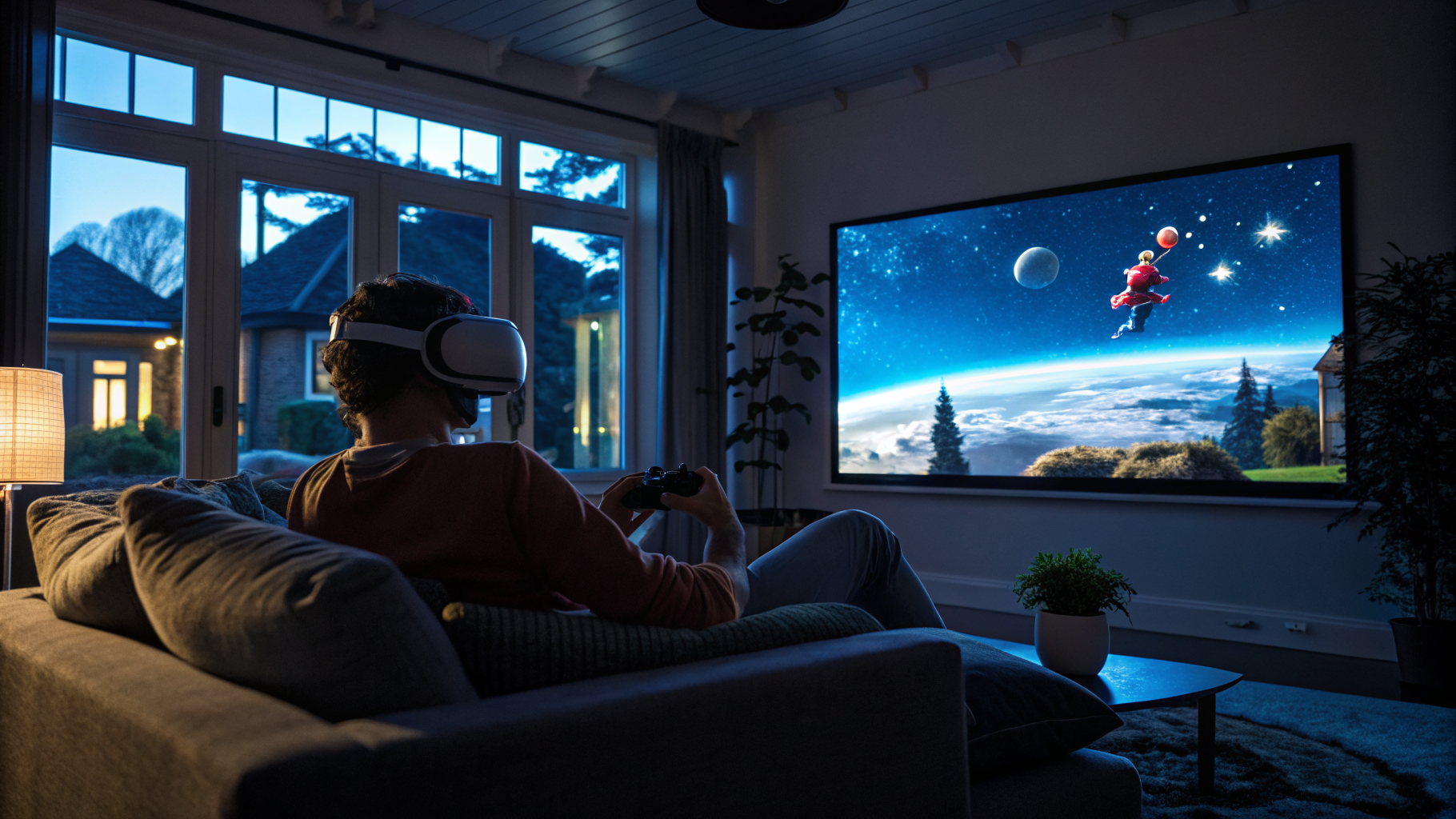
Apple just dropped two big-name 3D movies for Vision Pro: Avatar: Fire and Ash (2025) and The Super Mario Galaxy Movie (2026). On paper, it’s a flex. The crown jewel of James Cameron’s underwater Pandora, paired with Nintendo’s intergalactic plumbing adventure, both rendered in stereoscopic depth for your face computer. Apple’s message is clear: if you want the best 3D experience at home, you’re not buying a new TV. You’re strapping on a headset.
I’ve been watching this story play out for years. I remember sitting in a dark theater in 2009, wearing those clunky RealD glasses, watching Avatar for the first time. The 3D felt like a window into another world, not a gimmick. Cameron understood something that most directors still don’t: depth isn’t about throwing things at the audience. It’s about creating space. It’s about letting your eye wander into the background, discovering details that a flat frame can’t contain. That’s why Avatar worked. That’s why, fifteen years later, we’re still chasing that high.
Now Apple wants Vision Pro to be the delivery system for that high. And honestly? It might be the best chance 3D has had since the format’s last death spiral.
The 3D Graveyard Is Full of Good Intentions
Let’s not pretend the road here has been smooth. Consumer 3D has died so many times it’s practically a zombie. Remember 3D TVs? Samsung, LG, Sony all pushed them hard around 2010. You needed active shutter glasses that cost a hundred bucks, flickered like a strobe light, and made the room half as bright. The content library was thin: a handful of blockbusters, some nature documentaries, and that’s about it. By 2017, manufacturers quietly stopped making them. The format went back to theaters, where it still clings to life, mostly propped up by IMAX surcharges and the occasional Marvel movie.
Why did 3D fail at home? Simple. It asked too much of the viewer. You had to buy new hardware. You had to wear glasses that made you look like a cyborg from a 1990s sci-fi B-movie. You had to sit in a specific spot, at a specific angle, in a specific lighting condition. If you shifted your head three inches to the left, the effect broke. It was fragile. It was finicky. It was, frankly, a pain in the ass.
Vision Pro sidesteps most of those problems. The headset itself is the display, so there’s no ambient light washing out the image. The eye tracking and foveated rendering mean the depth cues feel natural, not forced. And because the screens sit millimeters from your eyes, the stereoscopic effect is consistent regardless of how you move your head. In my view, this is the first time a consumer device has actually solved the core technical issues that killed home 3D the first time around.
But here’s the catch: you have to buy a $3,500 headset. That’s a steep price of admission for a format most people have already written off.
Avatar: Fire and Ash — The Obvious Choice
Let’s talk about the movies themselves. Avatar: Fire and Ash is the third installment in Cameron’s blue-cat saga. The first sequel, The Way of Water, came out in 2022 and made $2.3 billion at the global box office. Critics called it a visual masterpiece. Audiences called it “pretty but long.” I called it a technical marvel that somehow felt both groundbreaking and oddly familiar. Cameron is a wizard with water simulation, underwater performance capture, and high-frame-rate 3D. But the story? It’s Dances with Wolves with tentacles. The characters are archetypes. The dialogue is functional at best. The villain is a cartoon.
Does that matter? For a home viewing experience on Vision Pro, maybe not. The draw here is immersion. Cameron films his 3D sequences with dual-camera rigs that mimic human eye spacing, then adjusts the convergence in post-production to create a comfortable, deep image. He doesn’t rely on cheap pop-out effects. He builds worlds. When you watch The Way of Water on Vision Pro, you feel like you’re floating in the ocean of Pandora. You can look around the frame. You can notice the bioluminescent algae drifting past, the subtle movement of the reef, the way light scatters through the water. That’s the kind of detail that 3D was made for.
I expect Fire and Ash to deliver more of the same. Cameron has talked about introducing a new Na’vi culture — the “Ash People,” who are more aggressive and fire-worshipping. That means new environments, new creatures, new opportunities for depth and scale. If any movie can sell someone on the Vision Pro’s 3D capabilities, it’s this one.
But here’s the rub: how many people are actually going to buy a $3,500 headset to watch one movie? Even if it’s a great movie. Even if it’s in 3D. The math doesn’t work for most households. This is a luxury play, not a mass-market one.
The Super Mario Galaxy Movie — The Surprise Contender
Now, The Super Mario Galaxy Movie is a different beast. The original Super Mario Bros. Movie (2023) was a massive hit, earning over $1.3 billion worldwide. It was also, let’s be honest, a safe bet. The animation was colorful, the voice cast was star-studded (Chris Pratt as Mario still feels wrong, but whatever), and the plot was a loose adaptation of the games’ basic premise: Bowser kidnaps Peach, Mario saves her. It was fun. It was forgettable. It made a zillion dollars.
This sequel, based on the Super Mario Galaxy game from 2007, has the potential to be something more interesting. The game is beloved for its inventive gravity mechanics, its orchestral score, and its sense of wonder. You run on little planetoids that curve away from you, jump between floating platforms, and collect stars that feel genuinely magical. Translating that into a 3D movie — and a 3D theatrical experience — is a natural fit. The game’s visual style is already built around depth and scale. The spherical worlds, the vast cosmic backgrounds, the sense of floating in space — these are tailor-made for stereoscopic conversion.
What struck me here is that Nintendo and Illumination are taking a risk. Galaxy is a weird game. It’s not the straightforward platforming of New Super Mario Bros. It’s not the open-world experimentation of Odyssey. It’s a game about gravity, about orbits, about the loneliness of space. If the movie captures even a fraction of that melancholy beauty, it could be something special. If it’s just another loud, quippy, celebrity-voiced animated feature, it’ll be a missed opportunity.
I’m cautiously optimistic. And I’m curious to see how the 3D presentation affects the experience. A flat screen can’t convey the vertigo of jumping from one tiny planet to another. Vision Pro’s immersive display might come closer.
Is Vision Pro the Savior 3D Needed, or Just Another Expensive Toy?
Let’s zoom out. Apple has now committed to bringing major theatrical 3D releases to Vision Pro on a regular basis. That’s a bet. It’s a bet that enough people will buy the headset, and that the headset’s unique capabilities will make 3D feel fresh again. It’s also a bet that the studios will keep producing 3D versions of their biggest movies, despite the fact that theatrical 3D is in decline. In 2023, only about 20% of all tickets sold in North America were for 3D screenings. That number used to be over 50% during the Avatar boom. The audience has shrunk. The novelty has worn off.
But here’s the thing: the audience hasn’t disappeared. It’s just gotten pickier. People will pay for 3D if the movie is worth it. Avatar: The Way of Water proved that. Spider-Man: Into the Spider-Verse proved that. Top Gun: Maverick — shot in IMAX, not 3D — proved that audiences care more about immersion than labels. If Vision Pro can deliver an experience that feels genuinely better than a standard home theater, then there’s a market. A niche market, sure. But a market.
I think the real question is not whether Vision Pro can revive 3D. It’s whether 3D can help sell Vision Pro. Apple needs a killer app. Not just a game or a productivity tool — an experience that makes people say, “I have to have this.” Right now, the immersive video content is thin. There are some nature documentaries. There are some concert films. There’s a handful of short films from Disney. But there’s no Stranger Things of spatial computing. No Game of Thrones. No must-see, water-cooler, binge-worthy series that you can only get on a headset.
3D movies are a step in the right direction, but they’re not enough. They’re a feature, not a reason to buy. They’re the kind of thing you show your friends to impress them: “Look, the lava is popping out of the screen!” But after the wow factor fades, you need deeper engagement. You need content that makes you keep coming back.
The Competition Isn’t Standing Still
Meanwhile, Meta is still in the game. The Quest 3 is cheaper, lighter, and has a growing library of mixed-reality experiences. It doesn’t have the same display quality as Vision Pro — the passthrough is grainier, the resolution is lower — but it costs a third of the price. And Meta has been aggressively courting studios for 3D content too. They have a partnership with IMAX. They have a deal with the NBA. They’re not ignoring this space.
What Apple has that Meta doesn’t is a direct pipeline to Hollywood. Apple TV+ is still a minor player in streaming, but Apple’s relationships with Disney, Warner Bros., and Universal are deep. They can negotiate exclusivity deals. They can get early access to 3D masters. They can position Vision Pro as the only place to see certain movies in their intended format. That’s a real advantage.
But it’s also a double-edged sword. If Apple leans too hard on exclusivity, they risk alienating the broader audience. People don’t want to buy a $3,500 headset just to watch a handful of movies. They want a platform that supports all their content, from Netflix to YouTube to their own ripped Blu-rays. Vision Pro is getting there — slowly — but it’s not there yet.
The Bottom Line
So where does this leave us? Avatar: Fire and Ash and The Super Mario Galaxy Movie are both coming to Vision Pro in 3D. That’s good news for anyone who owns the headset. It’s good news for the handful of developers and filmmakers who are betting on spatial storytelling. It’s good news for the format itself, which has been in desperate need of a high-profile champion.
But let’s not get carried away. This is not a revolution. This is a slow, incremental evolution. Apple is building a garden, and they’re planting seeds. The question is whether the soil is fertile enough to sustain them. Will Vision Pro become the go-to device for watching 3D movies? Maybe. Will it convince a skeptical public that 3D is worth another try? That’s a harder sell.
I’ll be watching both movies. I’ll probably enjoy them. But I’m not holding my breath for a 3D renaissance. The format has died too many times. It needs more than two blockbusters to come back to life. It needs a reason to exist beyond novelty. It needs stories that are told through depth, not just decorated with it.
Maybe Cameron will show us the way. Maybe Nintendo will surprise us. Or maybe, five years from now, we’ll be writing another obituary for 3D, and Vision Pro will be remembered as a beautiful, expensive footnote in its long, strange history.
I guess we’ll find out when the glasses come off.
Further Reading
Read the original story on Road to VR
Original source: read the full article