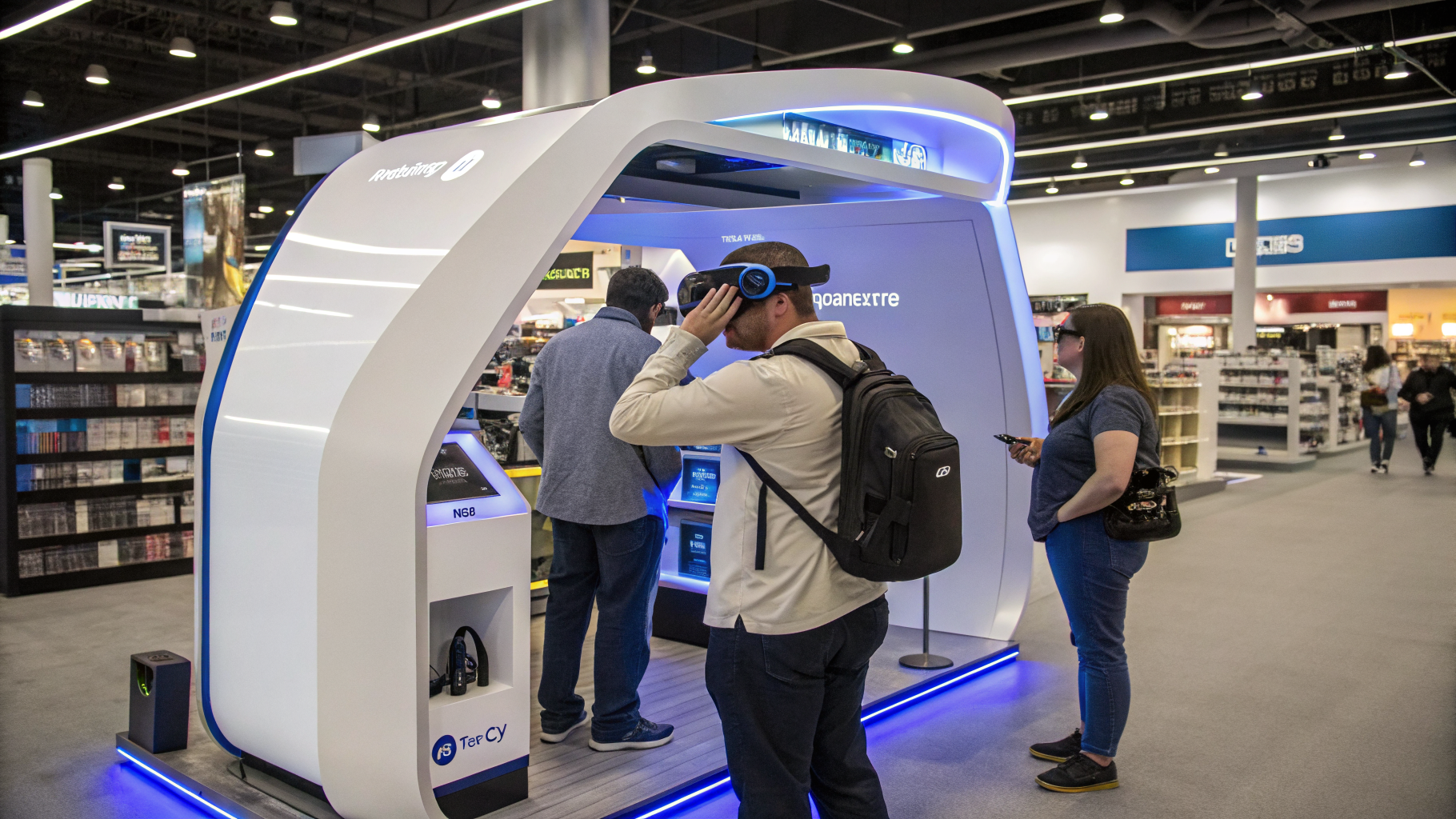
Welcome to the Meta Mall
Meta wants to sell you the future. And it wants to do it inside a Best Buy.
The company just announced it’s rolling out new 900 square-foot “store in a store” pop-ups inside the US’s biggest electronics retailer. The idea? Give customers a single place to demo both Meta’s Ray-Ban AI glasses and its Quest VR headsets. On paper, it makes sense. In practice, I have questions.
Let’s be honest: Meta has had a long-running relationship with Best Buy. They’re no strangers to retail. But this feels different. This feels like a bet that the metaverse — or whatever we’re calling it this week — needs a physical front door. And maybe it does.
The Demo Dilemma
I’ve been covering VR, AI, and the metaverse for over a decade. In that time, I’ve seen more demo stations than I care to count. Some were sleek. Many were sad. A few were just empty kiosks collecting dust in a corner of a mall.
Meta’s new pop-ups are supposed to be different. They’re 900 square feet of branded space, designed to let you try on the Ray-Ban Meta AI glasses, then slip into a Quest 3 headset, all without having to navigate to two separate aisles.
What struck me here is the timing. Meta is pushing this unification just as Apple’s Vision Pro is trying to own the high-end spatial computing narrative. Meta’s response isn’t to fight on specs. It’s to fight on accessibility. Walk into a Best Buy. Try the stuff. See if it clicks.
But does anyone actually want to demo AR glasses in a big-box store? I’m not sure. The Ray-Ban Meta glasses are stylish enough — I’ve worn them, they look like normal sunglasses — but they’re also $299. That’s an impulse buy for some, not a demo-driven decision. VR headsets, on the other hand, are a harder sell. You need to strap a brick to your face and be led around by an employee. It’s awkward. It’s sweaty. And it’s the best way to convert a skeptic.
Why Best Buy? Why Now?
Best Buy is not exactly thriving. The company has been cutting floor space, laying off staff, and struggling to compete with Amazon. But it still has one thing online retail can’t touch: physical touch. You can try a pair of headphones. You can pick up a laptop. And now, you can put on a headset and see if it makes you nauseous.
Meta knows this. They’ve been in Best Buy for years with the Quest line. But the AI glasses are a new beast. They’re not a headset. They’re eyewear with a camera, a microphone, and a tiny AI assistant that can tell you what you’re looking at. That’s a tough sell without a demo. You need to see it work. You need to hear the audio. You need to feel how light they are.
So I get the logic. Unify the demos. Let people bounce between the two products and imagine a world where both are part of their daily life. The glasses for the day. The headset for the night. It’s a nice story.
Is it true? I’m skeptical. The two products serve very different use cases. The Ray-Ban Meta glasses are about casual AI assistance and content capture. The Quest 3 is about immersive gaming and productivity. They don’t share a platform. They don’t share a UI. They barely share a brand identity beyond the Meta logo. Putting them in the same room doesn’t make them a unified ecosystem. It just makes them neighbors.
What the Kiosk Actually Looks Like
According to the announcement, the new pop-ups are designed to feel like a “store in a store.” That means branded walls, dedicated staff, and a layout that guides you from one demo to the next. I haven’t seen the final design, but I’ve seen enough of these things to guess: lots of white plastic, blue lighting, and a faint smell of optimism.
The key feature is that both products will be demoed in the same space. Right now, if you go to a Best Buy, the Quest headsets are usually in the gaming section, and the Ray-Ban glasses are with the smartwatches and headphones. That’s two different aisles, two different sets of staff, two different conversations. The new pop-ups eliminate that friction.
Will it matter? Maybe. For the average shopper, the biggest barrier to buying a VR headset or AI glasses is that they don’t understand what they do. A quick demo can change that. But a quick demo can also be overwhelming. I’ve watched people try the Quest 3 for the first time. They either love it or they get motion sick. There’s no middle ground.
The AI Glasses Problem
Let’s talk about the elephant in the room: the Ray-Ban Meta glasses are not a breakout hit. They’re fine. They’re well-made. The camera is decent. The AI features are nifty. But they haven’t captured the public imagination the way Meta hoped. I think part of the problem is that people don’t know what to do with them.
You can take photos, record videos, get AI summaries of what you’re seeing, and send messages via voice. That’s a lot of features. But it’s also a lot of complexity for a pair of glasses. Most people just want sunglasses that look cool. Adding a computer to your face is a hard sell.
Putting them in a Best Buy pop-up might help. But it might also highlight the awkwardness. You’re standing in a brightly lit store, talking to a pair of glasses while a salesperson watches. That’s not natural. That’s a performance. And not everyone wants to perform.
Meta needs to solve the “why” question before it solves the “where” question. The pop-up is a distribution play, not a product play. I respect the ambition. I’m just not sure it addresses the core challenge.
VR’s Retail Renaissance
On the VR side, the story is different. Quest 3 is a solid headset. It’s comfortable, the passthrough mixed reality is impressive, and the library is growing. But VR has always struggled with retail. People try it once, get blown away, and then never buy it. It’s the ultimate demo product.
Meta’s solution has been to flood the market with demos. They’ve done pop-ups in malls, partnered with gyms for fitness apps, and now they’re doubling down on Best Buy. The new 900 square-foot spaces are bigger than the old kiosks, which were often just a table with a headset and a staff member who looked bored.
I think the bigger space will help. It gives people room to move. It lets them see the mixed reality passthrough without bumping into a shelf of laptops. It’s a better experience. But it’s also more expensive for Meta to run. They need to staff these things, train the staff, and keep the hardware clean. That’s not cheap.
Is it worth it? For Meta, maybe. The company is burning cash on the metaverse bet. A few million dollars on retail pop-ups is a rounding error. But for Best Buy, it’s a lifeline. They get foot traffic, branded content, and a reason for people to come into the store instead of just ordering online.
The Bigger Picture
What Meta is doing here is not just selling hardware. It’s selling a vision. The vision is that AI and VR are converging. That the glasses you wear during the day will one day replace your phone, and the headset you put on at night will replace your computer. That’s a compelling story. It’s also a long way off.
In the meantime, we get pop-ups. And that’s fine. Pop-ups are low risk. They’re testbeds. If the Best Buy experiment works, Meta might expand it. If it fails, they’ll quietly pull the kiosks and try something else. That’s the beauty of retail: it’s flexible.
But I can’t help wondering: is this the best use of Meta’s resources? The company is pouring billions into AI and VR R&D. It’s fighting antitrust battles. It’s trying to rebuild its reputation after years of scandal. And here it is, building a 900 square-foot store inside a Best Buy. It feels small. It feels tactical. It doesn’t feel like a grand strategy.
Maybe that’s the point. Maybe Meta has learned that grand strategies don’t work. Maybe the future is built one demo at a time. Or maybe this is just another attempt to make the metaverse happen, one sweaty headset at a time.
Will It Work?
I don’t know. I really don’t. The optimist in me says yes. More demos mean more conversions. More conversions mean more users. More users mean more developers. More developers mean better content. It’s a virtuous cycle.
The pessimist in me says that VR and AR are still niche products. They’re expensive, uncomfortable, and socially awkward. A demo in a Best Buy can’t fix that. It can only delay the inevitable realization that most people don’t want to wear a computer on their face.
But I’ve been wrong before. I thought the iPhone was a dumb idea. I thought social media was a fad. So maybe Meta is onto something. Maybe the Ray-Ban Meta glasses will be the next Walkman. Maybe the Quest 3 will be the next PlayStation.
Or maybe they’ll both end up in a drawer, next to the Google Glass and the 3D TV. Time will tell.
For now, I’ll give Meta credit for trying. It’s not easy to sell the future. You need patience, money, and a willingness to look foolish. Meta has all three. And if nothing else, the new Best Buy pop-ups will give us something to talk about.
I just hope they remember to clean the headsets.
What I’d Like to See
If I were advising Meta, I’d tell them to do three things:
- Train the staff properly. Nothing kills a demo faster than an employee who doesn’t know how to use the product. I’ve seen it happen. It’s painful. Make sure the people running the kiosk are enthusiasts, not temps.
- Let people take the glasses outside. The best demo for the Ray-Ban Meta glasses is walking down the street, not standing in an aisle. Let people step out of the store for five minutes and see how they feel. It’s a risk, but it’s the only way to sell the experience.
- Make it fun. VR demos are often too serious. People are nervous. They don’t want to look silly. Add a game. Add a challenge. Make it social. The best VR moments are shared. Give people a reason to laugh.
Final Thoughts
Meta’s Best Buy pop-ups are a smart tactical move. They unify two product lines that needed unification. They give customers a low-friction way to try the hardware. And they give Meta a physical presence in the most important electronics retailer in the US.
But I’m not convinced it will move the needle. The challenges facing VR and AI glasses are not about distribution. They’re about utility, comfort, and social acceptance. A pop-up can’t solve those problems. Only time and better products can.
Still, I’ll be watching. I’ll visit the kiosks. I’ll talk to the staff. I’ll see if the magic is there. And if it is, I’ll be the first to admit I was wrong. That’s the job. That’s what a decade of covering this stuff has taught me: be skeptical, but stay curious.
Because the future is coming. It might just take a detour through Best Buy.
Further Reading
Original source: Meta Plans New Best Buy Pop-ups to Unify Demos of AI Glasses and VR Headsets – Road to VR
Original source: read the full article