Let me be blunt: the Apple Vision Pro launch felt like a parade of potential. A stunning piece of hardware, yes. A clear sense of what to actually watch on the thing? Not so much. Apple’s own immersive video content has been a slow drip – technically impressive, but about as varied as a three-course meal where every course is a different shade of beige.
Enter Amplium. A new dedicated destination for immersive video on Vision Pro that promises a wider, more interesting range of content. And I have to say, after spending a few hours with it, this feels like the first real step toward making spatial video something you actually want to put the headset on for.
The Great Content Drought
The Vision Pro is a marvel of engineering. The micro-OLED displays, the spatial audio, the eye-tracking that feels like telepathy. But for months, the biggest question from early adopters has been: what do I watch on this thing? Apple’s own Immersive Video offerings are gorgeous. The Alicia Keys performance, the dinosaur encounter, the aerial footage of Iceland. They’re all technically flawless. But they’re also short, heavily produced, and feel a bit like tech demos dressed up as entertainment.
I’ve been covering VR and spatial computing since before the Oculus Rift had a consumer version. I’ve seen this pattern before. A company builds a brilliant headset, then seems surprised when people ask for actual content to justify the price tag. The Apple TV+ strategy – a handful of prestige shows and movies – doesn’t translate well to immersive video. You can’t just port a Marvel movie into spatial format and call it a day. The medium demands new thinking.
What struck me about Amplium is that it doesn’t pretend to be Netflix. It’s a curated space, more like a boutique cinema than a multiplex. The name itself suggests expansion, room to breathe. And that’s exactly what it offers.
What’s Actually on Amplium?
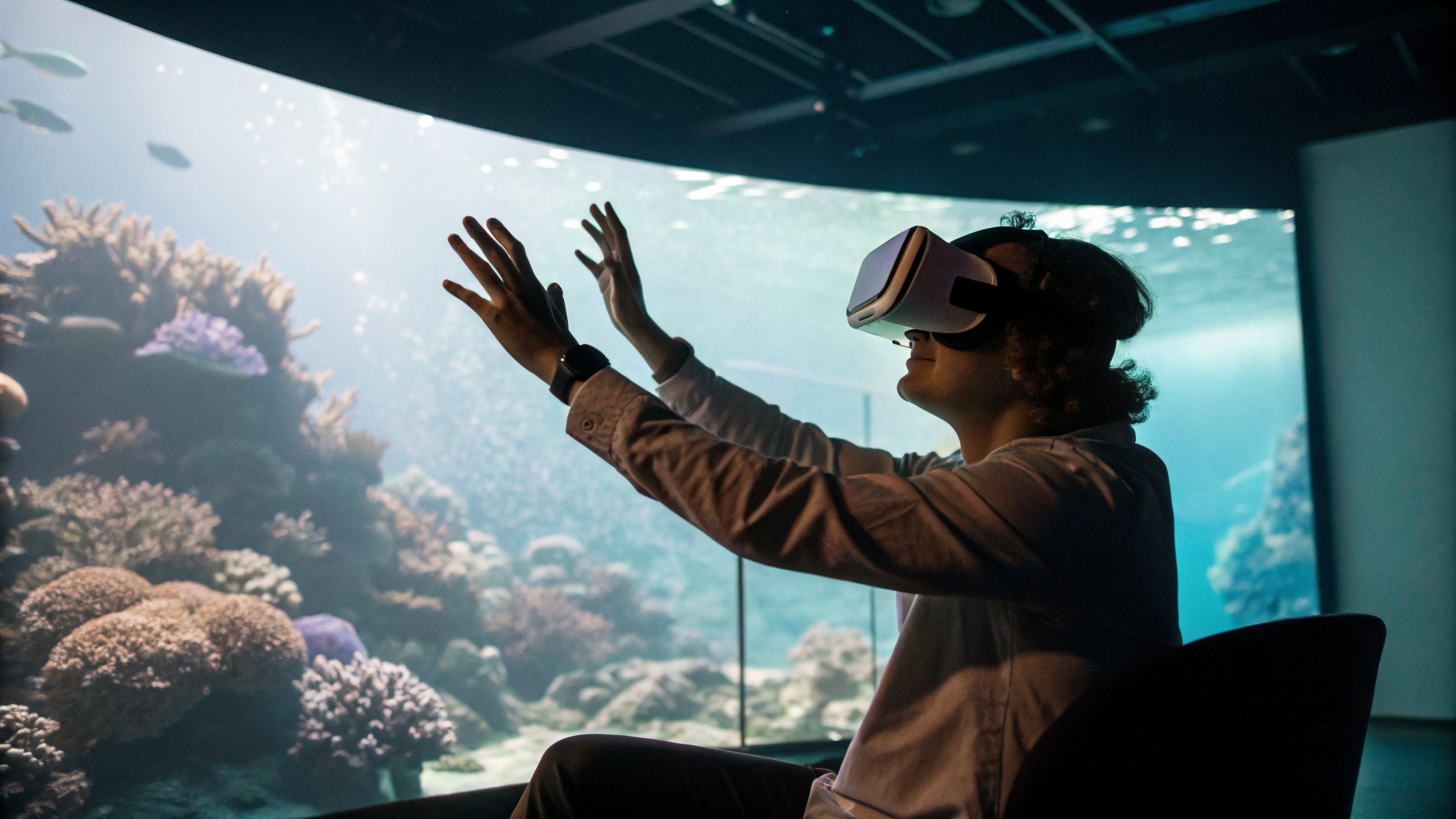
The lineup is modest but smartly chosen. You’ll find short immersive documentaries, music experiences, and what Amplium calls « spatial stories. » The range is deliberately wider than what Apple has offered so far. There’s a piece about Japanese tea ceremonies that puts you right in the room – you can almost smell the matcha. A music video from a rising indie artist that uses spatial audio in genuinely surprising ways, not just as a gimmick. A documentary short about coral reef restoration that made me feel like I was underwater, which is either immersive or terrifying depending on your relationship with the ocean.
Here’s what I appreciate: none of it tries to be a blockbuster. The creators seem to understand that immersive video works best when it’s intimate, not epic. You don’t need explosions when you can make someone feel like they’re standing next to a master craftsman in Kyoto. The medium’s strength is presence, not spectacle.
- Documentaries: Short, human-scale stories. Think National Geographic but without the voiceover.
- Music experiences: Live performances and visual albums designed for spatial immersion.
- Art and culture: Behind-the-scenes access to things you’d never see in person.
Are all of them successful? No. Some feel like they’re still figuring out the grammar of the medium. A few have the uncanny valley problem – close-ups that are too close, movement that feels slightly off. But that’s fine. This is early days. What matters is that someone is trying.
Why This Matters More Than You Think
In my view, the biggest threat to spatial computing isn’t technical. It’s cultural. People don’t know what to do with a headset once the novelty wears off. Gaming is the obvious answer, but the Vision Pro isn’t a gaming device first. It’s a media consumption device. And if the media isn’t there, the device becomes an expensive paperweight.
Amplium is betting that there’s an audience for thoughtful, curated immersive content. Not algorithmic slop, not corporate marketing dressed as « experiences. » Real stories, told in a new way. I think they’re right. The question is whether that audience is big enough to sustain a business. Right now, it’s probably not. The Vision Pro user base is still tiny. But platforms like this are how you build a market. You don’t wait for the audience to arrive; you make the content that attracts them.
There’s a parallel here with the early days of podcasting. Remember when podcasts were mostly tech nerds rambling into microphones? Then came Serial, and suddenly everyone wanted in. Amplium could be that moment for immersive video – a proof of concept that the medium can tell stories worth caring about.
The Business Side (Because This Is Still Tech)
Amplium isn’t free. It operates on a per-content or subscription model, depending on what you choose. The pricing feels reasonable – roughly the cost of a movie ticket for a short experience. But that raises an uncomfortable question: are people willing to pay for immersive content when they already pay for Netflix, Spotify, and a dozen other subscriptions?
I’m skeptical. The history of premium VR content is littered with well-made experiences that nobody bought. Remember Oculus Story Studio? They made beautiful short films and then shut down because the economics didn’t work. Amplium faces the same challenge. The Vision Pro install base is small, and the people who own one are probably already spending heavily on apps and accessories.
But here’s the counterargument: the Vision Pro audience is affluent and early-adopter-minded. They’re exactly the kind of people who will pay for a premium experience if it’s genuinely good. And Amplium’s curation gives it a signal-to-noise ratio that Apple’s own content feed lacks. You’re not scrolling through an endless grid of garbage. You’re picking from a handpicked selection. That has value.
What I’d Like to See Next
Amplium is a good start. It’s not a revolution. It’s not going to sell a million Vision Pros. But it’s a sign that the ecosystem is maturing. I’d like to see them partner with independent filmmakers and documentarians, not just studios. I’d like to see user-generated content that doesn’t look like a home movie. I’d like to see longer-form pieces – an hour-long immersive documentary, for instance, or a series that unfolds over multiple episodes.
I also think Amplium needs to solve the discovery problem. Right now, finding immersive content on Vision Pro is a chore. The App Store isn’t great at surfacing spatial experiences. If Amplium becomes a destination people know to visit, that’s half the battle. But it needs to be more than a niche curiosity. It needs to be the place you go when you want to show a friend what the Vision Pro can actually do.
And yes, they need to get the word out. The Vision Pro community is small but passionate. I’ve seen people in forums begging for more content. Amplium should be all over those conversations.
The Verdict (For Now)
Amplium is the most promising dedicated immersive video platform I’ve seen for the Vision Pro. It’s not perfect, and it’s not for everyone. But it understands something that Apple seems to have forgotten: that immersive video isn’t about showing off technology. It’s about making people feel something. Awe, curiosity, connection. The best moments I’ve had in VR were never about resolution or frame rates. They were about forgetting I was wearing a headset.
Amplium gets that. It’s a small step, but it’s in the right direction. I’ll be watching closely to see what they add next. And if you own a Vision Pro, you should check it out. Just don’t expect to be blown away every time. Expect to be intrigued. Expect to see what the medium can be when someone actually tries.
Because the future of this thing isn’t going to be built by Apple alone. It’s going to be built by people like the Amplium team – taking risks, curating carefully, and making room for a wider range of voices. And that, in my book, is worth paying attention to.
Further Reading
Read the original story on UploadVR: Amplium Makes Room For A Wider Range Of Apple Immersive Video On Vision Pro
Original source: read the full article