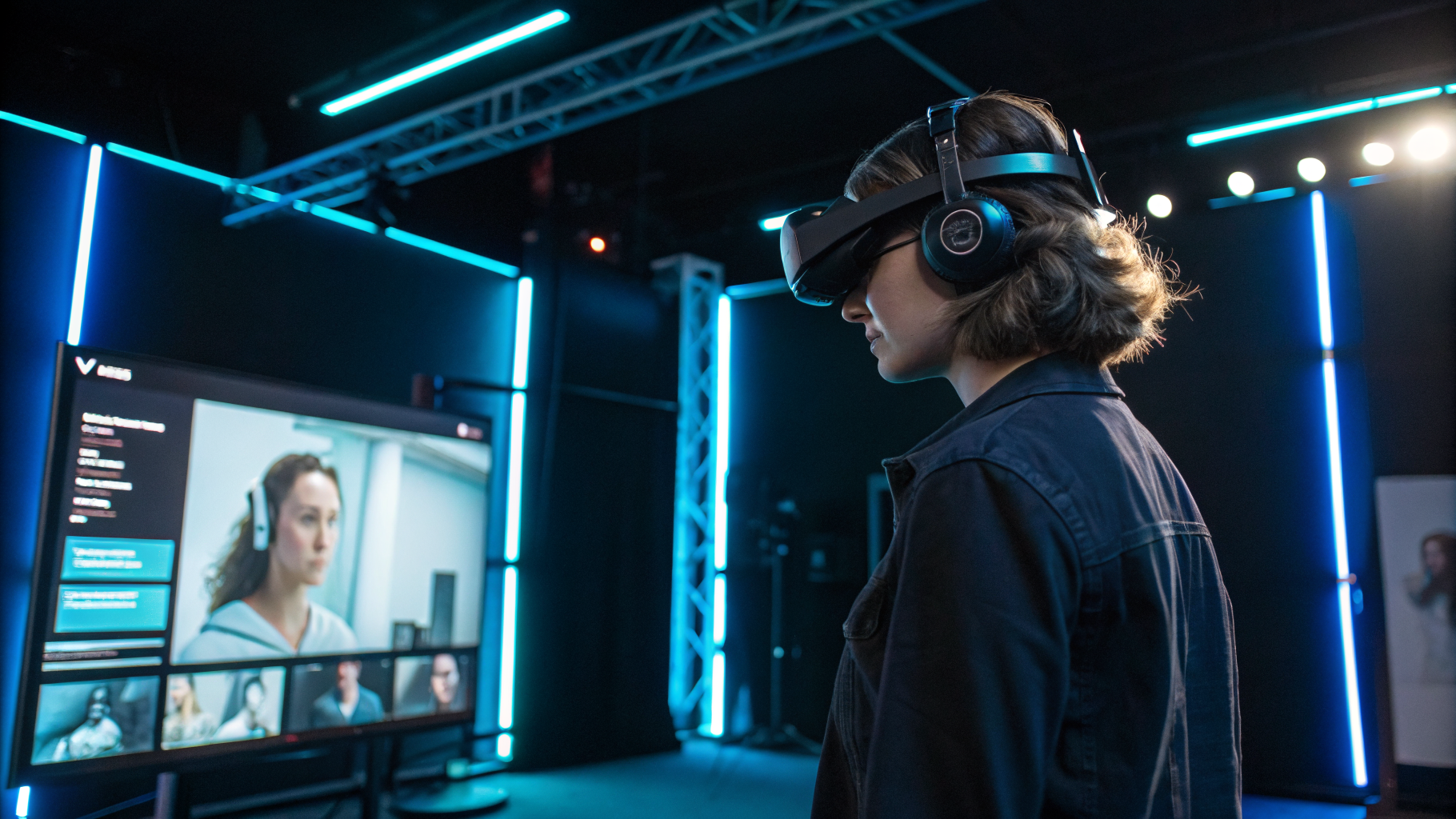
I’ve been covering VR long enough to remember when “expressive avatars” meant you flailed your arms like a malfunctioning windmill and hoped for the best. Then came eye tracking, face tracking, and a constellation of cameras that made your digital double look vaguely human — provided you had the hardware and the patience. Now, a Kickstarter project called PiEEG XR is promising something different: expressive avatars on Quest 3 without a single camera pointed at your face.
Let me be clear: I love the audacity of this. But I also smell hype. And after a decade of watching startups promise to read your mind (literally), I’ve learned to keep one eyebrow raised. So let’s dig into what PiEEG XR actually is, how it works, and whether it’s a genuine breakthrough or just another crowdfunded curiosity.
The Pitch: Electrodes, Not Cameras
PiEEG XR is an add-on for Quest 3 that uses electroencephalography (EEG) — yes, the brainwave-reading tech — to infer your emotional state and translate it into avatar expressions. You wear a headband with dry electrodes that touch your scalp. The device measures electrical activity in your brain, runs it through a machine learning model, and outputs things like happiness, surprise, or concentration as facial animations on your VR avatar.
No cameras. No infrared dots. No tracking your lip movements. Just your brain doing brain things.
What struck me here is the sheer weirdness of the proposition. We’ve spent years trying to make VR avatars more expressive by adding more sensors to the headset. PiEEG XR essentially says: why not skip the face and go straight to the source? It’s a clever inversion of the problem. But clever doesn’t always mean functional.
How Does It Actually Work?
The core technology isn’t new. EEG headsets have been around for years — Muse, Emotiv, NeuroSky — and they’ve been used for meditation, gaming, and even controlling drones with your mind. The difference here is that PiEEG is targeting real-time avatar animation inside VR, which is a much tougher nut to crack.
The company claims their model can detect six or seven emotional states with decent accuracy. You smile in real life? The avatar smiles. You furrow your brow? The avatar looks confused or angry. But here’s the thing: EEG detects patterns, not specific facial movements. It’s not reading your smile muscles — it’s reading your brain’s electrical signature when you feel happy. That’s a fundamentally different signal.
Does it matter? In theory, no. If the avatar looks happy when you feel happy, the social presence is improved. But in practice, EEG is noisy. Muscle tension from your jaw, eye movements, even blinking can create artifacts that confuse the model. The demo videos I’ve seen show smooth animations, but demo videos always do.
The Hard Truth About EEG in VR
I’ve tested EEG headsets for meditation apps. They work well enough when you’re sitting still with your eyes closed. But in VR, you’re moving your head, talking, laughing, maybe dancing like nobody’s watching (but your avatar is definitely watching). All that motion generates electrical noise that can swamp the brain signal.
PiEEG XR’s team says they’ve trained their model on data collected during VR use, which is smart. But training data and real-world performance are two different things. I’d love to see how it handles someone who talks with their hands, or someone who’s sweating from a Beat Saber session. Sweat messes with electrode contact. So does hair. So does wearing the headset for more than 30 minutes.
In my view, the biggest challenge isn’t the technology — it’s the ergonomics. Quest 3 is already a brick strapped to your face. Adding a headband with electrodes that need to stay in contact with your scalp is asking a lot. If the fit isn’t perfect, the signal degrades. And if the signal degrades, your avatar starts making faces that have nothing to do with how you feel.
Can you imagine trying to have a serious conversation in VRChat while your avatar randomly looks terrified because the electrode slipped? That’s the nightmare scenario.
What It Does Well — And What It Doesn’t
Let’s give credit where it’s due. PiEEG XR solves a real problem: face tracking cameras are expensive, power-hungry, and add weight to the headset. Meta’s Quest Pro had face tracking, but it was also $1,500 and sold poorly. The Quest 3 dropped face tracking entirely, which left a gap for anyone who wanted more expressive avatars without buying a different headset.
PiEEG XR fills that gap with a $299 (early bird) accessory that plugs into the Quest 3’s USB-C port. No batteries, no extra dongles — just the headband and a cable. That’s elegant. And the software is open source, which means developers can tweak the emotion models or integrate them into their own apps. That’s a smart move for building a community.
But here’s where I get skeptical: the company is comparing their tech to face tracking cameras. That’s not a fair comparison. Cameras can detect micro-expressions — the subtle twitch of a lip corner or an eyebrow raise — with high precision. EEG can only infer broad emotional categories. You won’t get a smirk from brainwaves. You’ll get “positive emotion” that might look like a smile, or “negative emotion” that might look like a frown.
Is that enough for social presence? Maybe. For casual chat, sure. For professional meetings or collaborative design reviews? I’m not convinced. People communicate a lot through subtle facial cues, and EEG is a blunt instrument.
The Kickstarter Factor
PiEEG XR is launching on Kickstarter, which always makes me nervous. I’ve covered too many VR crowdfunding campaigns that promised the moon and delivered a cardboard box. The team behind PiEEG has a track record — they previously made an EEG device for PC gaming — but that doesn’t guarantee success.
The campaign has already funded, which is a good sign. But the real test is shipping. If they can deliver working units to backers within a reasonable timeframe, they’ll have something real. If they start sending updates about “manufacturing delays” and “firmware optimization,” you know the drill.
I want to believe. I really do. The idea of reading emotions directly from the brain is the kind of sci-fi future we were promised. But VR is a brutal market, and accessories are a tough sell. Even the official Quest 3 Elite Strap with battery has mixed reviews. PiEEG XR is competing for your headspace — literally.
Who Is This For?
Let’s be honest: the target audience is small. You need to own a Quest 3, care deeply about avatar expressiveness, and be willing to wear an extra headband that might mess up your hair. That’s a Venn diagram with a tiny overlap.
But within that niche, there are real use cases. Social VR platforms like VRChat, Rec Room, and Horizon Worlds thrive on expression. If PiEEG XR can make avatars more lifelike without the cost and complexity of face tracking cameras, it could become a must-have for power users. Streamers, virtual event hosts, and educators might also find value.
For everyone else? It’s a curiosity. A fun gadget to show your friends at a VR meetup. But I wouldn’t bet on it replacing face tracking in the mainstream.
The Bigger Picture
What interests me most about PiEEG XR isn’t the device itself — it’s what it represents. We’re seeing a shift in how VR thinks about input. For years, the focus was on hands: controllers, hand tracking, finger tracking. Now the industry is moving toward faces, emotions, and even thoughts.
Apple Vision Pro brought eye and hand tracking to the mainstream. Meta is rumored to be working on neural wristbands. And now we have brainwave-reading headbands for Quest 3. The boundaries between body, mind, and machine are blurring faster than I expected.
But technology moves faster than human comfort. Are we ready for VR that knows how we feel? Not just what we say or do, but our actual emotional state? That’s a privacy question that PiEEG XR’s marketing doesn’t address. Where does the brain data go? Is it processed locally or sent to the cloud? Can apps access your emotional history? These are not hypotheticals — they’re real concerns that will determine whether this tech is adopted or rejected.
PiEEG says the data stays on-device and is not stored. I hope that’s true. But in a world where every app wants your data, I’m not taking anyone’s word for it.
Final Thoughts: Worth the Hype?
I’m going to hedge here, because that’s what honest journalism looks like. PiEEG XR is a fascinating experiment. It could be the first step toward a future where VR avatars are driven directly by your thoughts and emotions, bypassing the limitations of physical sensors. That’s exciting.
But it could also be a niche product that fades into obscurity because the signal quality isn’t good enough, the comfort isn’t there, or the market simply doesn’t care enough to wear an extra headband. I’ve seen too many promising VR accessories die on the vine to get carried away.
What I will say is this: I’ll be watching. And if PiEEG XR delivers on its promises, I’ll be the first to eat my words. Because a world where your avatar genuinely reflects how you feel — without cameras watching your every twitch — is a world I want to live in.
Just maybe not with electrodes in my hair.
Further Reading
Read the original article on UploadVR: This Quest 3 Accessory Makes Your VR Avatar Expressive Without Face Tracking
Original source: read the full article