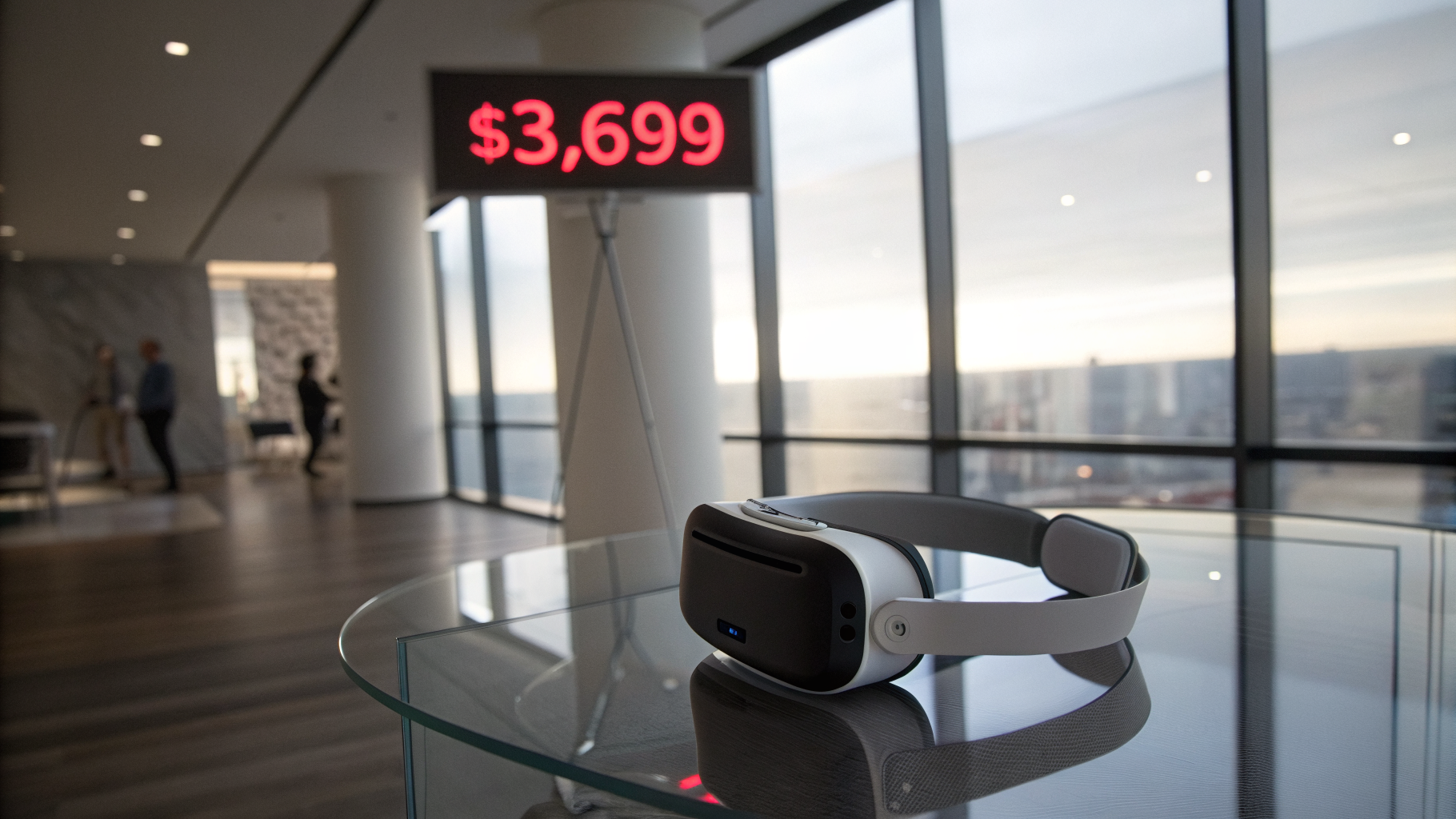
The $3,500 Headset Just Got a Whole Lot More Expensive
Apple is raising the price of the Vision Pro by $200. Let that sink in for a moment. This is a device that already costs as much as a decent used car, and now it costs more. The company announced the hike this week, citing ongoing shortages in RAM and storage components. I get it, supply chains are still a mess. But this feels like a special kind of tone-deafness, even for Cupertino.
The news broke via 9to5Mac, which spotted the price increases across a wide range of Apple products. Macs, iPads, and even some accessories are getting more expensive. But the Vision Pro increase stands out because it’s the most expensive consumer headset on the market, by a mile. The base model, which previously started at $3,499, now starts at $3,699. That’s not a rounding error. That’s a statement.
I’ve been covering this space for over a decade. I remember when the original Oculus Rift Dev Kit cost $300 and people complained it was too expensive. I remember when the HTC Vive launched at $799 and the internet lost its collective mind. Now we’re talking about a headset that costs more than a MacBook Pro, an iPhone, and a pair of AirPods Max combined. And Apple just made it even less accessible.
What struck me here is the timing. The Vision Pro launched to mixed reviews in early 2024. Some called it a technological marvel. Others called it a solution in search of a problem. The device is undeniably impressive in terms of display quality and hand tracking. But it’s heavy, tethered to a battery pack, and has a limited app ecosystem. Sales have reportedly been sluggish, with Apple supposedly cutting production targets. And now, instead of lowering the price to drive adoption, they’re raising it.
Is this arrogance? Or desperation? I honestly can’t tell anymore.
The RAM and Storage Excuse: Real or Convenient?
Apple says the price increase is due to a shortage of RAM and NAND flash memory. This isn’t entirely made up. The global memory market has been volatile, with prices for DRAM and NAND fluctuating wildly over the past year. Samsung, SK Hynix, and Micron have all cut production, leading to higher costs. But here’s the thing: Apple is the largest buyer of memory in the world. They have the leverage to lock in prices. So why pass the cost on to consumers now?
In my view, this is a convenient excuse. Apple could absorb the cost, but they choose not to. They know that the people who buy Vision Pros are early adopters with deep pockets. They’re betting that the price hike won’t deter the faithful. And they might be right. But it’s a dangerous game to play with a product that’s already struggling to find its audience.
Let’s look at the competition. The Meta Quest 3 starts at $499. The PlayStation VR2 is $549. Even the expensive Varjo headsets, aimed at enterprise, cost less than the Vision Pro. Apple is operating in a different stratosphere. And now they’re raising the price of admission. I can’t help but wonder: who is this for anymore?
A Brief History of Apple Pricing Hubris
Apple has a long history of pricing things high and then blaming external factors. Remember the $999 stand for the Pro Display XDR? That was a choice. Remember the $699 iPhone X, which later became a $1,099 iPhone 14 Pro Max? That was a strategy. Apple positions itself as a luxury brand, and luxury brands don’t lower prices. They raise them, because scarcity signals value.
But here’s the problem: the Vision Pro isn’t a luxury product in the traditional sense. It’s a computing platform. Or at least, it’s trying to be. You don’t buy a Vision Pro to show off at a party (well, maybe you do). You buy it to work, to create, to consume media. It’s a spatial computer, as Apple likes to say. And computers need users to survive. They need a developer ecosystem. They need content. If the price keeps going up, the user base shrinks, and the ecosystem withers.
I’m reminded of the Newton MessagePad, Apple’s first stab at a handheld computer. It launched in 1993 at a price of $699 (about $1,500 in today’s money). It was innovative, but expensive and buggy. Apple eventually killed it in 1998. The Vision Pro feels like it’s on a similar trajectory, minus the buggy part. The hardware is polished. But the market might not be ready, and the price isn’t helping.
What the Price Hike Actually Means for Developers
If you’re a developer building apps for visionOS, this price increase is bad news. You’re already working with a tiny install base. The Vision Pro sold an estimated 200,000 units in its first quarter, according to some analysts. That’s a fraction of what Meta sells in a week. Now, with a higher price, the potential user base shrinks even further.
I talked to a friend who’s building a productivity app for the Vision Pro. He was already struggling to justify the cost of development. « I’ve spent $10,000 on hardware and tools, » he told me. « And I’m not sure I’ll ever make that back. » He’s now considering porting his app to the Quest 3. That’s the kind of story that should worry Apple.
Developers need users. Users need apps. It’s a chicken-and-egg problem that every platform faces. But when you make the chicken more expensive, you get fewer eggs. Apple is betting that the quality of the experience will compensate for the price. But I’m not so sure. The Vision Pro is impressive, but it’s not a must-have device. It’s a luxury experiment. And experiments can fail.
Who Actually Buys a Vision Pro at $3,699?
Let’s do some quick math. If you want a Vision Pro with the higher storage option (1TB), you’re now looking at $3,899. Add in the optional travel case ($199) and the optical inserts ($149 for readers, $149 for Zeiss lenses), and you’re approaching $4,500. That’s a lot of money for a device that still doesn’t have a killer app.
Apple is clearly targeting early adopters, developers, and enterprise customers. But enterprise customers have alternatives. They can buy a Varjo XR-4 for a similar price, or a HoloLens 2 for less. They can build custom solutions with the Quest 3. The Vision Pro’s advantage is its seamless integration with the Apple ecosystem. But is that worth the premium? I’m not convinced.
I think Apple is making a strategic error here. They should be lowering the price to build a user base, not raising it. The Vision Pro is a first-generation product. It’s going to have limitations. The battery life is about two hours. The weight is noticeable. The app selection is thin. These are things that will improve over time, but only if people actually buy the device. By raising the price, Apple is slowing adoption. It’s like they’re trying to keep the device exclusive, but exclusivity doesn’t build a platform.
The Bigger Picture: A Pattern of Tone-Deafness
This isn’t just about the Vision Pro. Apple has been raising prices across the board. The MacBook Pro is more expensive. The iPad Pro is more expensive. Even the AirPods Max got a price hike, despite not being updated in years. It feels like Apple is testing the limits of its customers’ loyalty. And so far, the market has responded with shrugs. Apple’s revenue is still growing. But I wonder how long that will last.
The tech industry is in a weird place right now. AI is sucking up all the attention. The metaverse is a dirty word. VR and AR are struggling to find mainstream traction. Apple’s entry into the space was supposed to be a validation moment. Instead, it’s become a cautionary tale. The Vision Pro is a marvel of engineering, but it’s also a monument to Apple’s pricing philosophy: charge as much as you can, and let the market sort itself out.
I’m not saying the Vision Pro is doomed. Far from it. Apple has deep pockets and a long track record of iterating on first-generation products. The iPhone was expensive and limited when it launched. The iPad was mocked as a giant iPhone. The Apple Watch was dismissed as a toy. All of them succeeded in the end. But they succeeded because Apple eventually lowered prices, added features, and built ecosystems. They didn’t double down on exclusivity.
The Vision Pro is different, though. It’s not a mass-market device. It’s a niche product aimed at professionals and enthusiasts. And niches don’t grow by becoming more expensive. They grow by becoming more accessible. Apple seems to have forgotten that lesson.
A Final Thought on the State of VR
I’ve been writing about VR and AR for over a decade. I’ve seen the hype cycles come and go. I’ve watched companies like Google, Microsoft, and Meta pour billions into the space, only to pull back when things got tough. Apple’s entry was supposed to be the moment when VR became real. And in some ways, it was. The Vision Pro showed that spatial computing could be polished and beautiful. But it also showed that the technology is still too expensive, too heavy, and too limited for everyday use.
The price hike is a symptom of a deeper problem. The hardware is expensive to make. The components are scarce. The market is small. Apple is trying to thread a needle between ambition and reality. But with this price increase, they’re making the needle even smaller.
I don’t blame Apple for wanting to make money. They’re a business. But I do question the wisdom of raising prices on a product that’s already struggling. It feels like a misstep. And in an industry where every misstep can be fatal, I hope Apple knows what it’s doing.
Or maybe I’m overthinking it. Maybe the people who buy Vision Pros are the same people who buy $50,000 watches and $100,000 cars. Maybe price is irrelevant to them. If that’s the case, then Apple’s strategy makes perfect sense. But if they want the Vision Pro to be more than a toy for the rich, they need to rethink their approach.
I’ll be watching closely. And I’ll be writing about it. Because that’s what I do.
Further Reading
Read the original report on Road to VR.
Original source: read the full article