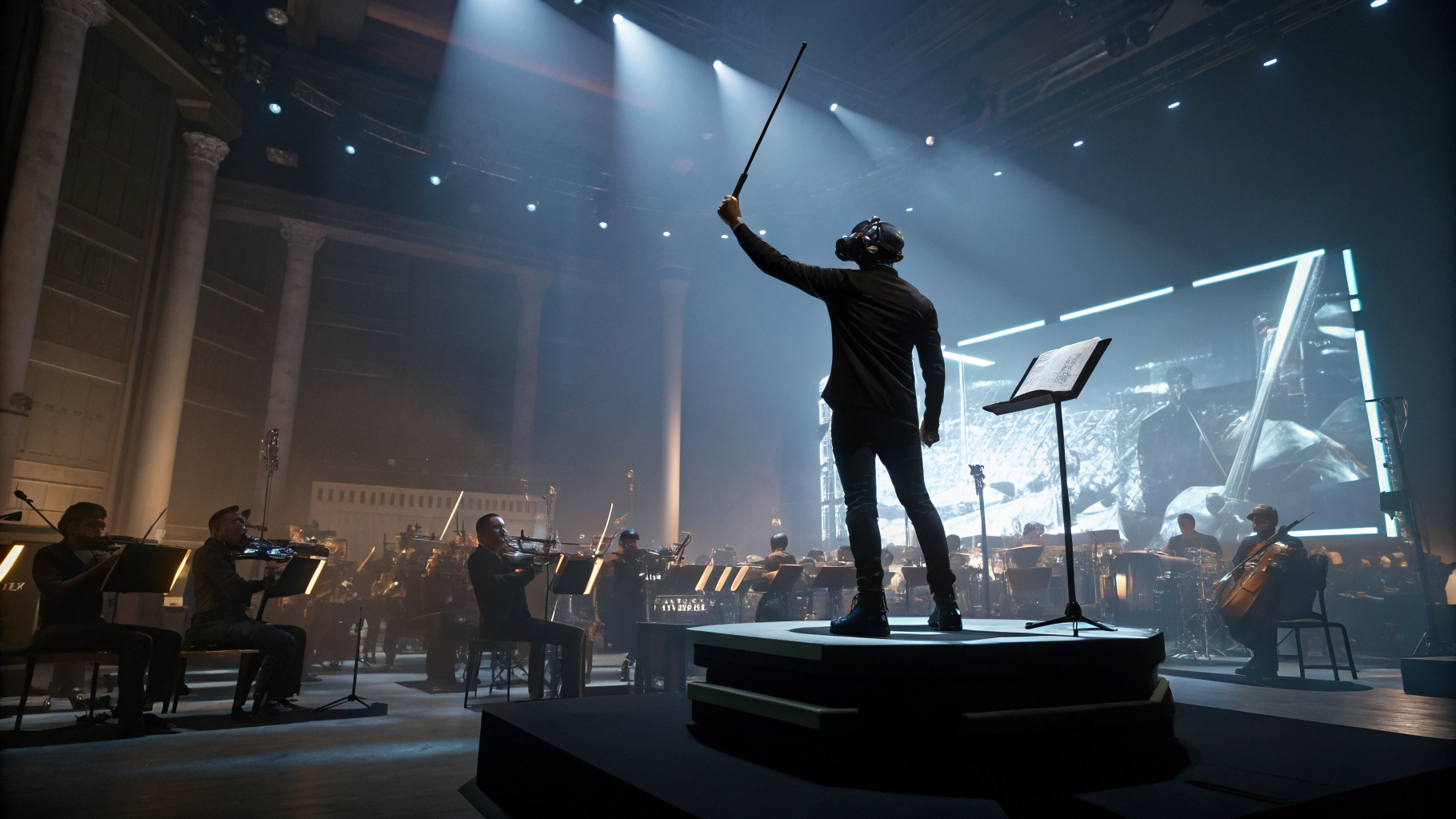
I’ve been covering VR since before the Oculus Rift DK1 landed on my desk, back when “immersion” meant duct-taping a Wii remote to your face. Over the years, I’ve seen a thousand rhythm games come and go. Most of them are glorified whack-a-mole simulators set to a beat. So when a symphony-conducting VR rhythm game called Maestro popped up, I was skeptical. Another gimmick, I figured. But then I actually played it. And now, with the announcement of an Attack on Titan orchestral DLC at the VR Games Showcase, I think we might be looking at something genuinely interesting.
Let me be clear: I’m not here to hype. I’m here to tell you what I think, which is that Maestro is one of the few VR rhythm games that understands the difference between playing along and performing. Most rhythm games ask you to hit notes. Maestro asks you to conduct an orchestra. It’s a subtle but crucial distinction, and it’s why this Attack on Titan DLC might actually work.
The Premise: You Are the Baton
If you haven’t tried Maestro, here’s the elevator pitch: You stand on a virtual podium, baton in hand, facing a full symphony orchestra. The music swells around you. Your job is to cue sections of the orchestra — strings, brass, percussion — by swinging your arms in time with the score. It’s less about hitting a specific target and more about feeling the phrase, about breathing with the music. Miss a cue, and the violins fall apart. Nail it, and the whole hall lifts.
There’s a physicality to it that most VR games miss. You’re not just flicking your wrists; you’re using your whole body, your core, your breath. I’ve played it at a convention booth, sweating through my shirt after a four-minute track. It’s exhausting in the best way. And now, the developers are adding tracks from Attack on Titan — specifically Hiroyuki Sawano’s bombastic, choral-heavy score. Think “YouSeeBigGirl” and “Attack on Titan” (the main theme). If you know, you know.
Why Attack on Titan Fits — and Why It Might Not
On paper, this is a match made in heaven. Sawano’s music is already cinematic, layered, and dramatic. It demands a conductor. The orchestral arrangements in the anime are some of the most iconic in modern media. I can already imagine the visceral thrill of cueing the brass section as the colossal titan’s hand smashes through the wall. It’s the kind of moment that VR was made for.
But there’s a risk here. Attack on Titan is a property with a very specific emotional weight. The show is about trauma, survival, and moral ambiguity. Its music reflects that — it’s not just “epic,” it’s anguished. If the DLC just presents the tracks as a series of beat-matching challenges, it will fail. The game needs to capture that tension, the sense of impending doom that makes Sawano’s scores so powerful. Can a VR rhythm game do that? I’m not sure. But I want to see them try.
What struck me here is that the developers didn’t choose a generic fantasy orchestra or a cheap licensed soundtrack. They chose something with weight. That suggests they understand the material. Or at least, they’re betting that their audience does. Maestro players aren’t casual rhythm game fans — they’re people who want to feel like they’re making the music. That’s a different psychology.
The Update That Matters More Than the DLC
Here’s where I get a bit contrarian. The Attack on Titan DLC is the headline, sure. But the free update announced alongside it might actually be more important. According to the UploadVR report, the update includes new gameplay mechanics, improved gesture recognition, and — crucially — a “practice mode” that lets you slow down tracks. This is huge.
Why? Because Maestro is hard. Not in a cheap way, but in a genuinely demanding way. The game expects you to read the conductor’s score, anticipate tempo changes, and coordinate both arms independently. That’s a lot for a casual player. A practice mode turns it from a punishing test into a skill you can actually build. It lowers the barrier to entry without dumbing down the experience. That’s smart design.
I’ve played enough VR to know that the graveyard of failed headsets is littered with games that were too hard, too niche, or too arrogant to adapt. Maestro is making the right call. The gesture recognition improvements are also critical. Early versions of the game had issues with baton tracking — sometimes the game would miss a cue if your swing was too fast or too wide. That’s a death sentence for a rhythm game. If these updates fix that, the core experience will be much more polished.
The Bigger Picture: VR Rhythm Games Are Stuck
Let me zoom out for a second. The VR rhythm game genre is weirdly static. Beat Saber is still the king, and for good reason — it’s elegant, addictive, and endlessly replayable. But everything else has felt like imitation. Synth Riders does flow. Pistol Whip does cinematic action. Dance Collider tried to be a party game. None of them have cracked the code the way Beat Saber did.
Maestro is different because it’s not trying to compete on the same axis. It’s not about speed or accuracy in the traditional sense. It’s about interpretation. You’re not a player; you’re a performer. That’s a subtle re-framing, but it changes everything. The feedback loop isn’t “you missed a note,” it’s “the orchestra sounds muddy.” The language is different. The emotional reward is different.
And that’s why I’m cautiously optimistic about this DLC. If Maestro can make me feel like I’m conducting the orchestra for the final battle of Attack on Titan, it could be something special. If it’s just a skin over the same mechanics, it’ll be a missed opportunity. The difference between art and product, as always, is in the execution.
The Business Side: Is This a Niche Too Far?
I have to ask: is a symphonic VR rhythm game with an anime orchestral DLC too niche to survive? The VR market is still small. The audience for classical music is older. The audience for Attack on Titan skews younger. The Venn diagram overlap might be a single dot. But that’s also the beauty of digital distribution — you don’t need to sell a million copies to be viable. You need to find your tribe and serve them well.
Maestro seems to understand that. The developers aren’t chasing the mainstream. They’re doubling down on what makes their game unique: the conductor fantasy. By licensing a score that is both culturally relevant and musically complex, they’re signaling to their core audience that they get it. That’s worth something. In an industry obsessed with growth at all costs, it’s refreshing to see a team that knows exactly who they’re making a game for.
Will it pay off? I don’t know. But I respect the bet. And I’ll be there on launch day, baton in hand, ready to conduct the chaos.
What I Want From the DLC
Since I’m a journalist with opinions and a platform, let me lay out what I think the DLC needs to do to succeed:
- Dynamic difficulty — The tracks should adapt to your skill level. A beginner should feel like they’re keeping the orchestra together. A veteran should feel like they’re shaping the performance. One size does not fit all.
- Visual storytelling — The game’s current visuals are abstract, with floating note particles and glowing cues. For Attack on Titan, I want to see the orchestra transform. Maybe the stage darkens during the more intense passages. Maybe silhouettes of titans appear in the background. Don’t just give me the music — give me the feeling of the show.
- Authentic arrangements — These tracks need to be orchestral, not electronic remixes. The whole point is the live orchestra vibe. If they water down Sawano’s score, I’ll be disappointed. The game is called Maestro. Act like it.
I realize I’m asking for a lot. But that’s the thing about VR — it raises expectations. Once you’ve experienced something that feels real, you can’t un-see the potential. Maestro has that potential. The Attack on Titan DLC could be the moment it realizes it, or the moment it proves that the concept is too fragile for the weight of a major IP.
Final Thoughts: Keep Your Eyes on the Baton
I’ve been writing about VR long enough to know that most announcements are vaporware. Half the games shown at the VR Games Showcase will never ship, or they’ll ship broken and never get patched. But Maestro is already out. It already works. The DLC is a bet, not a blind guess. That gives me more confidence than any hype trailer could.
Will I buy it? Probably. Will I enjoy it? That depends on whether the developers understood the assignment. The assignment wasn’t just to add popular songs to a rhythm game. The assignment was to let me feel like I’m conducting the end of the world. If they pulled that off, they’ll have my respect — and my sweaty, exhausted arms.
For now, I’m watching. Baton in hand.
Further Reading
Original source: UploadVR — Maestro Attack on Titan DLC announcement
Original source: read the full article