I’ve been writing about VR, AR, and the metaverse for over a decade now. I’ve seen prototypes that promised the moon and delivered a cardboard cutout. I’ve watched companies parade “live” 3D video that was actually pre-recorded and stitched together in post. So when I heard about SpatialGen Zeus — a rack-mounted system that can stream live Apple Immersive Video to the Apple Vision Pro — my first instinct was to raise an eyebrow. My second was to ask: Okay, but does it actually work in the real world?
The answer, based on what I’ve seen and read, is a cautious yes. And that’s more interesting than you might think. Because live immersive video has been the holy grail of VR for years. Sports, concerts, live theater — we’ve all imagined sitting court-side at an NBA game from our living rooms, or standing on the stage at Glastonbury without the mud. But the technical hurdles have been brutal. Latency, bandwidth, camera rigs the size of small cars, and the sheer compute required to stitch multiple 8K views in real time. Most attempts have ended up looking like a pixelated mess you’d rather watch on a regular screen.
SpatialGen Zeus isn’t promising to solve all of that. But it is promising to solve enough of it to make live immersive video feel like a product, not a demo. Let’s dig in.
What Actually Is This Thing?
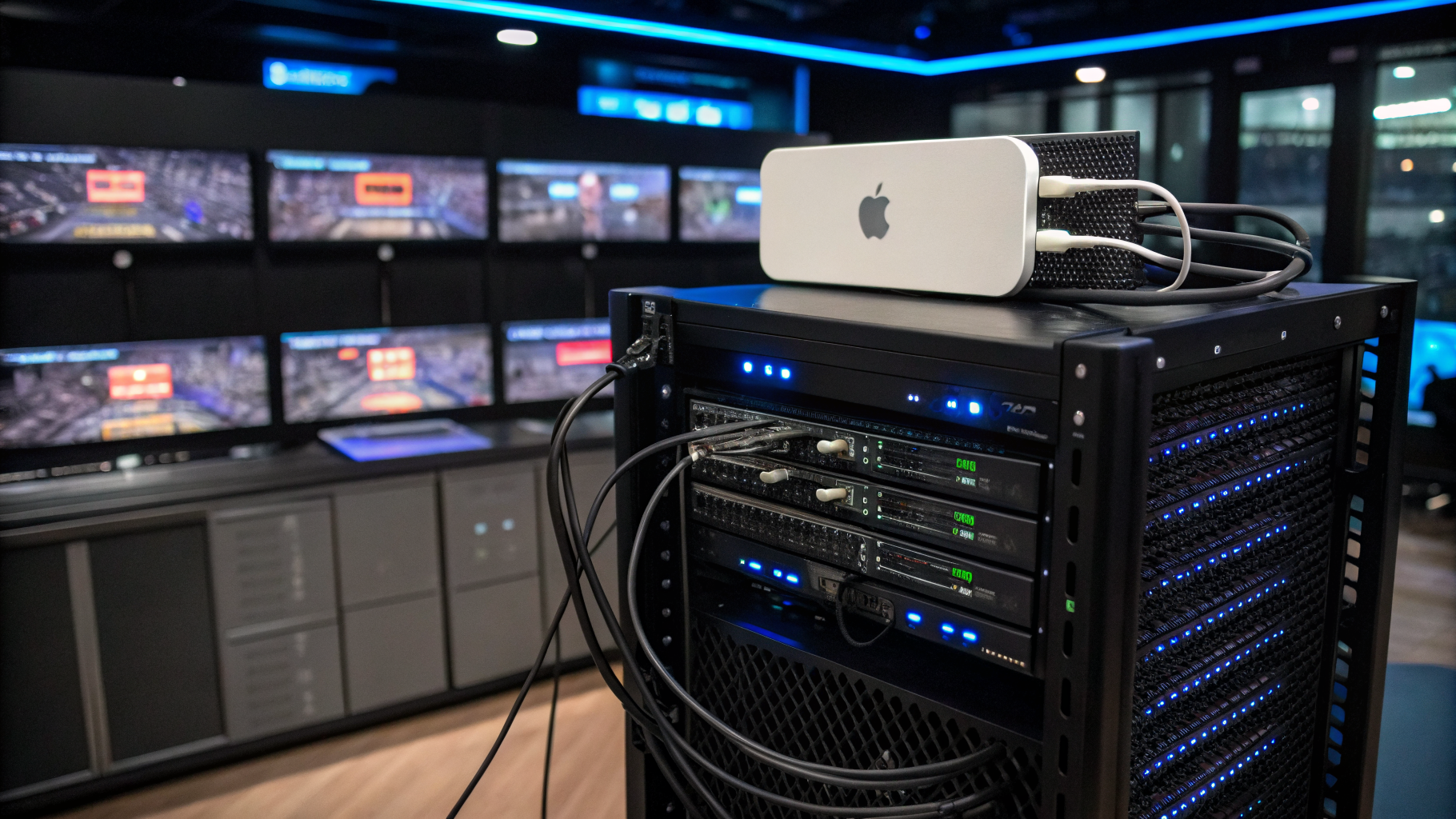
The Zeus is a rack-mounted system — think a server unit you’d slot into a broadcast truck or a data center. It takes in multiple camera feeds (the exact number isn’t specified, but we’re talking a full spatial rig) and processes them in real time. The result streams directly to Apple Vision Pro headsets using Apple’s Immersive Video format. That’s the same format Apple uses for its own pre-recorded content, like the immersive experiences they’ve been teasing since the Vision Pro launch. The key difference here is live. No hours of post-production. No waiting for a render farm. You’re seeing the action as it happens.
What struck me here is the target audience. This isn’t a consumer gadget. It’s a professional broadcast tool. SpatialGen is selling to sports leagues, concert promoters, and event producers. They’re the ones who will buy this, bolt it onto their existing infrastructure, and pipe the feed to Vision Pro users. That’s a smart move. Don’t try to sell headsets to consumers; sell the back-end to the people who already have the content and the distribution channels.
In my view, this is exactly the kind of B2B approach that will actually move the needle for spatial computing. Apple can sell all the Vision Pros it wants, but without compelling live content, the headset remains an expensive curiosity. Zeus is a piece of the puzzle that says: Here’s how you make live events work in this format, without rebuilding your entire workflow from scratch.
The Tech Under the Hood (Or, How They Might Actually Pull This Off)
I’m not going to pretend I’ve torn the Zeus apart and examined every chip. But based on what SpatialGen has shared and my own experience covering VR broadcasting, I can make some educated guesses. The system needs to handle several brutal tasks simultaneously:
- Ingest: Multiple high-resolution camera streams — likely 8K or higher per eye, running at 90 fps or more. That’s a firehose of data.
- Stitching: Combine those streams into a seamless 180-degree or 360-degree volumetric view. This has to happen in real time, with no visible seams or latency.
- Encoding: Compress the result into Apple Immersive Video format without destroying quality. Apple’s format is proprietary and optimized for their M-series chips, so the encoder needs to speak that language natively.
- Streaming: Deliver the encoded feed to Vision Pro units over the internet with sub-second latency. That’s a network engineering challenge all its own.
The fact that SpatialGen is doing this on a rack-mounted system suggests they’re using dedicated hardware acceleration — likely FPGAs or custom ASICs — rather than relying on off-the-shelf GPUs alone. That’s a good sign. Off-the-shelf gear tends to overheat, throttle, and fail under sustained real-time loads. A purpose-built box has a better shot at reliability.
But let’s be real for a second. Live immersive video has been “coming soon” for years. Remember the hype around NextVR? They raised millions, got acquired by Apple, and then… nothing. The tech was promising, but scaling it to live events at stadium scale proved too hard. Zeus might succeed where others failed because it’s designed from the ground up for Apple’s ecosystem, not as a generic VR streaming solution. That focus could be its superpower.
Why Apple Vision Pro Is the Right (and Only) Target Right Now
Here’s a thing I’ve noticed: every time a new VR headset comes out, a dozen companies rush to build “live 360 video” solutions that work on all of them. The result is invariably a mess — half-baked, incompatible codecs, terrible quality. SpatialGen is doing the opposite. They’re betting the farm on Apple’s format. That’s risky, but it’s also smart. Apple Immersive Video is a known quantity. It’s well-documented, it’s optimized for Apple Silicon, and it’s the format Apple is pushing for its own content. By aligning with that, SpatialGen ensures that what they build will work seamlessly on Vision Pro, without the fragmentation that plagues Android VR.
Is that a gamble? Sure. If Vision Pro flops — and let’s not pretend that’s impossible, given the price tag and the niche appeal — then Zeus becomes a very expensive paperweight. But if Vision Pro gains traction, especially in enterprise and premium consumer spaces, then SpatialGen is sitting on a first-mover advantage that could be huge.
I’m not saying Vision Pro will be the next iPhone. I’m saying that for live immersive video, it’s the only headset that currently has a coherent format, a decent user base, and a company willing to throw marketing money at it. Meta’s Quest line has more units, but Quest doesn’t have a native live immersive format that approaches Apple’s quality. So for now, Zeus on Vision Pro is the best game in town.
What This Means for Sports and Events (And Why You Should Care)
Let’s talk about the use case that makes everyone’s eyes light up: sports. Imagine you’re a fan of the LA Lakers. You can’t afford courtside seats — who can? — but you put on a Vision Pro and suddenly you’re sitting at mid-court, watching LeBron James in 3D, from an angle that no TV broadcast can replicate. The crowd is around you. The squeak of sneakers is in your ears. It’s not quite being there, but it’s closer than a flat screen has ever managed.
That’s the promise. And Zeus is the delivery mechanism. SpatialGen claims their system can handle the latency demands of live sports — meaning the action on your headset is within a second or two of the real-world event. That’s good enough for most fans. It’s not good enough for betting, but then again, if you’re betting on a live game through a VR headset, you have bigger problems.
Concerts are another obvious use case. Imagine watching Taylor Swift from the perspective of the sound engineer — or from a camera rig suspended above the crowd. Again, not a replacement for being there, but a very cool alternative for fans who can’t travel or afford tickets. And for event producers, it’s a new revenue stream: sell digital “seats” that don’t require physical space.
But here’s my honest take: the first few live events on Zeus will probably look rough. That’s just the nature of new tech. The lighting in a stadium is unpredictable. The camera rigs will have blind spots. The stitching will glitch. The first time someone tries to stream a live football game, there will be a moment where a player’s arm disappears into their torso. Count on it. The question is whether SpatialGen and its customers can iterate fast enough to turn those glitches into polish. I’m skeptical but hopeful. The tech is there; the execution is the hard part.
The Competition (And Why It’s Not Really Competition Yet)
Who else is doing live immersive video for headsets? Not many, for good reason. Meta has been experimenting with live 180-degree video on Quest, but the quality is inconsistent and the format isn’t standardized. HTC has some enterprise solutions, but they’re aimed at industrial training, not entertainment. There are startups like Pixvana and VRTUL, but they’ve mostly focused on pre-recorded content. Live is a different beast.
Apple itself has been quiet on the live front. They’ve showcased pre-recorded immersive experiences — like the Alicia Keys performance or the immersive basketball highlight — but nothing truly live. That leaves the door open for SpatialGen to be the first mover. And in tech, being first matters, even if you’re not perfect. You get to define the workflow, set the expectations, and build the relationships with content partners. By the time Apple builds its own live solution (if they ever do), SpatialGen could already be the default provider for major sports leagues.
Or Apple could acquire them. That’s always a possibility. Apple bought NextVR for its tech, and SpatialGen’s Zeus is in a similar space. If this works well, I wouldn’t be surprised to see Tim Cook’s team pick up the phone.
The Bigger Picture: Is Live Immersive Video the Killer App?
I get asked this a lot: What will make VR mainstream? And my answer has always been the same — it won’t be one thing. It’ll be a thousand small things that add up to a compelling experience. Live immersive video could be one of those things. Not the killer app, but a killer feature. The kind of experience that makes someone justify the $3,500 price tag of a Vision Pro because they can watch their favorite team from a seat they could never afford.
But let’s keep our feet on the ground. The infrastructure for live immersive video is still in its infancy. Zeus is a promising step, but it’s still a step. There are questions about bandwidth: can home internet connections handle the data rate required for high-quality immersive streaming? The answer today is “maybe, if you have fiber.” For most people, it’s “no.” There are questions about comfort: can you wear a Vision Pro for a full 90-minute soccer match without getting eye strain or neck fatigue? I’ve tested the Vision Pro for extended periods, and the answer is… not really. Not yet.
So I’m excited about SpatialGen Zeus, but I’m not going to call it a revolution. It’s an evolution. It’s a solid piece of engineering that addresses a real bottleneck in the spatial computing ecosystem. If it works as advertised, it will make live immersive video a viable product for the first time. That’s a big deal. But it’s not the end of the journey. It’s the beginning of the next chapter.
Final Thoughts: What I’m Watching For
I’ll be keeping an eye on a few things. First, which sports leagues or concert promoters actually sign up to use Zeus. A press release is one thing; a live stream of the NBA Finals is another. Second, the latency. SpatialGen says it’s low, but “low” in VR is measured in milliseconds, and anything above 100ms can cause nausea. I want to see independent tests. Third, the price. This is a rack-mounted system for professionals, so it won’t be cheap — but if it’s priced too high, even the big leagues might balk.
For now, I’ll file this under “promising, with caveats.” And I’ll keep writing about it, because that’s what I do. The metaverse — or spatial web, or whatever we’re calling it this week — isn’t built in a day. It’s built one rack-mounted streaming system at a time.
If you want to dive into the original announcement, head over to UploadVR for the full details.
Further Reading
SpatialGen Zeus Streams Live Immersive Video To Apple Vision Pro – UploadVR
Original source: read the full article