Lara Croft’s VR Adventure Is Dead Before It Ever Began
Another day, another VR project bites the dust. This time it’s Lara Croft — yes, the dual-pistol-wielding, ancient-tomb-raiding icon — whose rumored VR incarnation has reportedly been axed before anyone outside Vertigo Games’ Amsterdam studio ever got to touch it. Leaked images and video surfaced this week, courtesy of MP1st, showing what appears to be a fully modeled Lara in a virtual environment, complete with climbing mechanics, puzzle elements, and that signature athletic grace. But according to the leak, the project was canned in January 2025, after barely three months of active development.
Let’s be honest: it stings. I’ve been covering this space since before the Oculus Rift DK1 shipped, and I’ve seen more cancellations than I care to count. But Tomb Raider VR felt different. It had the brand weight, the studio pedigree (Vertigo Games made Arizona Sunshine and After the Fall), and the perfect genre fit — exploration, puzzle-solving, traversal — that VR excels at. So what the hell happened?
What the Leak Actually Shows
The leaked material, which I’ve pored over frame by frame, shows a surprisingly polished slice of gameplay. We see Lara navigating a crumbling stone temple, grabbing ledges, swinging across gaps, and aiming a bow at unseen threats. The visual fidelity is striking — this isn’t some low-poly placeholder. It’s running on what looks like a high-end PC VR setup, with dynamic lighting and detailed textures that scream “AAA production.”
There’s also a clip of a combat encounter: Lara crouches behind a pillar, peeks out, and fires an arrow into a hostile figure. The movement system appears to be smooth locomotion with a snap-turn option, which suggests Vertigo was targeting the core VR audience, not casuals. A menu screen shows the title “Tomb Raider: Relic of the Ancients” — though that could be a placeholder or internal codename.
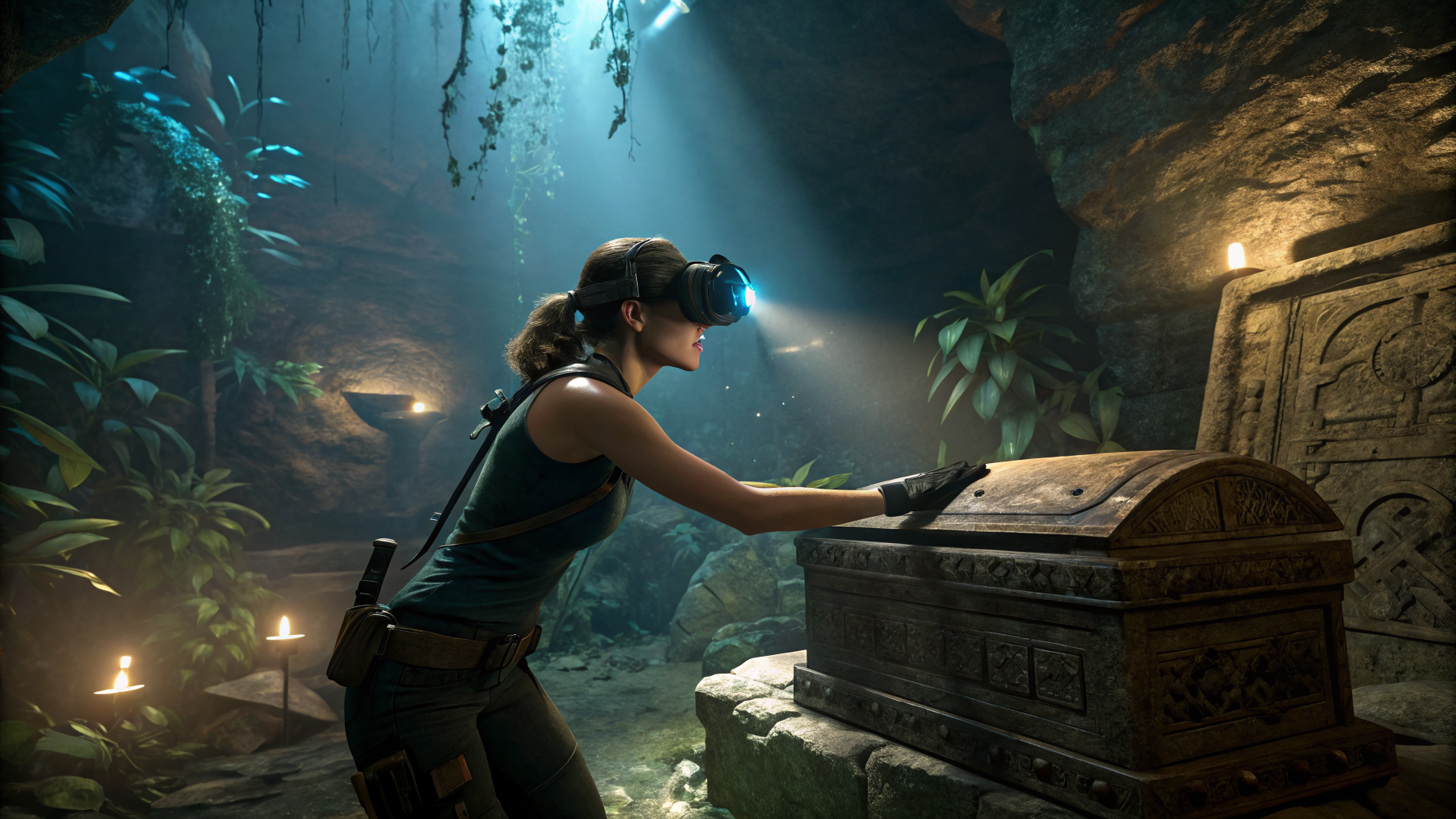
What struck me most is the environment design. One scene shows a vast underground cavern with bioluminescent flora and a massive sarcophagus at its center. It’s the kind of set piece that would make you stop and stare in VR, the kind that justifies the headset’s existence. And now it’s locked in a vault, probably never to see the light of day.
Why Did Vertigo Games Amsterdam Shut Down?
According to the leak, Vertigo Games’ Amsterdam satellite studio — the team behind this project — was closed as part of a broader restructuring. The parent company, Vertigo Games (now owned by Embracer Group after their acquisition spree), decided to consolidate operations. The Amsterdam office was shuttered, and the Tomb Raider VR project went with it.
This is where the story gets depressingly familiar. Embracer Group has been on a cost-cutting rampage since its $8 billion deal with Saudi Arabia’s Savvy Gaming Group fell through in 2023. Studios have been closed, games canceled, and thousands laid off. Vertigo Amsterdam was just another casualty in a war nobody asked for.
But here’s the question nobody’s answering: why wasn’t the project transferred to Vertigo’s main studio in Rotterdam? Or to another Embracer-owned VR developer? The leaked material suggests the game was far enough along to warrant a rescue attempt. My guess? Internal politics, budget reallocation, or — most likely — a decision that VR just isn’t a priority anymore.
The VR Market’s Cold Shoulder
Let’s not sugarcoat it: the VR gaming market in 2025 is a strange beast. On one hand, hardware sales are steady. The Meta Quest 3 and PlayStation VR2 have decent install bases. Apple’s Vision Pro, despite its exorbitant price, has brought spatial computing into the mainstream conversation. But software? That’s where the rot sets in.
AAA VR games are rare because they’re expensive to make and hard to sell. A game like Half-Life: Alyx raised the bar, but it was a loss leader for Valve. Resident Evil Village in VR was a port, not a ground-up build. And Horizon Call of the Mountain? Beautiful, but it didn’t move the needle for PSVR2 sales the way Sony hoped.
So when Embracer looked at a Tomb Raider VR title, they saw a multi-million-dollar investment with uncertain returns. Add in the fact that Crystal Dynamics (the main Tomb Raider developer) is busy with the next mainline entry and a Perfect Dark reboot, and suddenly Lara Croft in VR becomes an easy thing to cut.
I get it. I really do. But it’s still a damn shame.
What Could Have Been
Imagine for a second what a fully realized Tomb Raider VR game could have offered. The climbing, the swimming, the puzzle-solving — all of it translated directly to motion controls. You could physically pull yourself up ledges, examine ancient artifacts up close, and feel the weight of a bow as you draw the string. The immersion would be unparalleled.
Vertigo Games had the pedigree. Their Arizona Sunshine series proved they understand VR locomotion, combat, and storytelling. After the Fall showed they could handle co-op multiplayer. A single-player Tomb Raider VR title with their engine and expertise could have been a system seller.
Instead, we’re left with leaked images and a sense of what might have been. The VR community has been starved for major IPs. Yes, we get ports and indie gems, but where are the blockbusters? Where’s the game that makes someone buy a headset just to play it?
Tomb Raider VR could have been that game. Now it’s just a footnote.
The Leak Itself: A Double-Edged Sword
Leaks are a weird thing in the games industry. They generate hype, sure, but they also put pressure on publishers. Sometimes they force a project’s cancellation if the reception is negative. In this case, the reaction has been overwhelmingly positive — fans are begging for someone to pick up the torch. But leaks also reveal internal turmoil. Vertigo Games likely didn’t want this out there. It makes them look chaotic, and it makes Embracer look like the grim reaper of VR dreams.
I’ve seen this before. Remember the Star Wars: Battlefront VR mission? That was EA testing the waters, and then nothing. Remember Assassin’s Creed Nexus? It came out, sold modestly, and Ubisoft said “cool, we’re done.” The pattern is clear: publishers dip a toe into VR, get cold feet, and retreat.
The Tomb Raider VR leak might be the final nail in the coffin for big-budget VR adaptations of established franchises. Or it could be the spark that convinces a smaller studio to license the IP and finish the job. I’m not holding my breath, but I’ve been wrong before.
What This Means for VR’s Future
If you’re a VR enthusiast, you’re probably feeling a mix of anger and resignation. I’m right there with you. The cancellation of Tomb Raider VR isn’t an isolated incident — it’s a symptom of a larger disease. The VR industry is stuck in a chicken-and-egg loop: no big games means no mainstream adoption, and no adoption means no big games.
But there are glimmers of hope. Indie developers are pushing boundaries. Into the Radius, Vertigo 2, Boneworks — these are innovative, ambitious titles that prove VR doesn’t need a triple-A budget to be compelling. And platforms like Quest are making VR more accessible every year.
Still, I can’t help but mourn what we lost. Lara Croft in VR could have been the ambassador the medium needed. She’s iconic, recognizable, and her gameplay loop is tailor-made for immersive tech. The fact that a project with that potential got the axe before it even had a chance to fail or succeed is a tragedy.
The Bottom Line
So where does this leave us? The leaked images and video are a bittersweet glimpse into a parallel universe where Tomb Raider VR exists and — who knows — maybe even thrives. But in our timeline, it’s just another canceled project, another reminder that the VR industry is still fragile, still fighting for relevance, and still losing the battle for publisher confidence.
I’ll keep covering this space because I believe in the technology. I believe that VR can deliver experiences that flat screens never can. But days like today, I wonder if the industry will ever get out of its own way. Tomb Raider VR deserved better. And so did we.
If you’re reading this and you have the power to revive this project — publisher, investor, studio head — do it. The community is waiting. The hardware is ready. The only thing missing is the will.
Original source: read the full article