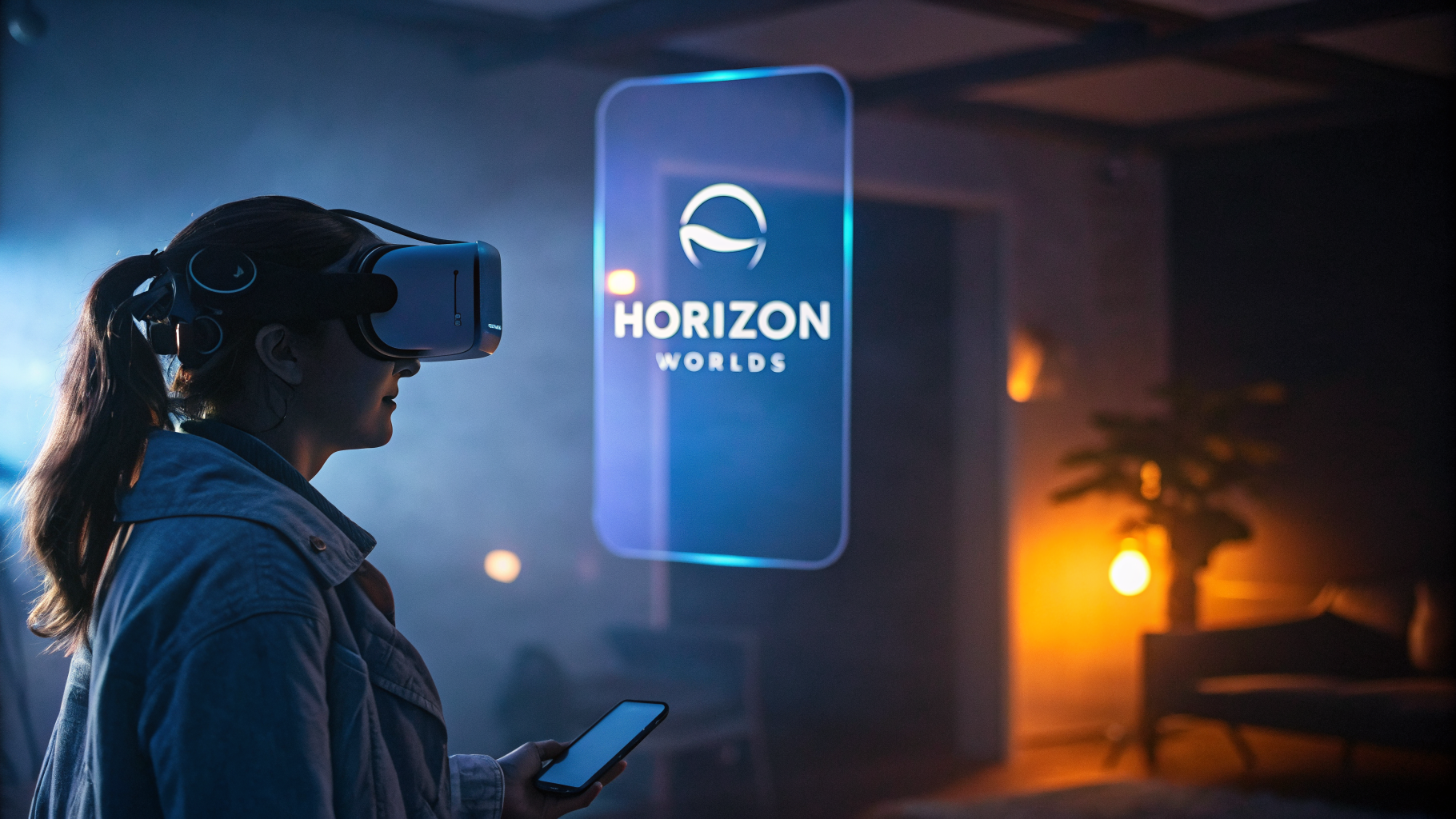
Remember when Meta rebranded an entire company around the metaverse, and Mark Zuckerberg stood there in a cartoon avatar with a face like a haunted mannequin, telling us all that Horizon Worlds was the future? Good times. Great times, actually, if you were a shareholder with a strong stomach and a blind eye for the billions bleeding out of Reality Labs.
Well, grab your VR headset and your nostalgia goggles, because the latest datamining suggests Meta is quietly working on a Horizon Worlds spin-off — yanking the social platform out of the current Horizon mobile app and giving it its own dedicated app. The current app, it seems, is being groomed for XR headsets only. You know, the hardware that almost nobody owns.
Let me be clear: this isn’t a death knell. Not yet. But it’s a repositioning that smells like a parent finally admitting their teenage kid isn’t going to be a professional skateboarder and needs to start thinking about community college.
What the Datamine Actually Tells Us
Datamining is a weird sport. You’re essentially picking through the digital entrails of an app, looking for strings, class names, and backend endpoints that hint at what the developers are cooking. The UploadVR report points to code references suggesting that Meta is building a separate mobile app for Worlds, while the existing Horizon app will focus on the headset experience.
Now, I’ve been around long enough to know that datamining isn’t gospel. Sometimes devs leave dead code around like old pizza boxes in an office fridge. But when you see consistent references across multiple updates, and when it aligns with Meta’s broader strategy — which has been shifting faster than a chameleon on a disco floor — you start to pay attention.
What struck me here is the direction of the split. Most companies would kill to have their metaverse product in the same app that powers their Quest headsets. But Meta is choosing to carve out Worlds into its own thing, leaving the main Horizon app to serve as the shell for the headset OS, social features, and maybe the storefront.
That’s not just a technical refactor. That’s a statement.
Why Would Meta Do This?
Let’s play armchair strategist for a second, shall we?
First, there’s the mobile reality check. Horizon Worlds on mobile has been… how do I put this delicately? A ghost town. You download the app, you wander around a few user-generated worlds, and you quickly realize that most of them are either empty, ugly, or both. It’s like walking through a mall where 90% of the stores are boarded up and the remaining ones sell socks with motivational quotes.
Second, there’s the headset push. Meta sells hardware. It loses money on Quest headsets, but it sells them in the hope that people will buy games, apps, and eventually, virtual goods. If Horizon Worlds is the flagship social experience, it needs to be deeply integrated with the headset’s core UI. A separate mobile app would free the main Horizon app to become the command center for the XR ecosystem — login, avatars, friends, maybe even the Quest Store.
Third, and this is the cynical take, Meta might be preparing to quietly sunset Worlds from the main app. You know, the old « let’s spin it off so we can kill it without it being a headline » move. I’ve seen this playbook before. In tech, when a product is spun off, it’s either because it’s thriving and needs its own space, or because it’s dying and management wants to isolate the smell.
Which is it here? Honestly, I’m not sure. And that uncertainty is the story.
The State of Horizon Worlds in 2025
Let’s recap where we are. Horizon Worlds launched in 2021 to a chorus of eye-rolls. The graphics were basic, the avatars had no legs, and the whole thing felt like a tech demo that had escaped from a trade show. Meta poured billions into it, but the user base remained stubbornly small compared to the hype.
Fast forward to 2024 and 2025, and Meta has been quietly rebranding. They introduced Horizon Worlds on the web, they added a creator monetization program (which mostly paid peanuts), and they’ve been pushing a more polished version with better social features. But the fundamental problem persists: why would anyone spend time in Horizon Worlds when they could be in Roblox, Fortnite Creative, or even just doomscrolling TikTok?
The answer, for a long time, was « because Zuckerberg wants you to. » But that’s not a compelling reason for most people.
Now, with the mobile app spin-off, Meta is essentially admitting that Worlds needs to stand on its own two feet (even if its avatars still don’t have legs). It needs to prove it can attract and retain users without being propped up by the Quest ecosystem.
That’s a high-stakes gamble. Because if the standalone Worlds app flops, it’s not just a failed product — it’s a signal that the entire metaverse thesis, at least as Meta has pursued it, is built on quicksand.
What This Means for Users and Creators
If you’re a creator who’s been building worlds in Horizon Worlds, this spin-off could be a double-edged sword.
On the one hand, a dedicated app might give you more visibility. Meta could pour more resources into discoverability, better tools, and maybe even a proper revenue share that doesn’t feel like an afterthought. The separation from the headset-focused Horizon app could also mean that Worlds stops being treated as a side feature and starts being treated as a real product.
On the other hand, spin-offs often come with budget cuts. If the new app is expected to be self-sustaining, Meta might slash the subsidies that kept the lights on. Creators might see their monetization rates drop, or the company might start charging for things that used to be free.
I’ve talked to several creators over the years, and the mood is cautiously optimistic but wary. They’ve been burned before. Meta has a habit of promising the moon and then quietly deleting the project and pretending it never happened. Remember Facebook’s gaming app? Yeah, that’s gone. Remember the Oculus Rooms? Gone. Remember that time Meta shut down the original Horizon? Actually, they just rebranded it, but the point stands.
The Bigger Picture: Meta’s Metaverse Retreat
This spin-off is also happening against a backdrop of Meta’s broader retreat from the « metaverse » as a buzzword. Zuckerberg has been talking more about AI than virtual worlds lately. The company’s stock price has rebounded on the back of AI investments, not VR sales. And the Reality Labs division is still losing money hand over fist.
In that context, spinning off Worlds from the Horizon mobile app could be seen as a way to contain the damage. If Worlds fails, it fails quietly in its own app, without dragging down the rest of the Horizon brand. And if it succeeds, well, great — Meta can claim victory and point to a standalone product that proves the metaverse isn’t dead.
But I think there’s a deeper motivation here. Meta is realizing that the metaverse isn’t a single destination. It’s a collection of experiences, and those experiences need to be accessible across devices. The mobile app was too cluttered, trying to serve both the headset users and the phone users. By splitting them, Meta can tailor each experience to its platform’s strengths.
That’s actually a smart move. It’s the kind of strategic clarity that’s been missing from Meta’s metaverse efforts for years. But it’s also risky because it exposes Worlds to the harsh light of the open market.
What I Think Will Happen Next
I’m not a fortune teller, but I’ve covered enough tech pivots to spot a pattern.
First, expect Meta to announce this change officially within the next few months. They’ll frame it as a « better experience for creators » and « more focused mobile presence. » They’ll use words like « empower » and « unlock potential. » It’ll be a polished press release.
Second, expect the new Worlds app to launch with a weasel-worded beta tag. It’ll be available in a few territories, then gradually roll out. There will be a blog post showing impressive growth numbers, even if the absolute numbers are tiny.
Third, watch the creator economy. If Meta starts offering better revenue splits or new monetization tools, that’s a sign they’re serious. If they start cutting corners, that’s a sign they’re trying to extract value before the thing collapses.
Fourth, keep an eye on the Quest headset integration. The current Horizon mobile app will become the control center for the XR ecosystem. That means your friends list, your avatar, your purchases — all of that will live in the main app. The Worlds app will just be a portal to specific worlds, which is fine, but it also means Worlds will become more dependent on the main app for identity.
The question is whether that dependency is a lifeline or a leash.
Is This the End of Horizon Worlds?
Let me be blunt: no, not yet. But it’s a significant inflection point. Horizon Worlds has been stumbling along for years, and this spin-off is an attempt to either fix it or finally pull the plug.
I’ve been to virtual worlds that were genuinely magical. I’ve stood on a virtual stage in front of a crowd of strangers and felt a connection that transcended the bitrate. I’ve also wandered through empty worlds that felt like digital graveyards, where every texture and polygon seemed to whisper, « Why are you here? »
Horizon Worlds has the potential to be the former, but it’s often been the latter. The spin-off could give it the focus it needs to become something people actually want to use. Or it could be the final chapter in a story that Zuckerberg will eventually bury in an earnings report footnote.
As a journalist, I’m excited to see what happens. As a human being who has watched Meta stumble through the metaverse for years, I’m skeptical. But that’s okay. Skepticism is healthy. It’s what keeps us from drinking the Kool-Aid.
So, here’s my advice: if you’re a creator, don’t panic. Keep building. If you’re a user, don’t abandon ship just yet. And if you’re a shareholder, well, you’ve already accepted the risk.
The only certainty is that Meta is once again rearranging the deck chairs on the Titanic. Whether the ship is sinking or just changing course, we’ll find out soon enough. But one thing is clear: Horizon Worlds is about to be tested in a way it never has been before. And I, for one, will be watching with a bucket of popcorn and a VR headset at the ready.
Stay tuned.
Original source: read the full article