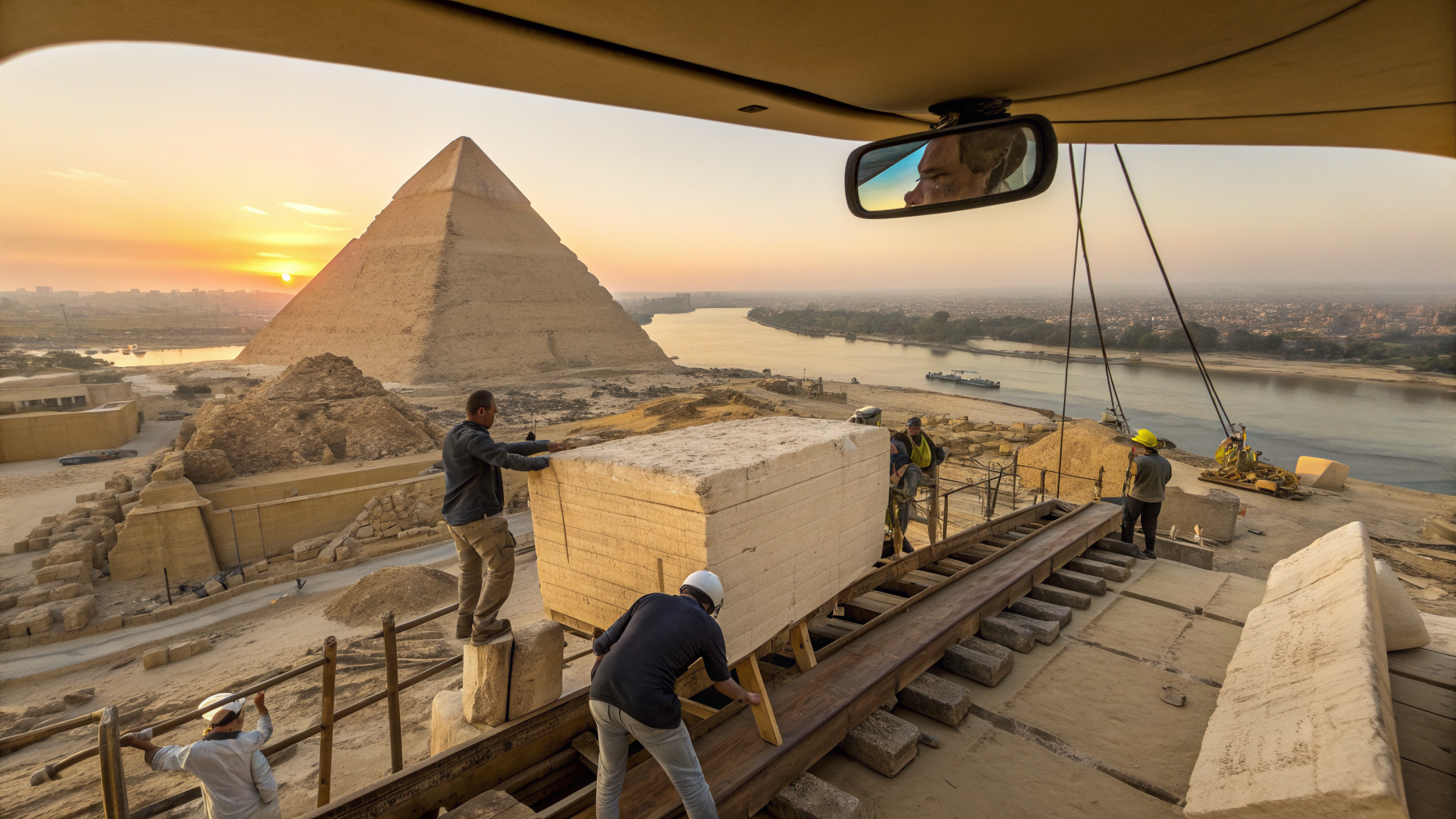
Let me guess: you’ve seen one too many VR documentaries that promise to “transport you back in time” and instead deliver a slideshow with a voiceover that sounds like a museum audio guide recorded in 2003. I’ve been there. I’ve reviewed enough of them to develop a twitch. So when I put on the headset for The Secret of the Pyramid Builders from Excurio, I braced myself for another polite yawn. What I got instead was a revelation. And I don’t use that word lightly.
This is an educational VR experience that doesn’t just tell you how the Great Pyramids were built. It makes you sweat with the workers, feel the drag of limestone blocks, and stand in awe as 2.3 million stones stack themselves into a monument that has haunted humanity for millennia. It’s the rare case where the medium and the message are perfectly aligned. You’re not learning about history. You’re living a hypothesis.
And that, my friends, is where the magic happens.
No Talking Heads Here
Excurio, the studio behind this wonder, has a track record. They did Horizon of Khufu and Inside the Pyramids, both of which were solid, but this new piece feels like a leap. The premise is simple: you’re dropped into ancient Egypt, circa 2500 BC, and you need to figure out how an ancient civilization moved 2.5-ton blocks without modern machinery. No aliens. No mystical energy beams. Just engineering, sweat, and a whole lot of human ingenuity.
What struck me here is the level of detail. The environment isn’t a generic desert backdrop. You see the Nile’s seasonal flood patterns, the ramps that spiral around the pyramid, the wooden sledges, the copper tools. You watch teams of workers—not slaves, as the outdated textbooks would have you believe—coordinating like an ant colony on caffeine. The experience even lets you test different theories: the straight ramp, the spiral ramp, the internal ramp. You get to feel why some work better than others.
It’s not a lecture. It’s a puzzle.
The Physics of History
Here’s where the educational VR experience really shines. Instead of just visually recreating a scene, Excurio has built a physics engine that respects the materials. When you pull a rope attached to a sledge, you feel the resistance. You learn quickly that wetting the sand reduces friction—because you literally see the difference in your own effort. I found myself adjusting my stance, leaning into the pull, even though there was no physical weight attached. My brain had fully bought in.
That’s the secret sauce. VR has always promised empathy and immersion, but educational content often forgets that you learn best when you do. This experience turns you into an active participant in history. You’re not a spectator watching a reconstruction. You’re the one who has to figure out how to get a colossal stone up a steep incline without breaking your virtual back.
I spent a solid ten minutes trying to solve a particularly tricky ramp angle, and when I finally got it right, I actually pumped my fist. That’s not something I can say about many VR experiences, let alone ones designed for classrooms.
The Great Pyramid, But Make It Interactive
The narrative structure is clever. You start as a curious apprentice who joins a crew of builders. Your guide is an old architect who doesn’t just dump facts on you but asks you questions. “Why do you think we use logs here?” he’ll say, and you have to look around, examine the terrain, and make a choice. Get it wrong, and you’ll see the consequences play out. Get it right, and the crew acknowledges you with a nod.
This isn’t just gamification for the sake of it. It’s a teaching method that respects your intelligence. You’re given the tools to think like an ancient engineer, and that’s far more valuable than memorizing dates and names.
What I also appreciated was the pacing. The experience runs about 45 minutes, which is longer than the typical VR vignette. But it never drags. Each section introduces a new challenge: quarrying, transporting, lifting, and finally placing the capstone. The finale, where you stand at the top of the completed pyramid and look out over the Giza plateau, is genuinely moving. I’m not ashamed to say I got a little choked up.
But Is It Really Educational?
Look, I’m a skeptic by nature. I’ve seen too many “educational” VR experiences that are just a thin veneer of interactivity over a standard documentary. So I went into this one with a critical eye. I checked the historical accuracy. I examined the assumptions. And you know what? They’ve done their homework.
The experience is based on the latest archaeological research, including work from the French Institute of Oriental Archaeology and the HIHP (Heliopolis University’s project). That means you won’t find the old “aliens built it” nonsense. Instead, you get the most credible theories, presented as theories, not absolute truths. The experience even allows for the fact that some aspects of pyramid construction remain debated.
That’s refreshing. Too often, educational content presents a single story as fact, leaving no room for nuance. This one encourages you to question, to test, to think critically. And that’s what education should be, whether in a classroom or a living room.
What Could Be Better?
No review is complete without a few caveats, right? For one, the experience requires a fair amount of physical space. You’ll be walking around, reaching, pulling, and sometimes crouching. That’s great for immersion, but it might be a challenge for those with limited mobility. There are seated options, but they lose some of the magic.
Also, the social aspect is limited. You can have up to six players in a group, but they’re all doing the same tasks simultaneously. There’s no real cooperation—you’re just sharing a space. I’d have loved to see a puzzle that required two people to pull different ropes at the same time. That would have been a killer team-building exercise.
And the narrative, while engaging, occasionally slips into cliché. The wise old mentor trope is a bit tired. But honestly, that’s a minor quibble in the grand scheme of things.
The Future of Field Trips
What excites me most about this educational VR experience is its potential in schools. Imagine a history class where students don’t just read about ancient Egypt but actively engage with its engineering challenges. This could be the template for a new kind of learning—one that’s hands-on, collaborative, and genuinely fun.
I’ve been covering VR for over a decade, and I’ve watched it go through cycles of hype and disappointment. But experiences like this remind me why I fell in love with the medium in the first place. It’s not about escaping reality. It’s about understanding it better.
So, if you have access to a VR arcade or a museum that’s hosting this, do yourself a favor and book a session. Whether you’re a history buff, a skeptic, or just someone looking for a unique experience, you’ll walk away with a new appreciation for the people who built the last remaining wonder of the ancient world.
And no, you won’t need to bring your own sandals.
Original source: read the full article