Finding Frida: A VR Documentary That Actually Earns Its Runtime
I’ve sat through enough VR documentaries to know the drill. You get a 360-degree camera, a celebrity narrator, and a runtime that feels like a hostage situation. Most of them are glorified travelogues with a headset strapped on. So when I heard about Finding Frida, a 41-minute VR piece at Venice Immersive about a forgotten Norwegian textile artist, I’ll admit I rolled my eyes. Another niche artist gets the immersive treatment? Great. But then I actually watched it. And I haven’t stopped thinking about it since.
What struck me first wasn’t the technology—though the photorealistic 3D scans are genuinely impressive. It was the restraint. Director (and I use that term loosely, because this feels more like archaeology than filmmaking) doesn’t shove the medium in your face. No gimmicks. No forced interactivity. Just Frida Hansen’s tapestries, resurrected from dusty archives and woven into a narrative that feels both intimate and monumental. You’re not just looking at her work; you’re standing inside it.
Who Was Frida Hansen, and Why Should You Care?
Here’s the uncomfortable truth: most of us—myself included—had never heard of Frida Hansen before this. A Norwegian textile artist working at the turn of the 20th century, she was celebrated in her time, then promptly forgotten. Her tapestries hung in museums, then in storage. Her name faded. This is the default fate of women artists, especially those working in « craft » mediums. Textiles don’t get the same reverence as oil on canvas. It’s a bias that persists today, and Finding Frida doesn’t just acknowledge it—it uses VR to correct it.
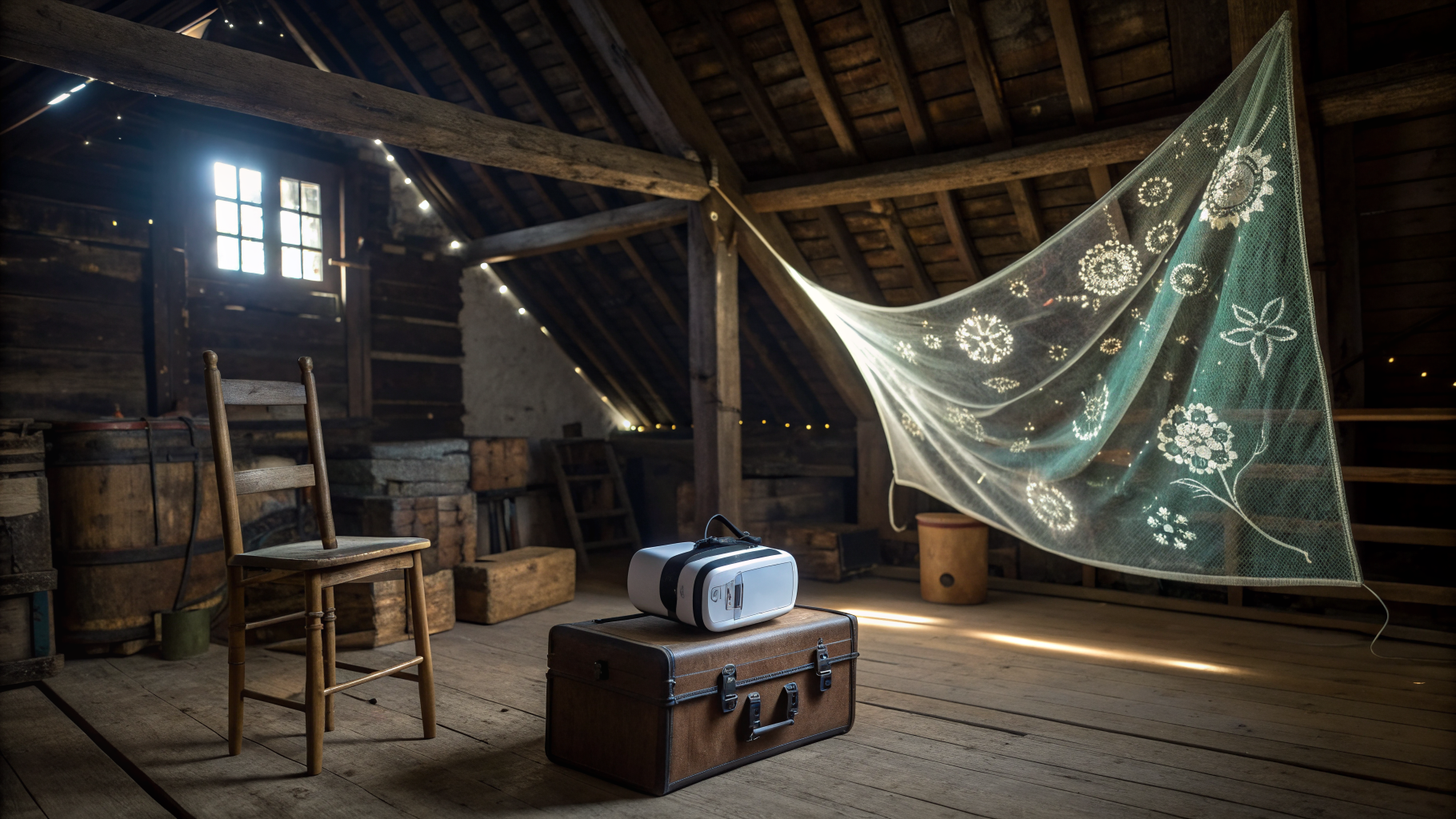
The documentary opens with a slow pan across a dusty attic. You’re in Norway, presumably. The light is cold, Nordic. A voice—Hansen’s, reconstructed from letters—begins to speak. She’s not a ghost. She’s a presence. The 3D scans of her tapestries are so detailed you can see individual threads, the slight unevenness of hand-dyed wool. It’s the kind of detail that flat photography obliterates. I found myself leaning in, literally, to trace the patterns. That’s the promise of VR: not escapism, but proximity. And here, it works.
The Technology: Photorealistic Scans and Animated Artwork
Let’s talk about the tech, because that’s what everyone will ask about. The team behind Finding Frida used a combination of photogrammetry and something they’re calling « animated artwork. » The tapestries aren’t just static scans. They breathe. Threads unravel and re-weave themselves. Flowers bloom and wilt in seconds. It’s a clever way to show Hansen’s creative process, though at times it edges into music-video territory. I could have done without the swirling particles. But when it works—when a tapestry dissolves into the landscape that inspired it—it’s genuinely moving.
The 41-minute runtime is a smart choice. Long enough to develop a real narrative, short enough to avoid the VR fatigue that sets in after an hour. My headset got warm. My neck got stiff. But I didn’t want to leave. That’s rare.
What Finding Frida Gets Right (and What It Doesn’t)
First, the good. The documentary treats Hansen as a subject, not a spectacle. There’s no melodramatic reenactment of her struggles. No tearful voiceover about how she died penniless. Instead, you get her work, her words, and a quiet sense of injustice that lingers. The VR format is used to create empathy through scale—standing before a tapestry that’s three meters tall hits different when it’s in your field of view. You feel small. You feel her ambition.
Now, the less good. The pacing drags in the middle. There’s a section about Hansen’s travels to Italy that feels like a tourism ad. And the interactive elements—you can pick up objects, sort of—are half-baked. Either commit to interactivity or don’t. Don’t tease me with a floating loom that I can’t actually use.
Also, and this is a bigger issue: who is this for? Venice Immersive is a niche within a niche. The people who need to see this—museum curators, art historians, anyone who thinks textiles are « lesser »—aren’t likely to put on a headset. The irony is thick. A VR documentary about a forgotten artist will itself be forgotten if it doesn’t find a wider distribution. I hope it does. But I’m not holding my breath.
The Bigger Picture: VR as a Tool for Art History
We’ve seen VR used to tour museums, recreate lost architecture, and let you walk through Van Gogh’s brushstrokes. Most of it is gimmickry. Finding Frida is different because it doesn’t try to replace the original. It can’t. A tapestry is a physical object. No scan, however photorealistic, captures the texture of wool under your fingers. But what VR can do is bring the forgotten back into the conversation. It can show you why Hansen mattered without asking you to book a flight to Oslo.
Is this the future of art history? Maybe. But let’s not get ahead of ourselves. The cost of producing something like this is prohibitive. The audience is tiny. And the technology, while impressive, is still clunky. My headset fogged up twice. I had to recalibrate the controllers. The magic is fragile.
Still, I think Finding Frida points to something important. Not every VR documentary needs to be a rollercoaster. Sometimes, the most radical thing you can do is slow down and pay attention. Hansen’s tapestries are full of stories. It took a medium she never could have imagined to tell them again.
Should You Watch It?
If you have access to Venice Immersive or a festival that picks it up, yes. Absolutely. It’s 41 minutes of your life that won’t feel wasted. If you’re a VR skeptic, it might not convert you. The medium still has a long way to go before it’s as seamless as a book or a film. But Finding Frida is a reminder that VR can be more than a tech demo. It can be a memorial. A resurrection. A quiet act of justice.
I’ll end with this: I don’t know if Frida Hansen would have liked VR. Probably not. She worked with her hands, with thread and dye. But I think she would have appreciated the intent. Someone remembered her. Someone built a world around her work. In an industry obsessed with the new, that’s worth something.
Original source: read the full article