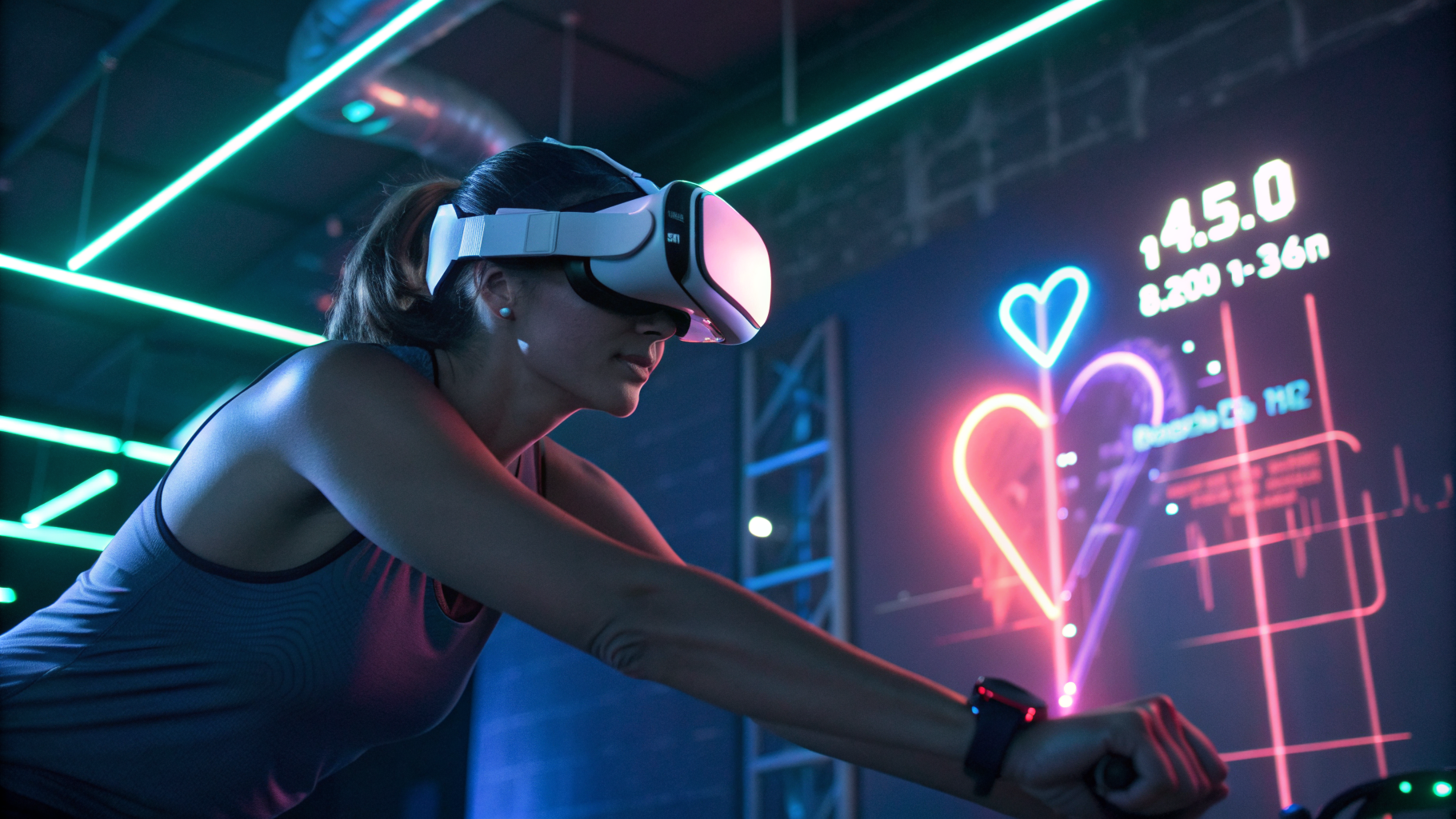
I’ve been covering VR fitness since the days when strapping a phone to your face and flailing around was considered a workout. So when FunFitLand announced a new phone app that pipes live heart rate data from wearables into VR workouts on Quest and Apple Vision Pro, I didn’t roll my eyes. I nodded. Finally, someone’s addressing the elephant in the virtual room: how do you know if you’re actually working out, or just having a really sweaty panic attack?
Here’s the deal. FunFitLand, which has been quietly building a fitness platform for VR, now lets you connect a compatible wearable—think Apple Watch, Garmin, Whoop, that sort of thing—to its smartphone app. The app then beams your real-time BPM into your VR headset. So while you’re punching virtual targets or squatting to a digital beat, you can glance at your wrist or a HUD element and see your heart rate climbing. No more guessing. No more finishing a session and wondering if you burned 200 calories or just stood there menacingly.
What struck me here isn’t the tech itself. Heart rate integration isn’t new. Peloton has it. Zwift has it. Even some VR fitness apps have dabbled. But FunFitLand is doing it in a way that feels less like a gimmick and more like a foundation. The company isn’t just slapping a number on the screen. It’s using that data to drive adaptive workouts. If your heart rate spikes too high, the app can dial back intensity. If you’re cruising, it can push you harder. That’s the kind of closed-loop feedback that VR fitness has been missing.
And let’s be honest: VR fitness has a credibility problem. For every person who swears by Supernatural or FitXR, there’s a skeptic who says it’s just Wii Fit with extra steps. I’ve been that skeptic. I’ve watched friends try VR workouts, get bored in a week, and go back to their gym memberships. The novelty wears off. The sweat doesn’t lie, but the motivation does. So anything that adds real accountability—real data—is a step in the right direction.
The Quest for a Real Workout
Let’s talk about the hardware dance here. You’ve got a Quest 3 or an Apple Vision Pro on your face. You’ve got a wearable on your wrist or chest. You’ve got a phone somewhere in the room. That’s three devices that need to talk to each other seamlessly. FunFitLand says its app handles the bridge. But I’ve tested enough VR fitness setups to know that ‘seamless’ is often a polite fiction. Bluetooth drops. Apps crash. Your heart rate monitor decides to take a nap mid-sprint.
Still, the promise is compelling. Imagine doing a VR boxing workout and seeing your heart rate zone change from yellow to red in real time. Imagine the app telling you to take a breather because you’re about to redline. That’s not just a feature. That’s a coach. A cheap, digital, slightly annoying coach. But a coach nonetheless.
The bigger question is whether this will actually make people work out harder or more consistently. I think it might. There’s something primal about seeing your own biometrics. It’s why Fitbit became a phenomenon. It’s why people obsess over their Apple Watch rings. When you see your heart rate climbing, you feel validated. You feel like you’re doing something. In VR, where the physical feedback is often muted by the headset and the controllers, that validation is even more important.
But here’s my concern: FunFitLand is still a relatively small player in a space dominated by bigger names. Supernatural has a rabid following. FitXR has partnerships with gyms. Apple is slowly building out its own fitness ecosystem for Vision Pro. Can a smaller app really carve out a niche by doing heart rate integration well? Maybe. But it needs to be more than a one-trick pony. The workouts themselves have to be good. The music has to be good. The progression has to be addictive. Heart rate data is a feature, not a product.
Why This Matters for the Metaverse That Never Was
Remember when we were all supposed to be living in the metaverse by now? Virtual concerts, virtual offices, virtual everything. That didn’t happen. Not really. But VR fitness is one of the few use cases that actually stuck. Why? Because it solves a real problem. It makes exercise less boring. It makes small apartments feel like big gyms. It makes you sweat.
And now, with heart rate integration, it’s solving another problem: accountability. The problem with home workouts—whether it’s a YouTube video or a VR game—is that it’s easy to slack off. No one’s watching. No one cares. But when your heart rate is on the screen, you’re watching. You care. It’s a mirror for your effort.
I think this is where FunFitLand’s move gets interesting. It’s not just about fitness. It’s about data. It’s about creating a feedback loop that keeps you coming back. The more data you feed into the system, the more personalized the experience becomes. The more personalized it becomes, the harder it is to walk away. That’s the hook.
Of course, there are privacy concerns. Your heart rate data is sensitive. It can reveal stress levels, sleep quality, even medical conditions. FunFitLand says it’s handling data responsibly. But we’ve heard that before. I’d want to see a clear privacy policy and maybe even an opt-out for data sharing. Because the last thing I want is my VR workout app selling my heart rate to an insurance company.
The Competition Is Not Sitting Still
Let’s not pretend FunFitLand is the only one thinking about this. Apple has been integrating heart rate data into Fitness+ on Vision Pro. Peloton is eyeing VR. Even Meta has hinted at fitness features for Quest. The race is on to own the VR fitness stack. And heart rate is just one piece of the puzzle.
What FunFitLand has going for it is focus. It’s not trying to be a general-purpose metaverse platform. It’s not trying to sell you virtual real estate. It’s trying to make you sweat. That’s refreshing. In a world where every tech company seems desperate to build the next big thing, a company that just wants to make a good workout app is almost quaint.
But focus alone won’t win. FunFitLand needs to execute. The app needs to work flawlessly. The workouts need to be fun. The heart rate integration needs to be accurate. And the pricing needs to be reasonable. If it nails all that, it could become a staple for VR fitness enthusiasts. If it doesn’t, it’ll be another forgotten app in a sea of forgotten apps.
I’m rooting for it. Not because I love VR fitness—I have a complicated relationship with it. But because I love the idea of using technology to make us healthier. And if a little heart rate monitor on your wrist can make you push a little harder in a virtual boxing ring, that’s a win. Even if you look ridiculous doing it.
What to Watch For
FunFitLand’s app is available now for Quest and Apple Vision Pro. It supports a range of wearables, though you’ll want to check the compatibility list before you buy. The company says more features are coming, including heart rate zone training and adaptive difficulty. I’ll believe it when I see it. But for now, this is a solid step forward for VR fitness. It’s not a revolution. It’s an evolution. And sometimes that’s enough.
So, will I use it? Maybe. I’ve got a Quest 3 and an Apple Watch. I’ve been meaning to get back into VR workouts. This might be the nudge I need. Or it might be another app I download, use twice, and forget. The difference will come down to execution. And execution is everything.
For now, I’m cautiously optimistic. FunFitLand is doing something right. It’s treating VR fitness like real fitness. And that’s a message the industry needs to hear.
Original source: read the full article