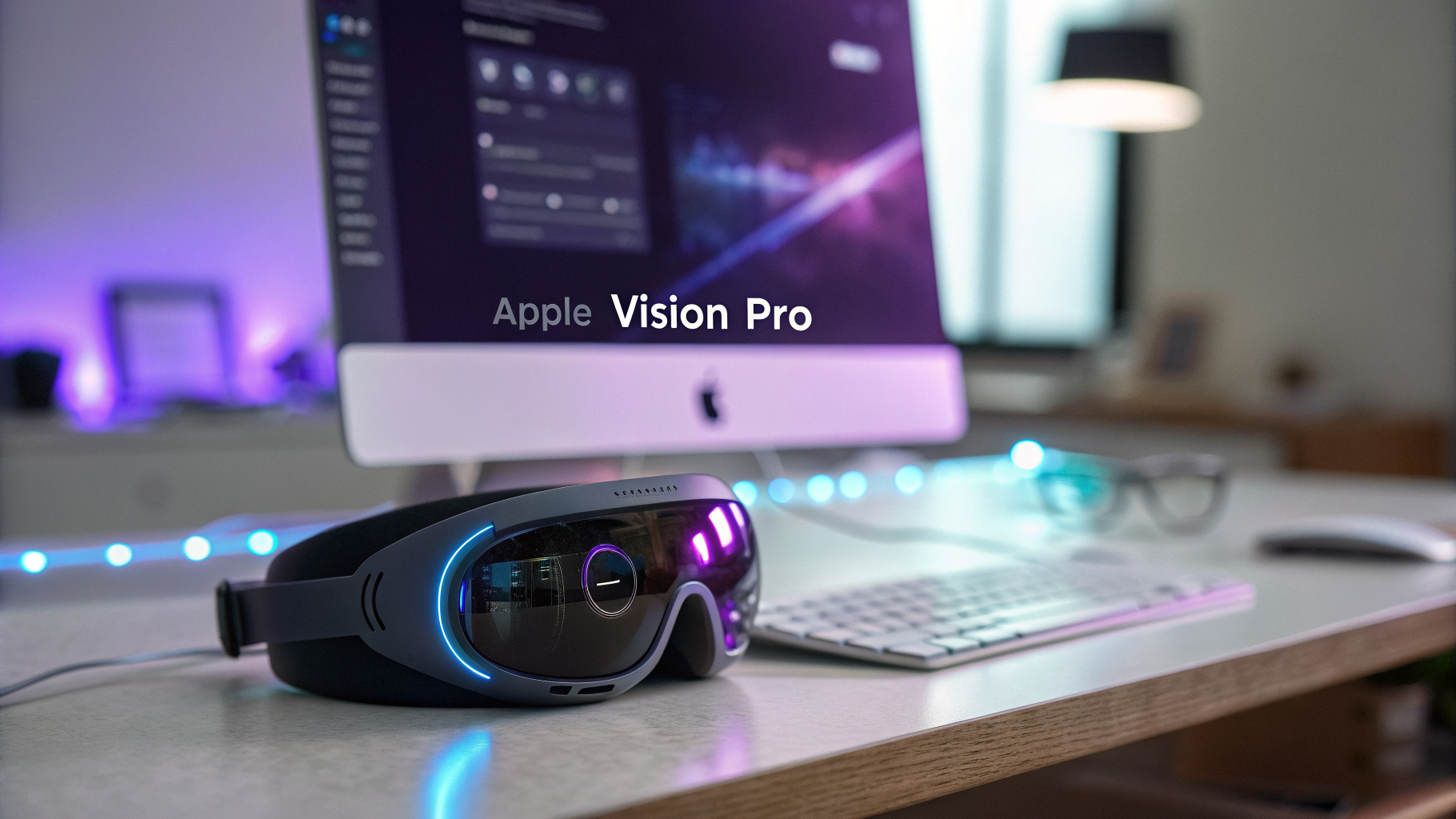
So You Want to Build a Vision Pro App? Acute Immersive Says ‘Hold My Beer’
Let’s be honest: the Apple Vision Pro has been a masterclass in breathtaking hardware paired with a software ecosystem that feels like a ghost town after a gold rush. The spatial video demos are stunning, but for the longest time, if you were a business that wanted to publish your own immersive video experience, you were stuck. You either hired a team of visionOS developers (good luck finding them) or you waited for a big studio to throw you a bone.
Enter Acute Immersive. The company just announced a platform that lets businesses build their own custom visionOS apps for immersive video, complete with publishing, monetization, and analytics baked in. On paper, it sounds like exactly what the doctor ordered for the Vision Pro’s content problem. But does it actually move the needle, or is it just another middleware layer dressed up in spatial computing buzzwords?
I’ve been covering this space since the Oculus DK2 was a glimmer in Palmer Luckey’s eye, and I’ve seen a hundred « democratization » platforms come and go. Most of them were glorified templates. So I dug into what Acute Immersive is actually offering, and I have thoughts.
The Pitch: No Code, No Problem (Allegedly)
Here’s the gist. Acute Immersive provides a toolkit that lets you take your immersive video content—think 180-degree, 360-degree, or spatial video—and wrap it into a native visionOS app without writing a single line of Swift. You get a drag-and-drop interface, presumably some pre-built UI components that match Apple’s design language, and a backend that handles the boring stuff: user authentication, payments, and data dashboards.
The monetization angle is the real hook. Apple’s App Store policies for Vision Pro are still a bit of a Wild West, but Acute Immersive claims to have figured out the plumbing for subscriptions, one-time purchases, and even ad-supported models. That’s huge for indie creators and mid-sized media companies who don’t have the legal team to navigate Apple’s arcane rules.
And analytics? Yes, please. If you’re spending six figures on a 360-degree documentary about penguins, you damn well better know how many people watched past the first 30 seconds. Acute Immersive says it gives you heatmaps, drop-off points, and engagement metrics that go beyond simple view counts. That’s the kind of granularity that could actually help creators iterate and improve.
But here’s the thing: I’ve heard this song before. Remember when every VR platform promised « analytics for immersive content » and then delivered a CSV file with timestamps? Let’s hope Acute Immersive does better.
Why This Matters More Than You Think
The Vision Pro’s biggest problem isn’t the price tag—it’s the lack of compelling, repeatable content. Apple built a Ferrari and forgot to pave the roads. Sure, you can watch a few impressive demos, but where’s the daily news show in spatial video? Where’s the immersive fitness class that actually tracks your form? Where’s the niche documentary series about deep-sea creatures that you’d happily pay $5 a month for?
Those things don’t exist at scale because the barrier to entry is absurdly high. You need a visionOS developer, a video engineer, a backend specialist, and a partridge in a pear tree. Acute Immersive is essentially saying: skip all that. Use our tools, focus on your content, and we’ll handle the tech.
That’s a noble goal. But I’m skeptical about the execution. Building a custom visionOS app isn’t just about wrapping a video player in a pretty skin. You have to deal with spatial audio, hand tracking, eye tracking, and the unique performance constraints of the device. If Acute Immersive’s templates are too rigid, you’ll end up with a generic experience that feels like a glorified YouTube player in 3D space. And if they’re too flexible, you might as well hire that developer.
The sweet spot is somewhere in between—a platform that gives you enough customization to stand out, but not so much that you need a computer science degree. I haven’t had hands-on time yet, so I can’t say which side of the fence they land on. But the fact that they’re even attempting this is a good sign.
The Monetization Question: Will Apple Play Nice?
Let’s talk about the elephant in the room: Apple’s cut. The App Store takes 30% (or 15% for small businesses) of every transaction. That’s a hefty chunk for any creator, especially when you’re already paying Acute Immersive a subscription fee (pricing wasn’t disclosed, which is always a red flag).
Acute Immersive says it supports multiple monetization models, but I want to know how they’re handling Apple’s in-app purchase requirements. Are they using StoreKit? Are they routing payments through their own system? If it’s the latter, they’re playing a dangerous game. Apple has a history of cracking down on apps that circumvent its payment rails. One wrong move and your custom visionOS app could get yanked from the store.
I reached out to Acute Immersive for comment but haven’t heard back yet. If I were a betting man, I’d say they’re using Apple’s native APIs and just abstracting the complexity. That’s the smart play. But it also means Apple still gets its pound of flesh, and creators need to factor that into their pricing.
Then there’s the question of discoverability. Even if you build a killer app with Acute Immersive, how will anyone find it? The Vision Pro App Store is a ghost town compared to iOS. There’s no editorial curation to speak of, and search is a joke. Acute Immersive can give you the tools to publish, but it can’t magically generate an audience. That’s still on you.
The Analytics Angle: Data or Dud?
I’m a sucker for good analytics. In the flat-screen world, we take for granted that we can see exactly where viewers drop off, what they rewatch, and how they interact with UI elements. In VR and spatial computing, that data is often missing or woefully incomplete.
Acute Immersive promises session durations, heatmaps of gaze direction (if the user consents), and even completion rates for different video segments. If they deliver on that, it’s a game-changer for content creators. Imagine being able to see that 80% of viewers look at the left side of the frame during a particular scene. That’s actionable. That’s how you get better.
But here’s my concern: privacy. Eye-tracking data is incredibly sensitive. Apple has strict rules about what developers can collect, and for good reason. If Acute Immersive is aggregating gaze data, they need to be transparent about it and give users meaningful control. One whiff of a privacy scandal and the whole platform could go up in smoke.
I asked Acute Immersive about their data handling policies, and again, no response yet. I’ll update this piece if I hear back. In the meantime, consider this a yellow flag. Not a red one, but definitely something to watch.
Who Is This Actually For?
Let’s break down the potential customers. First, you have indie creators—the folks making experimental 360-degree films and niche documentaries. They’re the ones who need this most, but they’re also the ones least likely to afford a subscription fee on top of Apple’s cut. If Acute Immersive prices itself out of reach, it’s dead on arrival.
Second, you have mid-sized media companies. Think local news stations, sports leagues, or educational publishers. They have budgets and a desire to experiment with spatial video, but they don’t want to hire a full-time visionOS team. Acute Immersive could be a perfect fit here. The monetization tools alone—subscriptions, pay-per-view, etc.—are worth the price of admission.
Third, you have enterprises. Training simulations, virtual tours, product demos. These use cases are less about entertainment and more about utility. Acute Immersive’s analytics could help them prove ROI, which is always the hardest part of selling VR to a skeptical CFO.
Notice who’s missing: the big studios. Disney, Warner Bros., and the like have their own development teams. They don’t need a middleware platform. So Acute Immersive is fishing in a smaller pond, but that pond is still pretty big.
The Competition: Who Else Is Playing This Game?
Acute Immersive isn’t the only company trying to solve this problem. There’s a handful of startups and established players angling for the same market. Some focus on live streaming, others on pre-recorded content. Some are building for Vision Pro specifically, while others are platform-agnostic.
What sets Acute Immersive apart, at least from what I can tell, is the combination of publishing, monetization, and analytics in one package. Most competitors offer one or two of those pieces. Having all three is a compelling value proposition—if it works.
But here’s the thing: Apple could crush them at any moment. If Apple decides to release its own first-party tools for building immersive video apps, Acute Immersive’s raison d’être evaporates. That’s a risk every middleware company faces, and it’s why I’m always hesitant to go all-in on platforms that sit between the creator and the hardware.
My Verdict: Cautiously Optimistic (With Caveats)
I want Acute Immersive to succeed. The Vision Pro desperately needs more content, and the only way to get it is to lower the barrier to entry. If Acute Immersive can deliver on its promises—no code, built-in monetization, robust analytics—it could unlock a wave of creativity that Apple’s own tools haven’t managed to inspire.
But I’ve been burned before. The devil is in the details: pricing, Apple’s approval process, privacy compliance, and the actual quality of the generated apps. Until I see a real-world example that doesn’t feel like a tech demo, I’m keeping my enthusiasm in check.
What struck me most during my research was the lack of a public demo. Acute Immersive’s website is slick, but it’s all marketing copy. Show me a case study. Show me a video of someone building an app in 10 minutes. Show me the analytics dashboard. Without that, it’s just another promise in a space full of broken ones.
So here’s my advice: if you’re a creator with a budget and a burning desire to get your immersive video onto Vision Pro, keep an eye on Acute Immersive. Sign up for the beta if it exists. But don’t bet your entire business on it until you’ve kicked the tires. The spatial computing revolution is still in its infancy, and the tools are evolving fast. Today’s savior could be tomorrow’s footnote.
And to Acute Immersive: prove me wrong. I’d love nothing more than to write a follow-up piece titled « I Was Wrong About Acute Immersive. » The ball’s in your court.
One More Thing: The Web3 Elephant
I’d be remiss if I didn’t mention the Web3 angle. Acute Immersive didn’t say anything about NFTs, blockchain, or token-gated content, but you know it’s coming. Every immersive platform eventually pivots to « community ownership » and « digital collectibles. » If Acute Immersive adds that layer, it could attract a whole new audience of creators who want to monetize directly without Apple taking a cut.
But that’s a double-edged sword. Web3 still has a stench of scamminess for mainstream users, and Apple is notoriously hostile to crypto in its ecosystem. So if Acute Immersive goes down that road, it’ll have to tread carefully. For now, they’re playing it safe. Smart move.
Ultimately, the success of custom visionOS apps depends on whether Apple opens up its platform or keeps it locked down. Acute Immersive is betting on the former. I’m betting on a slow, messy evolution where tools like this fill the gaps Apple leaves behind. Let’s see who’s right.
Original source: read the full article