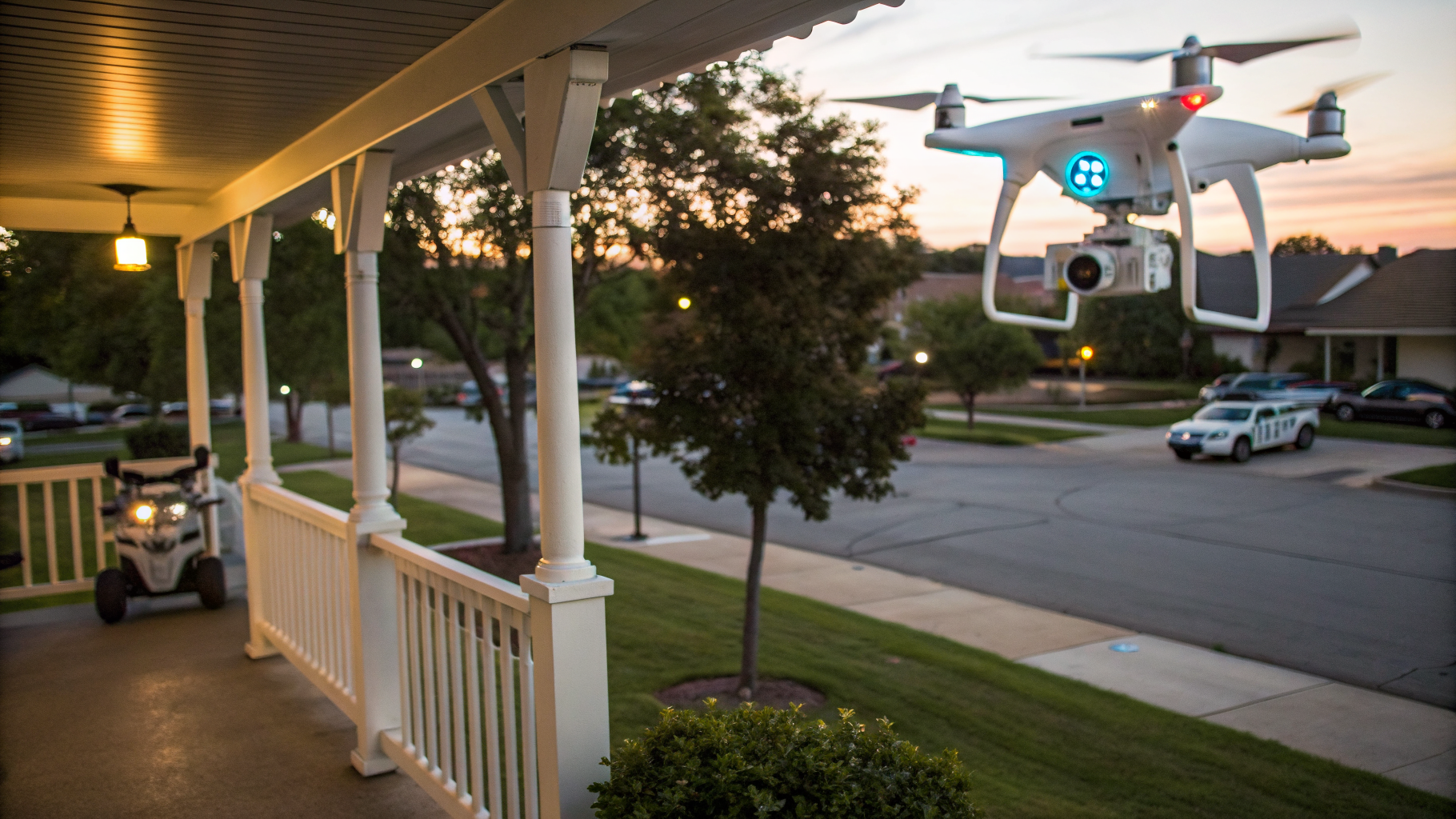
Ring Just Built a Drone. Because Of Course It Did.
I’ve been covering consumer robotics long enough to remember when a drone that followed you around was the stuff of Kickstarter fantasies and mildly disappointing CES demos. Now Ring, the company that made it socially acceptable to have a camera pointed at your front porch, has decided the porch isn’t enough. It wants the sky. And your office park, too.
Amazon-owned Ring announced this week that it’s launching a home security drone and a rolling enterprise robot designed to patrol businesses. That’s the short version. The longer version is that Ring is officially a robotics company now, and I’m not entirely sure how I feel about that.
Let’s start with what we actually know.
The Ring drone: autonomy with a subscription problem
The home security drone is the headline act. Ring’s pitch is straightforward: your fixed cameras can’t be everywhere, but a drone can. It takes off, flies a patrol route, and streams back what it sees. Sounds neat. Sounds a little terrifying. Sounds expensive.
Here’s what struck me when I read the announcement: the drone isn’t really a gadget, it’s a service. You’re not buying a flying camera so much as you’re buying into Ring’s ecosystem of cloud storage, AI detection, and whatever tier of subscription they’ve cooked up for 2026. The hardware is the hook. The subscription is the business model. That’s not cynicism, that’s just how Amazon operates.
And look, I get the appeal. If you have a big property, a drone that can investigate a motion alert before you call the cops is genuinely useful. It’s the kind of thing that sounds absurd until you have a raccoon situation at 2 a.m. and you’d rather not put on shoes.
But let’s ask the obvious questions. What happens when it’s windy? What happens when the battery dies mid-flight — does it land gently or does it become a projectile? What happens when your neighbor’s Ring drone and your Ring drone have a mid-air disagreement? Ring hasn’t answered any of this yet, and I suspect the answers will arrive in a firmware update and a terms-of-service revision.
The enterprise robot is the real story
Everyone’s going to write about the drone. I think the rolling robot is the more interesting bet.
Ring is positioning it as a patrol-and-protect machine for businesses — warehouses, parking lots, office campuses. It rolls around, it watches, it reports. If that sounds like a Knightscope unit with better branding, well, it kind of is. But Ring has something Knightscope never had: distribution. Ring is already in millions of homes. It’s already in the Amazon store. It already has a brand that people recognize, even if that recognition is sometimes deeply ambivalent.
That’s the play here. Ring isn’t trying to invent a new market. It’s trying to extend an existing one. Home security becomes business security becomes ambient security. Your doorbell, your drone, your parking lot robot — all one dashboard, all one subscription, all one company.
Is that convenient? Absolutely. Is it also a little unsettling? Also absolutely. I’ve spent a decade watching the metaverse and Web3 promise decentralization while Big Tech quietly centralized everything, and this is the same pattern in hardware form. The convenience is real. So is the concentration of power.
What Ring isn’t saying
Here’s where I get annoyed. The announcement is heavy on capability and light on constraint. Ring is telling us what the drone can do, not what it won’t do. That’s backwards, and it’s a pattern I’ve seen across every consumer robotics launch since the first Roomba.
- Where does the drone fly, and who sets the geofence — Ring or the user?
- What footage gets stored, for how long, and who can access it?
- Does the enterprise robot record audio, and does it notify people it’s recording them?
- What’s the subscription price, and what happens to the hardware if you cancel?
These aren’t gotcha questions. They’re the questions any journalist should ask, and the fact that Ring’s announcement didn’t lead with them tells you something about how the company wants this story told. They want you to picture a sleek drone circling your house. They don’t want you to picture the data pipeline behind it.
I’m not saying Ring is doing anything wrong. I’m saying the burden of proof is on them, and they haven’t met it yet.
The AI angle nobody’s talking about
Both products are AI plays, whether Ring says so or not. A drone that patrols is only useful if something in the stack can tell the difference between a deer and a person. A rolling robot is only useful if it can flag the weird thing in the parking lot at 3 a.m. without waking up the whole security team.
That means Ring is shipping computer vision at scale, in the physical world, with real consequences. False positives aren’t just annoying — they’re a drone hovering over your neighbor’s fence at midnight. False negatives are worse. This is the part where the AI hype meets the actual sidewalk, and I’ll be watching closely to see how Ring handles it.
What struck me here is how much of this is déjà vu. We spent years being told the metaverse would change everything, and what actually changed was the camera on your doorbell. The real ambient computing revolution isn’t a headset. It’s a subscription and a rotor.
Should you buy one?
Honestly? Wait. Not because the drone is bad — I haven’t touched one, and neither has anyone else writing about it this week. Wait because the first generation of any flying consumer gadget is a beta test you pay for. Wait because the subscription terms aren’t public yet. Wait because the enterprise robot’s privacy posture is a black box.
Ring has earned a lot of trust over the years, and it’s also burned a lot of it. That’s the reality of being a category-defining company. The drone and the robot are interesting, ambitious, and exactly the kind of thing this industry should be building. But the announcement is a promise, not a product. I’ll believe the promise when I see the terms.
For now, I’ll keep my doorbell. It’s boring. It works. And it doesn’t need a flight plan.
Original source: read the full article