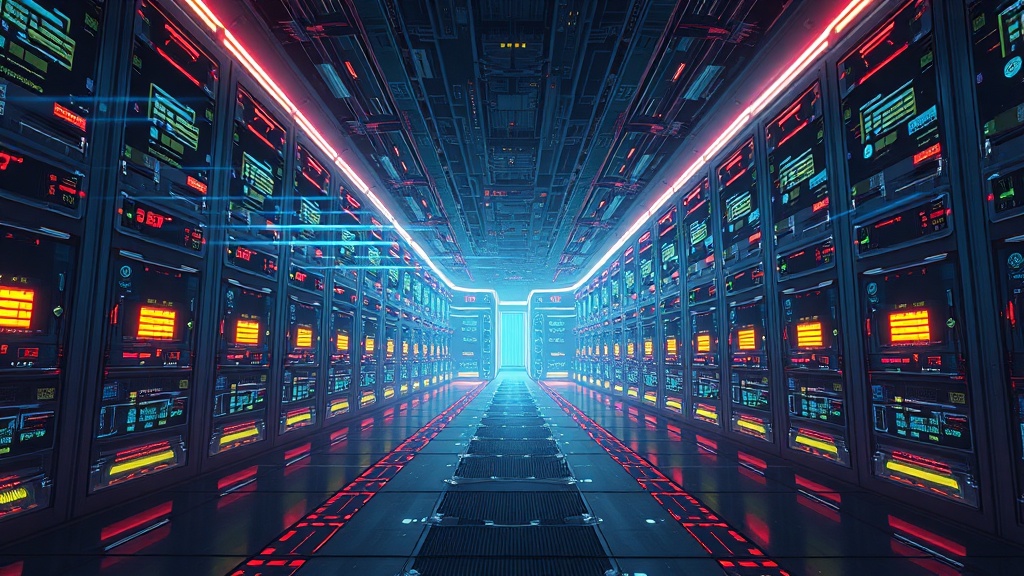
Let me paint you a picture. Last week, I sat with my grandmother as she scrolled through photos on her tablet. « Where do these live, really? » she asked, tapping the screen. I launched into my usual spiel about the cloud—that fuzzy, weightless place where our digital lives float. She smiled, nodded, and I could see her imagining some kind of celestial filing cabinet in the sky. But the truth is far less magical and far more grounded. The cloud isn’t a misty realm; it’s a massive, sweating, humming building full of wires, fans, and electricity. And that’s exactly why we need to talk about data centers tangible costs—the real-world price tags attached to our digital dreams.
We toss around phrases like « digital transformation » and « AI revolution » like they’re just software updates. But behind every ChatGPT response, every Instagram story, every autonomous vehicle test drive, there’s a physical beast: a data center. These aren’t the quiet, forgotten server rooms of yesteryear. They are sprawling, energy-guzzling, water-sucking industrial complexes. And as we push deeper into the age of AI, these data centers tangible costs are becoming impossible to ignore. They’re not just line items on a tech company’s balance sheet; they’re showing up in our water bills, our energy grids, and even the landscapes around us.
The Thirst of the Digital Beast
Let’s start with something we all understand: water. When I say data centers get hot, I mean really hot. Those servers, packed in by the thousands, generate enormous heat. To keep them from melting into expensive puddles of silicon, we need cooling. Lots of it. Many facilities use evaporative cooling systems, which essentially work like giant swamp coolers. And that requires a constant, massive flow of fresh water.
I visited a facility outside a small town in Oregon last year. The locals told me that during peak summer months, the data center down the road was consuming water equivalent to a small city’s daily usage. Meanwhile, nearby farmers were rationing irrigation for their crops. That’s a data centers tangible costs story you don’t hear in a tech keynote. It’s not about bits and bytes; it’s about a finite resource that we all share. And with AI models requiring exponentially more computing power, the thirst is only growing. We’re essentially asking our digital toys to drink from the same well that waters our food.
The Energy Appetite That Never Sleeps
Now, let’s talk about electricity. Data centers already account for about 1-2% of global electricity use. That might sound small, but it’s roughly the same as the entire country of France. And AI is supercharging that demand. Training a single large language model can consume as much energy as hundreds of homes use in a year. Then, every time you ask that model a question, it burns more power. This isn’t a one-time party; it’s a never-ending rave that keeps the lights on—and the coal plants running in many regions.
The data centers tangible costs here are staggering. We’re building new power plants, upgrading grids, and sometimes even delaying renewable energy transitions just to keep our AI chatbots responsive. I’ve spoken with utility engineers who describe data centers as « energy black holes » that warp local infrastructure. They demand so much power that communities nearby sometimes face rolling blackouts or higher electricity rates. That’s the price we pay for instant answers and seamless streaming.
Understanding Data Centers Tangible Costs
Let’s get specific about what « tangible » really means here. When I talk about data centers tangible costs, I’m not referring to abstract concepts like « digital disruption » or « innovation overhead. » I mean the stuff you can touch, measure, and feel in your daily life. These costs fall into three clear categories:
- Environmental costs: Water depletion, carbon emissions, and land use that disrupts ecosystems. For example, a single hyperscale data center can consume up to 3-5 million gallons of water per day, often in drought-prone areas.
- Infrastructure costs: The strain on local power grids, roads, and housing. Data centers require dedicated substations, new transmission lines, and sometimes even new highways to transport equipment. This drives up taxes and utility bills for everyone nearby.
- Social costs: Displacement of communities, noise pollution from cooling towers, and the « heat island » effect where buildings raise local temperatures. In some cases, data centers have pushed up property prices so much that long-term residents can no longer afford to live there.
These aren’t hypotheticals. They’re happening right now in places like Northern Virginia, where the « Data Center Alley » hosts hundreds of facilities. Residents there report constant hums from fans, increased traffic from construction crews, and skyrocketing electricity bills. The data centers tangible costs are written into their daily lives—and they’re not optional.
What Can We Do About It?
Look, I’m not saying we should unplug the internet and go back to writing letters. I love my AI tools as much as anyone. But we need to be honest about what we’re building. The good news? There are solutions. Some companies are experimenting with liquid cooling, which uses far less water than evaporative systems. Others are building data centers in colder climates or underwater to reduce energy needs. And a few are even using waste heat to warm nearby homes and greenhouses. That’s the kind of innovation we need to scale.
For a deeper dive into how these facilities work and where they’re headed, check out our guide on virtual worlds and infrastructure. And if you’re curious about the environmental impact of your own digital habits, read our article on your digital footprint. These links will help you connect the dots between your screen and the real world.
The Bottom Line: We Can’t Ignore the Physical World
My grandmother’s question— »Where do these live, really? »—deserves an honest answer. Our digital dreams are built on steel, copper, water, and electricity. They have a weight, a cost, and a consequence. The data centers tangible costs are not a bug to be fixed later; they’re a feature of our current system. Every time we click, stream, or ask an AI a question, we’re pulling from a finite pool of resources.
That doesn’t mean we should stop. But it does mean we need to design smarter. We need to push for transparency from tech companies about their water and energy usage. We need to support local regulations that require data centers to use renewable energy and recycle water. And we need to remember that the cloud is not a cloud—it’s a building. A hot, loud, thirsty building that sits somewhere, affecting someone’s life. So the next time you tap your screen, think about the tangible costs behind that magic. They’re real, they’re growing, and they’re ours to manage.