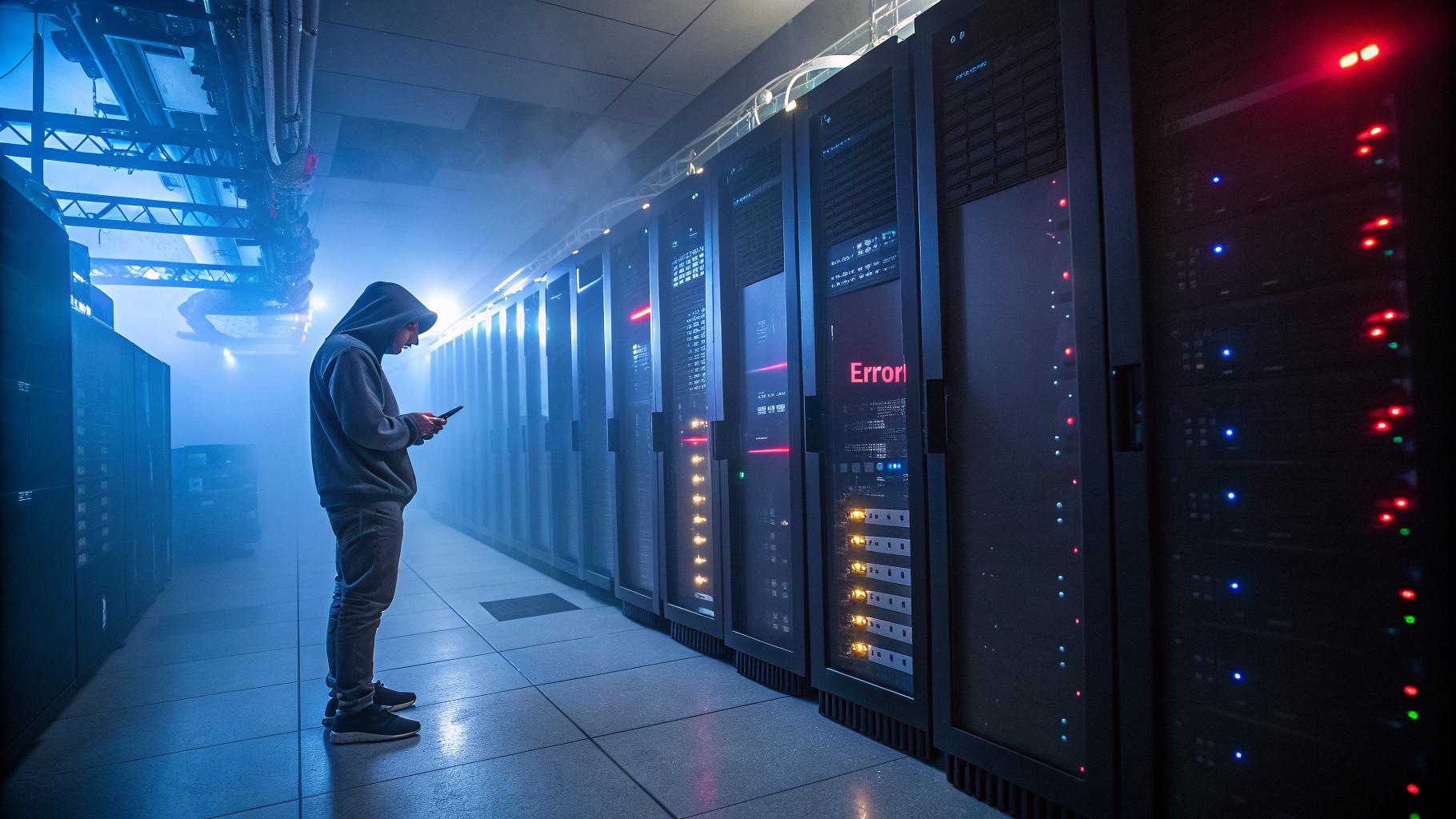
It was a Tuesday, right? These things always happen on a Tuesday. Or maybe it was a Wednesday. Honestly, the days blur when you spend them staring at chat interfaces, waiting for a cursor to stop spinning. But the date doesn’t matter. What matters is what happened: ChatGPT, Claude, Grok, and Gemini — the four horsemen of the generative AI apocalypse — all went down. At the same time. Practically simultaneously.
I’m not talking about a little lag, a few extra seconds of « thinking » while the model pretends to ponder the meaning of your prompt. I’m talking full-on, bone-dry, can’t-reach-the-server downtime. The kind that makes you check your own internet connection first, because surely, surely it’s not them. It’s always you, right? Wrong. This time, it was them. All of them.
The news broke on Ars Technica, and my timeline turned into a digital bonfire of takes. Some people were panicking — « Is this the AI apocalypse? » — which, no. Others were gleeful — « See, they’re not so reliable! » — which, fair. But what struck me, after a decade of covering this beat, wasn’t the fact of the outage. It was the overlap. The simultaneity. The fact that four competing platforms, built on different infrastructure, by different companies, with different supply chains, all decided to take a collective nap at the same moment.
When the Cloud Gets a Stomach Ache
Let’s get one thing straight: cloud outages are not news. AWS goes down, and half the internet goes with it. That’s been true since before most of us had smartphones. But this was different. This wasn’t one provider failing. It was a coordinated failure across the four largest consumer AI platforms. And that suggests something deeper than a single bad server or a botched deployment.
I started making calls. Not to the PR flacks — they were all busy issuing the same canned statement: « We are aware of the issue and are working to restore service. We apologize for the inconvenience. » No, I called my friends who actually run infrastructure. The people who keep the lights on for these things. And what they told me made me put down my coffee.
« It’s the power grid, » one said. « Or maybe it’s the undersea cables. Or maybe it’s a shared dependency on a single GPU supplier. » He didn’t know. And that’s the problem. Nobody outside the inner sanctums of OpenAI, Anthropic, xAI, and Google knows exactly what happened. But the fact that it happened at all — and to all four at once — should make us ask some uncomfortable questions.
The Fragility We Pretend Doesn’t Exist
Here’s the thing about AI models that the marketing departments don’t want you to think about: they’re not magic. They’re math. And math runs on hardware. And hardware runs on electricity. And electricity flows through a grid that is, frankly, held together with duct tape and prayers in some parts of the world. When you ask ChatGPT to write a poem about your cat, that request doesn’t just vanish into the ether. It travels to a data center somewhere — probably in Virginia or Iowa or maybe even in a repurposed coal plant in Wyoming — where thousands of GPUs hum in unison, consuming enough power to light up a small town.
Now imagine that entire delicate ecosystem — the cooling systems, the power distribution units, the networking gear, the load balancers — and then imagine what happens when one thing goes wrong. A firmware update that bricks a rack. A cooling failure that forces a shutdown. A fiber cut that isolates an entire region. Usually, these things are isolated. The architecture is designed for redundancy. But this time, it wasn’t.
I don’t have access to the post-mortems yet — and I doubt we’ll see full transparency, because these companies treat their infrastructure details like state secrets. But I can speculate. And I will, because that’s what opinionated tech journalists do. My guess? A shared dependency. Maybe it’s a cloud provider that hosts APIs for all four. Maybe it’s a DNS provider that got hit. Maybe it’s a certificate expiry that cascaded. Or maybe — and this is the scary one — it’s a deliberate attack. A coordinated cyber assault on the very foundations of the AI industry.
Before you call me paranoid, consider this: AI models are now critical infrastructure. We use them for work, for school, for medical advice, for relationship advice, for god knows what else. And yet, they run on infrastructure that is shared and opaque. When those systems fail, we don’t even get a clear explanation. We get a status page that says « Investigating » for three hours before it flips to « Resolved. »
What Were You Doing When the Machines Went Silent?
I asked my readers — yes, I have readers, and they’re wonderful — what they did during the outage. The responses ranged from the mundane to the existential. One person said they had to actually think for themselves for once. Another said they tried to use an AI-powered writing tool to draft an email about the outage, but that tool was down too, so they had to dictate it to their phone. The irony was not lost on them.
But the most telling response came from a freelance designer who said, « I realized I’ve built my entire workflow around these tools. When they went down, I couldn’t work. I just sat there. It was terrifying. »
That’s the real story here. Not the technical failure, but the human dependency. We’ve become so reliant on these AI systems that a few hours of downtime feels like a blackout in a city that never prepared for one. And yet, we’re not doing anything to prepare for the next one. Because there will be a next one. Outages are inevitable. What’s not inevitable is our collective amnesia after they happen.
I remember the last big AWS outage, back in 2021. It took down Netflix, Amazon, and a bunch of other services. We all tweeted about it, laughed it off, and then went back to binge-watching as soon as it was fixed. We didn’t demand better. We didn’t ask for redundancy. We just accepted it as part of the digital age. And now we’re doing the same with AI.
But here’s the difference: Netflix going down means you can’t watch The Boys. AI going down means you can’t do your job, or you can’t get a diagnosis, or you can’t draft a legal document. The stakes are higher. And the companies running these models know it. They’re making billions. They can afford to build better infrastructure. But they won’t, because it’s cheaper to let the occasional outage happen and apologize than to invest in true resilience.
The « Cloud » Isn’t a Cloud — It’s a Pyramid
Let me explain something that might sound obvious but is often forgotten: when you use an AI model, you’re not just relying on one company. You’re relying on a pyramid of dependencies. At the top are the model providers — OpenAI, Anthropic, xAI, Google. Beneath them are the cloud providers — AWS, Azure, Google Cloud. Beneath them are the chip manufacturers — Nvidia, AMD, maybe some custom silicon. And beneath them are the foundries that make the chips — TSMC, Samsung. And beneath them are the raw material suppliers, the energy grid, and the undersea cable operators.
If any single layer in that pyramid sneezes, the whole thing catches a cold. And when multiple layers fail at once, you get what we saw this week: a coordinated silence from the machines that have become our digital co-pilots.
What struck me most was the silence. Not just the downtime, but the lack of communication during it. I checked Twitter (or X, whatever), and the official accounts were posting updates every 30 minutes, but they were all variations of « We’re on it. » No details. No transparency. No acknowledgment that this was not just a technical hiccup but a systemic vulnerability.
I get it. They don’t want to reveal their hand. They don’t want competitors to know their weak spots. But at some point, the public deserves better. We’re trusting these systems with our most sensitive data, our creative work, our children’s homework. We deserve to know when the foundation is shaky.
Is This a Wake-Up Call? Or Just Another Tuesday?
I’ve been writing about technology long enough to know that most « wake-up calls » are ignored. We had a wake-up call about social media addiction back in 2016, and look where we are now. We had a wake-up call about data privacy after Cambridge Analytica, and we just shrugged and kept scrolling. So I’m not holding my breath for a fundamental shift in how AI companies approach reliability.
But I do think this particular outage — because it hit all four major models at once — might be different. It’s too visible to ignore. It’s too inconvenient for the « AI is inevitable » crowd. And it’s too ironic for the « AI is a bubble » crowd. The fact that the tools we’ve been told are indispensable can all fail simultaneously is a narrative that writes itself.
What should happen now? Ideally, the companies would publish detailed post-mortems, invest in independent infrastructure, and create transparent status pages that actually explain what’s wrong. But I’m not naive. I expect a few blog posts, some apologetic tweets, and then business as usual.
Meanwhile, we — the users, the businesses, the educators — need to build our own resilience. That means not putting all our eggs in one basket. Or four baskets. It means having offline backups for critical tasks. It means teaching kids how to write without AI assistance — you know, the old-fashioned way. And it means, maybe, just maybe, asking ourselves why we’re so willing to hand over our cognitive load to systems that can vanish in an instant.
I’m not saying we should abandon AI. That would be stupid. These tools are incredible. They write code, they compose music, they help me outline articles when I’m staring at a blank page. But they’re not omnipotent. They’re not magic. They’re services. And services fail.
So, the next time your ChatGPT session times out, or your Claude response is stuck on « Analyzing… », don’t panic. Don’t assume it’s your fault. And don’t just refresh the page and wait for it to come back. Take a moment to appreciate the fragility of this digital empire we’ve built. Because the machines went silent for a few hours this week. And in that silence, we heard a warning.
I just hope someone’s listening.
Original source: read the full article