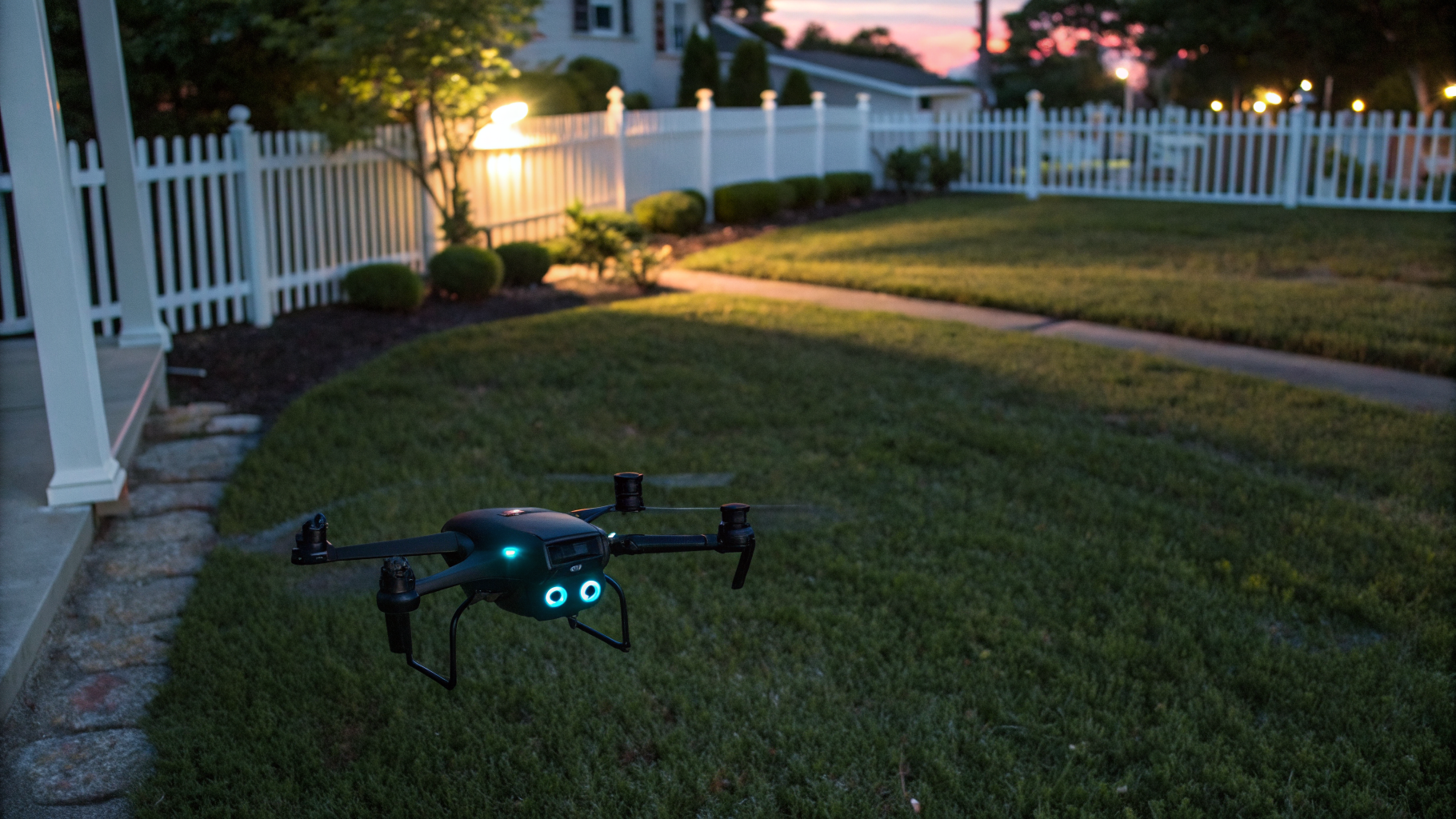
The Ring drone is here, and it’s exactly what you feared
I’ve been covering consumer tech long enough to remember when a Ring doorbell felt like a radical idea. A camera on your porch? Connected to your phone? Wild. Now Amazon wants that camera to detach itself from the wall, sprout rotors, and follow your kids around the backyard. Progress, I guess.
Ars Technica reported this week that Amazon is finally pulling the wraps off its Ring Robotics line — a roaming security drone and a ground-based robot, both slated to ship in late 2026 and early 2027. The pitch is simple: your fixed cameras have blind spots, so why not let a flying one chase the action? On paper, it’s the logical next step for a company that has spent a decade turning suburban paranoia into a subscription business. In practice, it’s a privacy nightmare wrapped in a propeller guard, and I’m genuinely surprised it took this long to arrive.
Let me be clear: I’m not against home security. I’ve tested enough cameras to know that a well-placed floodlight cam can deter a would-be burglar. But there’s a difference between a device that watches a fixed patch of driveway and one that can autonomously decide to follow a person across your property. Amazon is calling this « ambient intelligence. » I call it a flying Ring camera with a mind of its own — and nobody outside Amazon’s PR department seems entirely comfortable with that.
What Amazon actually announced, minus the marketing gloss
The details are still thin, which is typical for a product that won’t hit shelves for another year or two. What we know: the drone is designed to launch from a base station, patrol pre-set waypoints, and respond to motion events flagged by your existing Ring cameras. The ground robot does something similar but stays on the lawn. Both use AI to identify people, pets, and vehicles, and both will presumably tie into Ring’s existing subscription tiers, because of course they will.
Amazon’s framing is all about « proactive security. » Instead of waiting for a camera to catch something, the drone goes looking for it. That’s a meaningful shift in how these systems work. A fixed camera is passive; a roaming drone is an active agent making decisions about where to point its lens. The company insists users will have full control over patrol routes and that the drone won’t wander off-property. But I’ve heard enough « trust us » promises from tech giants to know that the gap between the demo and the driveway is where the ugly stuff lives.
What struck me most is the timing. Amazon has been under pressure on multiple fronts — regulatory scrutiny, privacy lawsuits, the slow-motion collapse of its Alexa ambitions. A flashy drone announcement is a classic pivot: look over here, at the shiny thing, not at the subpoenas. I’m not saying the Ring drone is a distraction. I’m saying the company has a vested interest in making sure you see it that way.
The privacy question nobody at Amazon wants to answer
Here’s the thing about a security drone: it’s not just watching your house. It’s watching your neighbors’ houses, the sidewalk, the street, the park at the end of the block. A fixed camera has a natural boundary — the edge of your property. A drone’s boundary is wherever the software says it is, and software is written by people who have never met you.
Amazon will tell you the drone stays within geofenced limits. It will tell you footage is encrypted and stored securely. It will tell you that you, the user, are in control. And all of that might even be true. But the history of Ring is a history of feature creep. The company started with doorbells, added floodlights, added car cams, added a neighborhood watch app that turned into a de facto surveillance network. Each step was sold as a convenience. Each step expanded the perimeter of what « your » camera could see. A drone is the logical endpoint of that trajectory: a camera that can go anywhere.
What happens when the drone misidentifies a delivery driver as an intruder and follows them down the street? What happens when it captures a neighbor’s kid playing in their own yard and that footage gets stored on Amazon’s servers? What happens when a police department requests access to that footage under the same partnerships Ring has already built? These aren’t hypotheticals. They’re the predictable consequences of putting an autonomous camera in the air and calling it security.
I think the most telling detail is that Amazon hasn’t announced pricing. That’s not an oversight. It’s a signal that the company is still figuring out how to monetize the fear it’s about to sell you. A drone that patrols your yard is a drone that needs a subscription. A drone that uses AI to identify threats is a drone that needs an AI tier. The hardware is the hook; the recurring revenue is the point.
Does anyone actually need this?
Let’s step back for a second and ask the obvious question: who is this for? The average Ring customer lives in a suburban house with a driveway, a front door, and maybe a side gate. They want to know when a package arrives or when someone suspicious walks up. A fixed camera does that job fine. A drone adds coverage, sure, but it also adds complexity, cost, and a whole new category of things that can go wrong.
The people who genuinely need roaming security are not homeowners. They’re warehouses, construction sites, large commercial properties — places where a fixed camera grid leaves real gaps. Amazon knows this, which is why the initial rollout will probably target business customers first. But the consumer marketing will follow, because that’s where the volume is. And that’s where the privacy erosion happens fastest.
I’ve seen this movie before. The metaverse was going to change how we work. Web3 was going to decentralize everything. AI was going to solve climate change. Each time, the hype outpaced the reality, and the companies pushing hardest were the ones with the most to gain from your attention. The Ring drone is not a revolution. It’s a camera on a stick, with a propeller and a subscription fee. The only thing genuinely new is that it can chase you.
Maybe that’s fine. Maybe I’m being paranoid. But I’ve covered this industry long enough to know that when a company tells you a flying camera is for your safety, you should ask who else it’s watching. The answer is usually someone who didn’t consent.
The bottom line, for now
Amazon’s Ring drone is real, it’s coming, and it will probably sell. Not because it’s necessary, but because it’s novel, and because fear is a reliable market. The company has a year or two to get the privacy story right before these things start buzzing over suburban fences. I hope they do. I doubt they will.
In the meantime, if you’re in the market for a security camera, buy a fixed one. Mount it where it belongs. Point it at your door. And maybe — just maybe — accept that you don’t need a drone to feel safe. You need a lock, a light, and a neighbor who waves back. Everything else is just Amazon’s next subscription tier.
Original source: read the full article