Palmer Luckey’s Latest Toy Is No Joke
Remember when Palmer Luckey was just the guy who sold Facebook a VR company and then got fired for funding a pro-Trump meme group? That feels like a lifetime ago. These days he’s running Anduril, a defense startup that’s essentially turning the Pentagon’s wildest sci-fi fantasies into procurement contracts. And his latest reveal? A pair of augmented reality glasses called EagleEye that can do wide field-of-view night vision.
The company dropped a new video this week showing off the tech. I watched it. Then I watched it again. And honestly? I’m not sure whether to be impressed or unsettled. Probably both.
Let me back up. EagleEye was first teased late last year as a kind of heads-up display for soldiers — think Call of Duty HUD meets military-grade data fusion. But the new footage focuses specifically on night vision capability with a field of view that Anduril claims is significantly wider than current-gen systems. And by “current-gen” I mean the stuff soldiers are actually carrying right now, not the concept art from a trade show.
What Wide FOV Actually Means in the Dark
If you’ve ever used military night vision goggles — and I haven’t, but I’ve talked to people who have — you know the biggest complaint is tunnel vision. You’re basically looking through two soda straws. Your peripheral awareness goes to zero. Soldiers have died because they couldn’t see the guy flanking them in the dark. It’s not a minor annoyance; it’s a tactical liability.
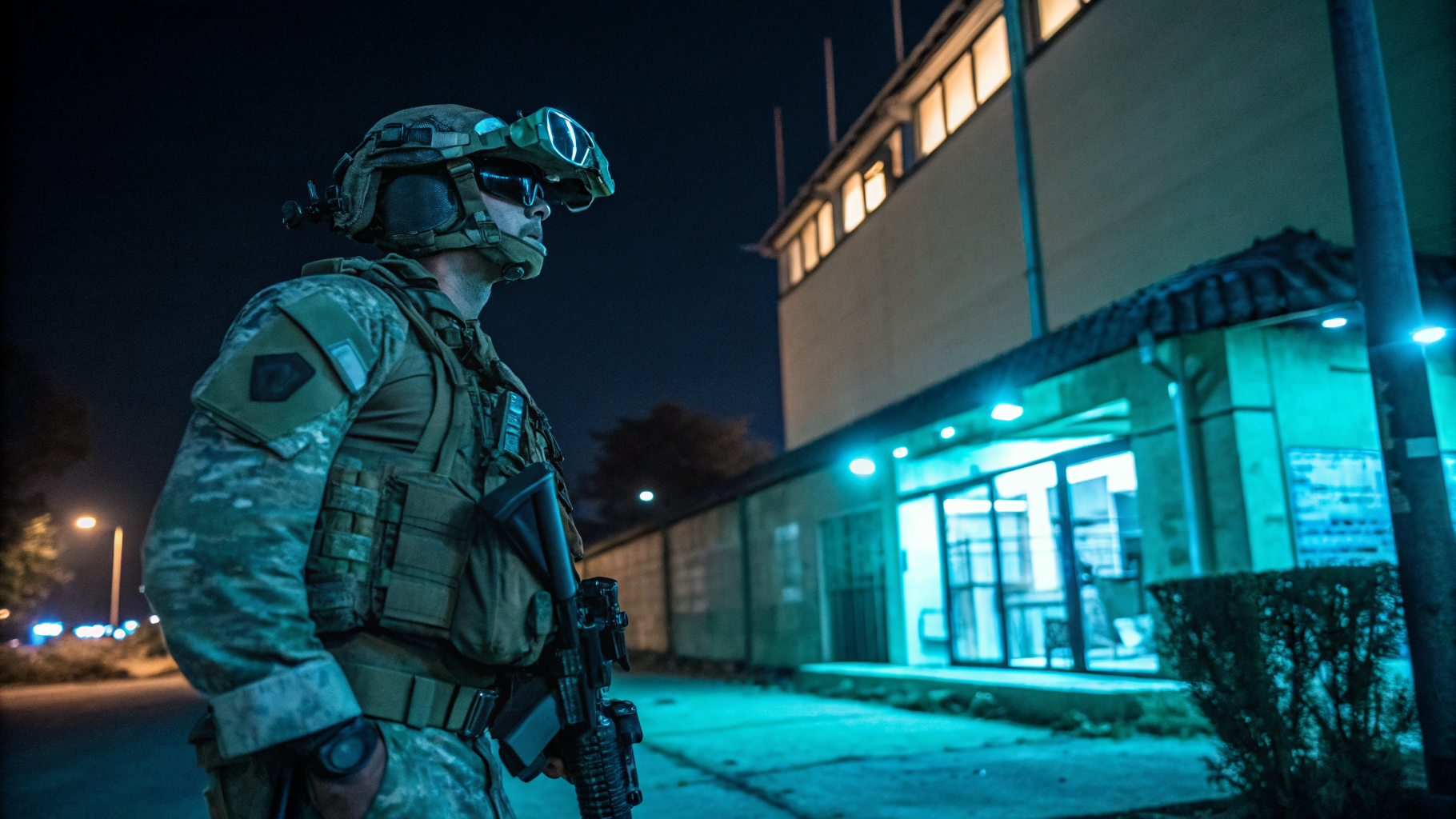
Anduril’s EagleEye appears to solve that by using a curved waveguide display that wraps around the wearer’s line of sight. The video shows a soldier moving through a dark building while the glasses overlay a bright, wide image of the environment. The demo is clearly staged — everything looks a bit too clean — but the underlying tech is real enough.
What struck me here is the sheer resolution of the night vision feed. It’s not grainy green like you’d expect. It’s crisp, almost daylight quality. That’s the result of fusing multiple sensor inputs — thermal, low-light optical, and LIDAR — into a single seamless image. The glasses aren’t just amplifying photons; they’re reconstructing reality in real time.
And that’s the part that gives me pause.
The Creep Factor Nobody’s Talking About
Look, I get it. This is a tool for soldiers. If I were patrolling a hostile village at 2 AM, I’d want every technological advantage I could get. But EagleEye isn’t just night vision goggles. It’s a full augmented reality platform that can identify targets, display biometric data, and presumably link back to a central command that sees everything the soldier sees.
In my view, that’s a double-edged sword. On one hand, you reduce friendly fire incidents and give individual soldiers godlike situational awareness. On the other hand, you’re building a system where every twitch and glance is monitored, recorded, and potentially used against the wearer — not by the enemy, but by their own chain of command.
I’m not saying Anduril is building a surveillance dystopia for the battlefield. But I am saying that when a company run by Palmer Luckey — a guy who once said he wanted to build a “real-life Oculus Rift for the military” — shows off a device that can see in the dark, identify targets, and stream data to the cloud, maybe we should ask some uncomfortable questions.
Like: what happens to all that data? Who owns it? And what happens when the war is over and the tech trickles down to police departments?
How EagleEye Stacks Up Against the Competition
Anduril isn’t the only player in this space. Microsoft’s IVAS program — the military version of HoloLens — has been in development for years and has faced a litany of problems: motion sickness, narrow FOV, reliability issues. The Army spent billions and still hasn’t gotten a system that soldiers actually want to use.
Then there’s L3Harris, Elbit, and a dozen other defense contractors with their own night vision and AR programs. But none of them have the Silicon Valley swagger that Anduril brings. That matters more than you’d think. The Pentagon is desperate for innovation that doesn’t take a decade to field. Anduril moves fast, breaks things, and then sells the broken thing as a feature.
But speed isn’t everything. IVAS has a wider ecosystem — it runs Windows-based software, integrates with existing military networks, and has Microsoft’s cloud backend. EagleEye, by contrast, is Anduril’s own proprietary stack. It’s Lattice, their AI platform, running the show. That gives them tight integration but also creates vendor lock-in. If you buy EagleEye, you’re buying the whole Anduril package.
Here’s a quick comparison of what we know so far:
- Field of view: EagleEye claims “wide” — likely 70-80 degrees diagonal. IVAS is around 60 degrees. Standard PVS-14 night vision is about 40 degrees.
- Weight: Anduril hasn’t published exact numbers, but the demo unit looks bulkier than IVAS. Trade-off for the wider FOV.
- Battery life: Unknown. But running night vision, AR overlays, and wireless streaming simultaneously is going to chew through power. Expect hot-swappable battery packs.
- AI integration: EagleEye uses Lattice for object recognition and threat assessment. IVAS uses Microsoft’s Azure. Both are capable, but Lattice is purpose-built for military use.
So far, Anduril is winning the hype war. Whether they win the actual procurement race is another question.
The Palmer Luckey Factor
I can’t write about EagleEye without talking about the guy behind it. Palmer Luckey is a fascinating figure — a genuine visionary who also has a talent for courting controversy. He’s the kind of person who shows up to meetings in flip-flops and Hawaiian shirts, then casually drops that his company is building autonomous drones and submarine-hunting AI.
Anduril’s culture is a weird mix of startup energy and military-industrial complex pragmatism. They hire engineers from gaming and VR, not just defense contractors. They prototype in weeks, not months. And they’re not afraid to make things that look terrifying. The EagleEye video is a prime example: the soldier looks like a cyborg from a dystopian action movie. That’s intentional. Luckey knows the aesthetic sells.
But there’s a serious side. Anduril has been vocal about wanting to reduce civilian casualties through better targeting. The argument goes that if soldiers have perfect situational awareness, they’re less likely to shoot the wrong person. I want to believe that. I really do. But history suggests that better tech doesn’t always lead to more ethical warfare. Sometimes it just makes killing more efficient.
I’m not saying EagleEye is bad. I’m saying we should be honest about what it is: a tool designed to give one side an overwhelming advantage in combat. There’s no moral framing that changes that reality.
Will Soldiers Actually Want to Wear This?
This is the question that keeps me up at night — figuratively, not literally, I sleep fine. But seriously, the history of military AR is littered with expensive failures. The Army’s Land Warrior program in the 1990s was a disaster. IVAS is still struggling with usability. Soldiers are notoriously conservative about gear. If it’s heavy, fragile, or drains batteries too fast, they’ll leave it in the truck.
Anduril seems to understand this. The EagleEye demo emphasizes ruggedness and ease of use. The glasses are mounted on a standard helmet bracket. The controls are minimal — mostly voice and eye tracking. They’ve clearly learned from IVAS’s mistakes.
But there’s a deeper problem. AR glasses, no matter how good, add cognitive load. A soldier already has to watch for IEDs, communicate with their squad, interpret radio chatter, and not get shot. Adding a heads-up display with dozens of data streams could be information overload. The best AR systems are the ones that get out of the way. Whether EagleEye achieves that remains to be seen.
Anduril says they’ve done extensive user testing with active-duty soldiers. I’d like to see those test results. Until then, I’m cautiously optimistic but not sold.
The Bigger Picture: AR Is Going to War
EagleEye is just one data point in a larger trend. Augmented reality is moving from consumer entertainment into the battlefield. The same technology that powers Pokémon Go and Meta’s Quest Pro is being repurposed for missile tracking and drone coordination. That’s not inherently bad, but it changes the conversation around AR.
For years, the VR/AR industry has tried to sell us on the promise of virtual meetings and digital art galleries. The military application was always the elephant in the room — everyone knew it was coming, but nobody wanted to talk about it at industry conferences. Now it’s here, and it’s real.
What does that mean for the rest of us? Well, military R&D has a long history of trickling down to civilian life. GPS, the internet, even the computer mouse — all started as military projects. The night vision and sensor fusion tech in EagleEye will eventually find its way into firefighting helmets, search-and-rescue gear, and maybe even consumer AR glasses. The question is how long that takes and how much it costs.
But there’s also a darker path. The same surveillance capabilities that make EagleEye useful for soldiers could be used by authoritarian regimes to track dissidents. The same AI that identifies enemy combatants could be used to profile civilians. Anduril can’t control how their technology is used once it leaves their hands. That’s true for any defense contractor, but it’s worth saying out loud.
Final Thoughts: Impressed, but Not Comfortable
I’ll give Anduril this: they make impressive hardware. The EagleEye wide FOV night vision is genuinely next-level. If I were a soldier, I’d probably want a pair. But as a journalist who’s watched this industry for over a decade, I can’t help feeling a knot in my stomach.
We’re building systems that give humans superhuman perception, and we’re putting them in the hands of people trained to kill. That’s a profound responsibility, and I’m not sure the tech industry has thought through the consequences. Palmer Luckey seems to believe that better tech leads to better outcomes. I hope he’s right. But I’ve seen too many well-intentioned technologies turned into instruments of harm to take that on faith.
For now, EagleEye is a remarkable piece of engineering. Whether it makes the world safer or just more efficiently dangerous is a question that won’t be answered in a press release.
Further Reading
Read the original coverage at Road to VR.
Original source: read the full article