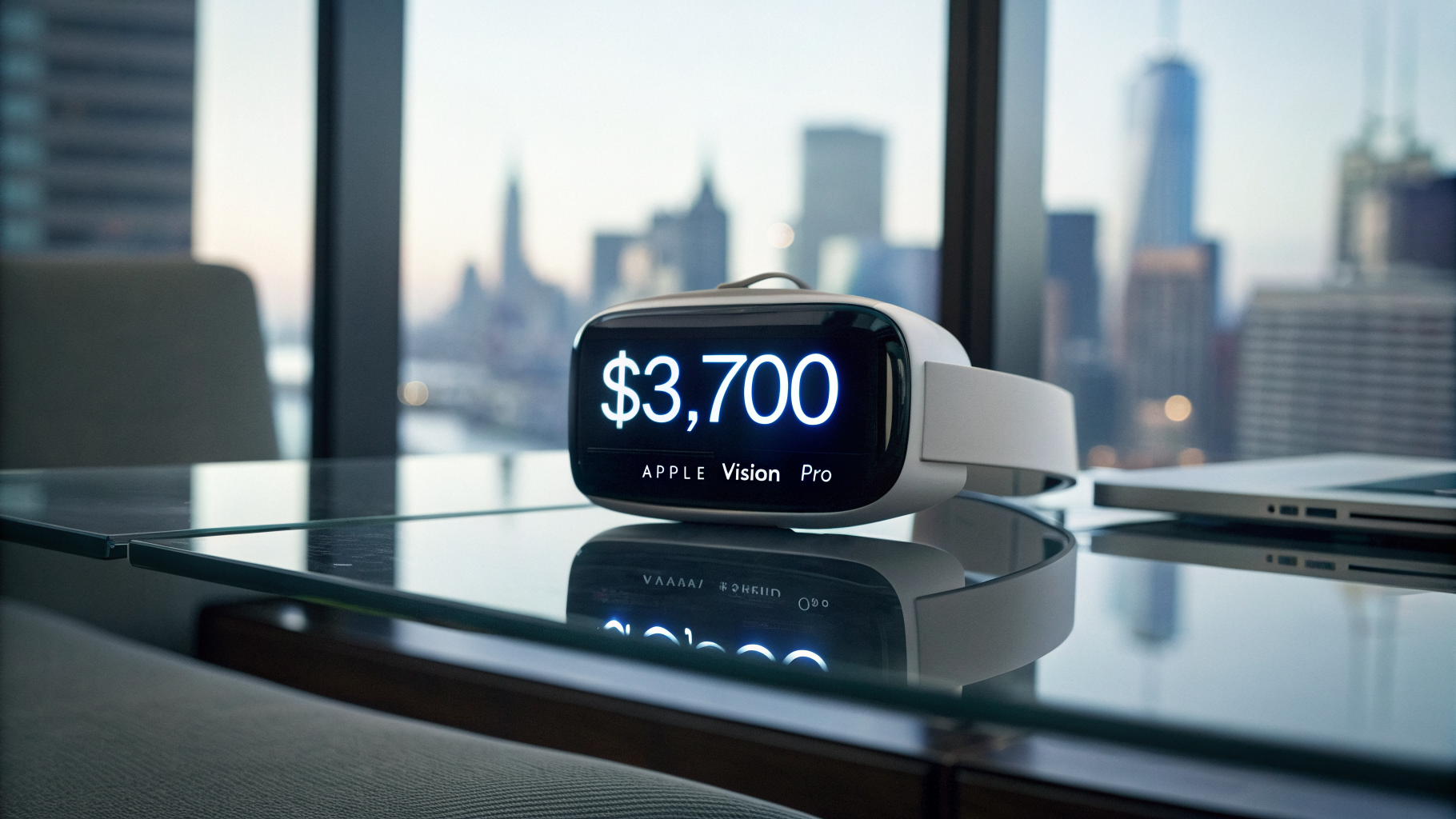
Well, it finally happened. Apple raised prices across nearly its entire product line, and the Vision Pro—already a hard sell at $3,499—now starts at a cool $3,700. That’s a $201 bump for a device that hasn’t even found its footing in a market still skeptical of mixed reality. Tim Cook, in his typically measured tone, blamed the “global memory crisis,” calling it unlike anything he’s ever seen. And I believe him—mostly. But there’s more to this story than supply chains and DRAM shortages.
Let’s start with the elephant in the room, or rather, the $3,700 headset on your face. The Vision Pro was never going to be a mass-market hit at its original price. At this new price, it feels less like a product and more like a statement. A statement that Apple is willing to bet its reputation on a niche device while the rest of the world is still trying to figure out if they even want a VR headset from Meta that costs a tenth as much. I’ve been covering this space for over a decade, and I can tell you: price hikes in VR are almost always a gamble. Sometimes they pay off (think high-end PC VR from a few years back). Often, they don’t.
The Memory Crisis Excuse: Real or Convenient?
Cook’s argument is straightforward: memory chips—DRAM, NAND, the stuff that makes your devices fast—are in short supply. He’s not wrong. The memory market has been volatile for the past couple of years, with COVID-era demand spikes, geopolitical tensions, and factory outages creating a perfect storm. But here’s the thing: memory prices have actually been trending downward in recent quarters. Samsung and SK Hynix have been slashing prices to clear inventory. So why is Apple raising prices now?
I think there’s a layer of opportunistic pricing at play. Apple knows its loyal customer base will grumble but ultimately pay up. The iPhone 15 Pro Max got a $100 bump. The iPad Pro is now $100 more. Even the MacBook Air, the darling of the laptop world, saw a $50 increase. The Vision Pro, though, feels like the canary in the coal mine. If the global memory crisis were truly as dire as Cook claims, wouldn’t we see similar increases across Android phones and Windows PCs? Sure, some have risen, but not across the board. Not like this.
What struck me here is the timing. Apple’s earnings call last week was surprisingly upbeat, with services revenue hitting records. So why the price hike now? Perhaps it’s a preemptive move to shore up margins before a potential recession. Or maybe it’s to justify the Vision Pro’s existence to shareholders who are starting to ask hard questions. “Why is our $3,500 headset not selling?” The answer: “Because memory is expensive.” It’s a convenient shield.
Vision Pro: The Loneliest Headset in the Room
Let’s talk about the Vision Pro itself. I’ve spent time with it—not as much as I’d like, given the price tag even for a journalist—but enough to know it’s a marvel of engineering. The displays are the best I’ve ever seen in a consumer headset. The eye-tracking is borderline magical. The passthrough is good enough to make you forget you’re wearing a giant ski mask. But the software ecosystem is thin. The killer app is still missing. And the price was already a barrier before this hike.
At $3,700, the Vision Pro now costs more than a high-end MacBook Pro plus an iPad Pro combined. For that money, you could buy a full Meta Quest 3 setup, a gaming PC, and still have cash left over for a decent dinner. I’m not saying price is everything—Apple has always been a premium brand—but at some point, the value proposition breaks. And I think we’re past that point.
In my view, Apple is making a bet that early adopters in tech, Hollywood, and architecture will pay whatever it takes to be on the bleeding edge. And they’re probably right. Those buyers exist. But the broader VR and mixed reality market—the one that includes developers, educators, and enterprises—needs a price that makes sense for deployment. A $3,700 headset per employee is a tough sell when you can buy three Quest 3s for the same price. The Vision Pro feels like a luxury good, not a tool. And that’s a problem if Apple wants it to be the future of computing.
How Did We Get Here? A Brief History of VR Pricing Follies
I’ve been writing about this stuff since the Oculus Rift DK1 days. Back then, the dream was that VR would become as cheap as a smartphone. Instead, we got the HTC Vive at $799, the Valve Index at $999, and then Apple just casually drops a $3,500 headset. The price trajectory has been inverted: instead of getting cheaper, high-end VR has gotten more expensive. Why? Because companies are chasing fidelity over accessibility. They want to impress reviewers and win awards, not sell millions of units.
The memory crisis is just the latest excuse. But let’s be honest: if Tim Cook wanted to keep the Vision Pro at $3,499, he could have. Apple has the margins to absorb a $200 cost increase on a product that’s already priced for the stratosphere. The fact that they didn’t tells me they’re testing the upper limits of what the market will bear. And honestly, after a decade of watching this industry, I’m tired of the “it’s too expensive to make” narrative. If you can’t make a product at a price people will buy, maybe you need to rethink the product.
What This Means for the Metaverse (Yes, That Word Again)
I know, I know—everyone hates the word “metaverse” now. But bear with me. The Vision Pro was supposed to be Apple’s entry into spatial computing, the device that would finally make the metaverse a reality for the masses. Instead, it’s become a symbol of how out of touch the tech industry can be. At $3,700, the Vision Pro isn’t a gateway to the metaverse; it’s a velvet rope. It says, “You can’t come in unless you’re rich or funded by VC money.”
And that’s a shame, because the technology is genuinely impressive. The hand tracking, the spatial audio, the ability to place virtual objects in your real room—it’s all there. But none of it matters if no one can afford it. The metaverse, if it’s ever going to happen, needs to be built on accessible hardware. Not on a $3,700 headset that requires a separate $1,000 Mac to run some apps.
I’ll give you a rhetorical question to chew on: What happens if Apple’s price hike actually works? If the Vision Pro sells out at $3,700, what message does that send to the rest of the industry? It tells Meta, Sony, and HTC that they can charge more. It tells developers that they should build for the high-end only. And it tells consumers that VR is a luxury, not a utility. That’s a dangerous path for an industry that’s still trying to escape the shadow of “gimmick.”
The Bigger Picture: Apple’s Pricing Strategy Is a Warning
This isn’t just about the Vision Pro. The iPhone, iPad, MacBook Air, and even the Apple Watch all got price bumps. That’s a coordinated move. Apple is signaling that it expects inflation, component shortages, and possibly a weaker economy to persist. But they’re also signaling something else: they believe their brand is strong enough to absorb the backlash. And they might be right. Apple’s customer loyalty is legendary. But even loyal customers have limits.
I’ve talked to a few developers who were planning to buy Vision Pros for their studios. One told me, “I was already on the fence. This pushed me over to the Quest side.” Another said, “I’ll wait for the cheaper version, if it ever comes.” That’s the real risk here: Apple might be alienating the very people who could build the ecosystem. Developers need affordable hardware to experiment, iterate, and create. At $3,700, the barrier to entry is too high for indie studios and solo creators.
And let’s not forget the enterprise angle. Companies like Spatial and Frame are building collaborative metaverse tools that work on multiple headsets. A $3,700 Vision Pro per employee is a non-starter for most businesses. They’ll stick with the Quest Pro or the HTC Vive XR Elite, which are cheaper and, in some cases, more flexible. Apple might win the high-end consumer market, but they’re losing the developer and enterprise battle.
My Take: The Vision Pro Needs a Price Cut, Not a Hike
I’m going to say something that might get me banned from Apple events: the Vision Pro should have been $2,999 from day one. At that price, it would still be expensive, but it would feel like a serious tool, not a vanity project. A $200 hike is the wrong direction. If anything, Apple should be working to bring the price down through better manufacturing, cheaper components, and maybe a lower-spec version. But instead, they’re doubling down on premium.
Maybe that works for them. Apple has always been the luxury player in tech, and they have the cash to wait out the market. But VR and mixed reality are not like smartphones. The smartphone market was already mature when Apple entered it. The VR market is still embryonic. It needs volume, not exclusivity. It needs developers, not just early adopters. And it needs a price that doesn’t make you choke on your coffee.
I’m not saying the Vision Pro is a failure. Far from it. It’s a technical achievement that will influence every headset that comes after it. But the pricing strategy feels like a miscalculation. Tim Cook can blame the memory crisis all he wants. The real crisis is one of vision—a failure to see that the future of spatial computing needs to be accessible, not aspirational.
So here we are. The Vision Pro is now $3,700, and the metaverse is still a dream. Maybe that dream will come true when the price drops to $1,500 in a few years. Or maybe Apple will pivot to a cheaper model. Or maybe—and this is the scariest thought—the industry will learn the wrong lesson and keep chasing high prices, leaving VR in a gilded cage. I’ve been wrong before. I hope I’m wrong about this.
Further Reading
Original source: Apple Raises Price Of Many Products, Including Vision Pro – UploadVR
Original source: read the full article