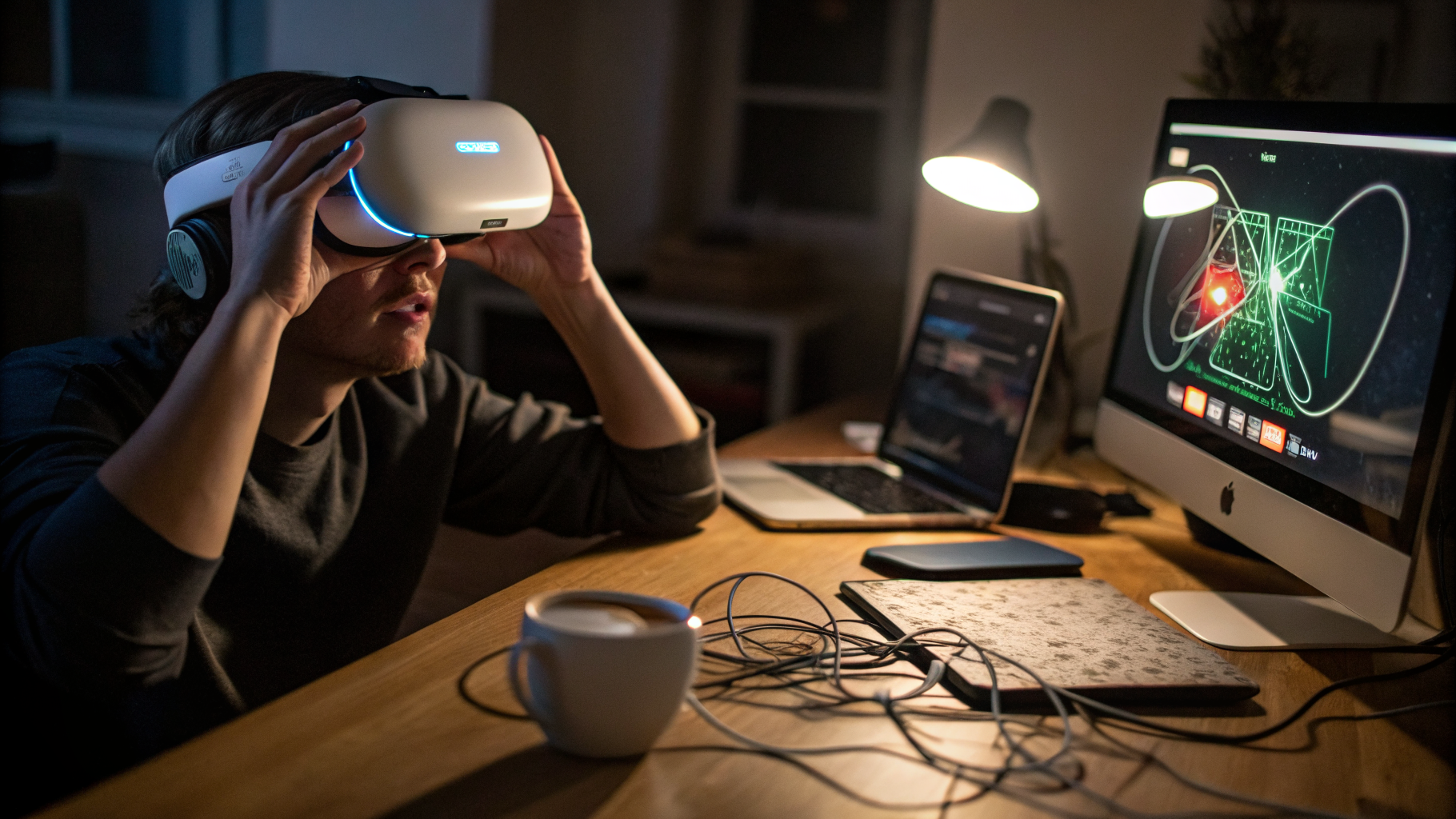
So You Want to Build for the Vision Pro?
I’ve been covering VR, AR, and whatever nonsense the metaverse hype machine vomits up for over a decade. I’ve seen developers weep over Unity crashes, rage-quit after Oculus SDK updates, and quietly mourn projects killed by Google’s graveyard. But nothing — and I mean nothing — prepared me for the stories coming out of the Apple Vision Pro launch window.
Let’s talk about CONNECTOME: A Game of Points. It’s a spatial puzzle game that landed on visionOS a few weeks ago. On paper, it sounds like a perfect fit: minimalist aesthetic, intuitive point-and-connect mechanics, the kind of ambient experience Apple likes to show in keynote demos. But the developer’s account of actually shipping this thing reads less like a triumphant launch story and more like a survival log from the trenches.
I sat down with the team (virtually, because nobody flies anywhere anymore) and what I heard made me wince. Not because the game is bad — it’s actually quite good — but because the process of getting it onto Apple’s shiny new headset reveals just how much friction remains under that polished glass surface.
The Vision Pro Paradox: Beautiful Hardware, Brutal Software
Here’s the thing about Apple’s spatial computing debut. The hardware is undeniably impressive. The micro-OLED displays, the M2+R1 chip combo, the eye-tracking that actually works — it’s a technical marvel. I’ve tried it. It feels like wearing a luxury car on your face. But luxury cars also come with absurd maintenance costs and a manual thicker than a phone book.
CONNECTOME’s developer walked me through their journey. It started with excitement. Apple’s SDKs looked clean. The simulator ran smoothly. Early prototypes felt magical. Then came the real device.
“The simulator lied to us,” they told me, half-laughing, half-sighing. “Not maliciously, but consistently. Things that worked perfectly in the sim would break in unexpected ways on the actual headset. Performance profiles didn’t match. Memory limits were tighter than we expected. We had to rewrite large chunks of our rendering pipeline.”
This isn’t unique to Apple. Every new platform has a gap between simulation and reality. But the Vision Pro’s gap felt wider because Apple’s ecosystem is usually so polished. Developers coming from iOS or macOS expect a certain level of refinement. Spatial computing is not there yet.
The Eye-Tracking Tax
One of the Vision Pro’s headline features is eye-tracking-based input. You look at something, you pinch your fingers, it clicks. Sounds simple. In practice, it’s a nightmare to calibrate for every user.
CONNECTOME relies on precise point selection. Players need to connect nodes in 3D space. If the eye-tracking is even slightly off — say, a user has astigmatism, or wears glasses, or just has weirdly shaped eyeballs (we all do, by the way) — the game becomes unplayable.
The developer spent weeks tuning sensitivity curves. They added a calibration sequence that takes longer than Apple’s built-in one. They tested with dozens of people, including some with visual impairments. “We basically had to build a second game just to make the eye-tracking work for everyone,” they said.
And here’s the kicker: Apple’s own input guidelines keep changing. The developer showed me a thread in their internal Slack where one engineer shouted, “Which pinch gesture are we supposed to use this week?” That’s not a joke. Apple has updated its human interface guidelines for visionOS multiple times since launch, sometimes reverting to earlier versions. Developers are chasing a moving target.
The Price of Exclusivity (and the Absence of a Store)
Let’s talk money. The Vision Pro costs $3,499. That means the install base is tiny — maybe a few hundred thousand units worldwide, optimistically. For a small indie studio, developing for that audience is a bet. A risky one.
CONNECTOME’s developer didn’t go into specifics, but they hinted that the game’s revenue so far hasn’t covered development costs. “We did it because we believe in spatial computing,” they said. “But belief doesn’t pay rent.”
Apple doesn’t have a dedicated VR/AR storefront like Meta does. Apps live on the regular App Store, buried under millions of iPhone apps. Discovery is abysmal. There’s no “spatial computing” category. No curated section for immersive experiences. Users have to search specifically for “Vision Pro apps” and even then, the results are messy.
The developer showed me their analytics. Most users found CONNECTOME through word of mouth or social media, not through Apple’s store. “Apple’s discovery is worse than the Oculus Go store was in 2018,” they said. “And that’s saying something.”
I think that’s a damning indictment. Apple built this incredible piece of hardware, but they forgot to build the distribution infrastructure. Developers are left to fend for themselves. And if you’re not a big studio with a marketing budget, good luck.
The Comfort Conundrum
Another issue that doesn’t get enough attention: comfort. Not the headset’s weight — we all know it’s heavy — but the comfort of using it for extended periods.
CONNECTOME is a puzzle game. Players might want to play for an hour or more. But the Vision Pro’s battery life is around two hours, and the headset gets warm. The developer noticed that after about 30 minutes, some users started getting eye strain. Not from the game itself, but from the combination of high brightness, close-to-eye displays, and the cognitive load of spatial navigation.
They added a “comfort mode” that reduces visual complexity and increases font sizes. They also added reminder prompts to take breaks every 20 minutes. “We’re basically building a game that tells you to stop playing it,” they joked. “Not great for engagement metrics.”
But it’s the right call. The worst thing that can happen to spatial computing is a wave of users reporting headaches or nausea. Apple’s polished demos don’t show the reality: this is still first-gen hardware with first-gen problems.
The Developer’s Wishlist: What Apple Needs to Fix
I asked the CONNECTOME team what they’d change about the Vision Pro development experience if they had a magic wand. Their list was blunt:
- Better simulator fidelity. The simulator shouldn’t let you think your app runs at 90fps when the real device struggles to hit 60.
- Stable input APIs. Stop changing gesture recognizers every few months. Pick one and stick with it.
- A real spatial computing store section. Give us a category. Let users browse immersive apps. Make discovery possible without a marketing degree.
- Longer battery life. Or at least allow hot-swappable batteries without rebooting the app.
- More forgiving eye-tracking calibration. Not everyone has perfect vision. Build for the 99th percentile, not the 50th.
I’d add one more: lower the price. $3,499 is a development barrier. Fewer users mean fewer developers. Fewer developers mean fewer apps. Fewer apps mean the platform stagnates. It’s a vicious cycle.
The Silver Lining: Why CONNECTOME Matters
Despite all the pain, CONNECTOME is a genuinely good game. I played it for about 45 minutes (with breaks, as instructed). The core loop is satisfying: you connect glowing nodes in 3D space, creating patterns that unlock new levels. The spatial audio is excellent. The haptic feedback via the Digital Crown is subtle but effective.
What struck me here is that the game belongs on the Vision Pro. It’s not a port. It’s not a lazy VR conversion. It was designed from the ground up for eye-tracking and spatial gestures. That’s rare. Most Vision Pro apps are either flat iPad apps stretched into 3D or rushed experiments that feel like tech demos. CONNECTOME feels like a real product.
The developer’s struggle is not a sign that the Vision Pro is doomed. It’s a sign that the platform is immature. Every successful computing platform went through this. The iPhone had no App Store at launch. The iPad had no native apps for months. The Oculus Rift shipped with a handful of demos and a lot of motion sickness.
The difference is that Apple usually skips the awkward teenage phase. They launch polished products that just work. The Vision Pro is the first Apple product in decades that launched with rough edges. And developers are paying for those edges with their time and money.
What I Think This Means for the Future
I’ve been writing about this space long enough to know that hype cycles are dangerous. The Vision Pro is not going to replace your iPhone. It’s not going to sell 100 million units in year one. It’s an expensive niche device for early adopters, developers, and enterprise clients.
But it’s also the best spatial computing device I’ve ever used. The potential is real. The technology is almost there. What’s missing is the ecosystem maturity that Apple usually delivers on day one.
CONNECTOME’s developer told me they’re already working on their next project for visionOS. “We’re not giving up,” they said. “But we’re also not going to pretend it’s easy.”
That’s the honest truth. Building for the Apple Vision Pro right now is hard, expensive, and sometimes frustrating. But for developers who can stomach the pain, there’s an opportunity to define a new medium. CONNECTOME is proof that beautiful experiences are possible. The question is whether Apple will fix the platform fast enough to keep those developers from burning out.
I’ll be watching. And yes, I’ll be taking breaks every 20 minutes.
Original source: read the full article