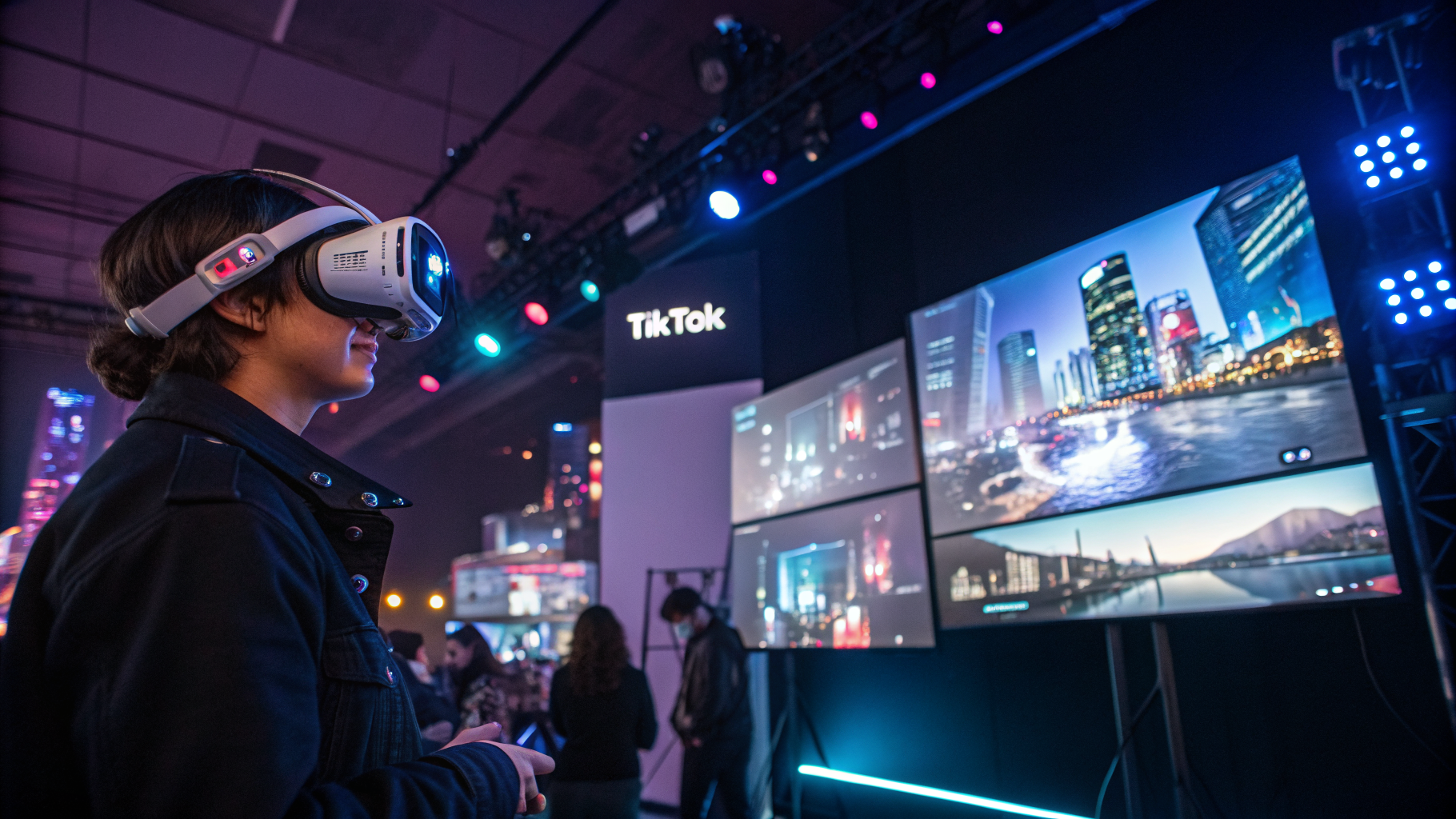
Let’s cut through the noise: TikTok’s parent company, ByteDance, is reportedly building an AI model that could generate real-time spatial video — the same trick Google showed off with its Genie model earlier this year. Bloomberg broke the news, and if it’s half true, we’re looking at a serious arms race in the immersive-content space.
I’ve been covering this beat for over a decade, and I’ve learned to take “sources familiar with the matter” with a grain of salt. But ByteDance has the cash, the talent, and the sheer will to make this happen. The company is already using AI to recommend videos to a billion-plus users, so why not let them generate their own 3D worlds?
What Exactly Is ByteDance Building?
According to the report, ByteDance is readying an AI model dedicated to creating real-time spatial videos. Think of it as a text-to-3D-VR tool. You type a prompt, and the model spits out a moving, three-dimensional scene that you can explore from any angle — in real time. That’s not a static image or a pre-rendered clip; it’s a live, interactive environment.
Google’s Genie, which debuted in February 2024, does something similar. It turns a single image into a playable 2D platformer world. ByteDance’s model would go further, adding spatial depth and true interactivity. The goal, per Bloomberg, is to create a “flywheel” that feeds ByteDance’s entire ecosystem — from TikTok to its VR headset efforts, and even its music and gaming divisions.
Now, here’s where it gets interesting. ByteDance isn’t just copying Google. The company has been quietly investing in AI research for years, and it owns the Pico VR headset line, which is basically the only serious rival to Meta’s Quest outside China. If this model works, it could turn Pico into a must-have device for anyone who wants to create, not just consume, VR content.
Why Real-Time Spatial Video Matters More Than You Think
Let’s be honest: most AI-generated video today is a gimmick. You see a prompt like “a cat astronaut on Mars” and you get a 10-second clip that looks cool but has zero depth. You can’t move the camera. You can’t step inside. It’s a flat, dead medium.
Spatial video changes that. It’s the difference between watching a nature documentary and actually walking through the jungle. And if ByteDance can generate that on the fly — without a massive render farm — it unlocks something we’ve only dreamed about in the metaverse era: infinite, personalized worlds.
I remember testing early VR demos where you’d walk around a static room and think, “This is neat, but where’s the life?” Real-time spatial video could inject that life. You could ask for a “neon-lit cyberpunk alley at midnight, raining, with a street vendor selling ramen” and within seconds, you’re standing in it. That’s not a tech demo; that’s a new creative canvas.
The Flywheel That Could Spin Out of Control
ByteDance’s “flywheel” isn’t just corporate jargon. Think about it: TikTok already knows what makes a video go viral. Combine that with generative AI, and you have a platform where anyone can become a 3D storyteller. The model could suggest scenes based on trending sounds or challenges. It could auto-generate spatial backgrounds for TikTok Live streams. It could even power a new generation of user-generated VR games.
That’s a smart move, but it also scares me a little. Because once you have a flywheel that generates content faster than humans can moderate it, you’re asking for trouble. We’ve seen how deepfakes and misinformation have plagued social media. Now imagine that in VR, where people can create false memories or fake immersive news events. ByteDance better have a plan for that, because regulators are watching.
Google’s Genie Set the Stage, But ByteDance Could Steal the Show
Google’s Genie was impressive — a research breakthrough that showed how AI can turn a single image into a playable environment. But here’s the catch: Genie is still a toy. It works on 2D platformers, not full 3D worlds. And it’s not real-time in the sense of streaming to a headset; it’s more of a batch process.
ByteDance’s alleged model would leapfrog that. Bloomberg’s sources say the goal is real-time generation, which means low latency — under 100 milliseconds, ideally. That’s the kind of performance that separates a “wow” demo from an actual product.
But can they pull it off? I’ve seen ByteDance’s research papers, and they have some serious AI talent. They’ve also got something Google doesn’t: TikTok’s endless supply of video data. That’s a massive training advantage. Google has YouTube, sure, but TikTok’s short-form content is more dynamic and varied. It’s like training an AI on a thousand hours of GoPro footage versus a thousand hours of static vlogs.
So yes, ByteDance could steal the show. But they’re not alone. Meta has been pouring billions into AI for AR glasses and Horizon Worlds. Apple is pushing spatial video on the Vision Pro. Even startups like Luma AI and Spline are doing interesting things with 3D generation. The question isn’t who gets there first — it’s who makes the first tool that people actually want to use every day.
The Hardware Problem Nobody Wants to Talk About
Here’s the uncomfortable truth: even if ByteDance’s model works flawlessly, you still need a headset. And right now, the consumer VR market is a graveyard of good ideas. Meta has sold tens of millions of Quests, but most of them are gathering dust. Pico has a tiny fraction of that. The Vision Pro is a $3,500 luxury item that hasn’t exactly flown off shelves.
Real-time spatial video generation could be the killer app that changes that. Imagine a TikTok where you can swipe left to “enter” a video and look around. That’s a compelling reason to buy a Pico or Quest. But it’s a chicken-and-egg problem: developers won’t build for headsets that no one owns, and consumers won’t buy headsets that have no content.
ByteDance might have a workaround. Instead of requiring a headset, they could start with phones. Spatial video doesn’t have to be viewed in VR — you can watch it on a flatscreen with parallax effects or on a foldable phone. That’s a smarter play. Get people hooked on the content first, then upsell them on the hardware.
I’ve been saying this for years: VR won’t go mainstream until it’s as easy as Instagram. ByteDance gets that. They’re not building a headset-first experience; they’re building an AI-first experience that happens to work on headsets.
What This Means for Creators, and Why I’m Skeptical
If ByteDance pulls this off, creators will have a superpower. You could film a 360-degree video of your kitchen, then use AI to replace the wallpaper with a medieval castle. Or you could type “make my music video a 3D space journey” and get exactly that. The creative possibilities are endless.
But I’m skeptical. Not about the tech — I’ve seen AI progress faster than anyone predicted. My skepticism is about the business model. ByteDance’s AI will be cheap, maybe even free, to lure creators. But cheap AI means a flood of low-quality content. We already see that on TikTok with AI-generated slop. Imagine that in 3D.
And there’s the copyright issue. ByteDance trains its models on everything — including your videos. That’s fine for user-generated content, but what about professional creators who don’t want their work scraped? Lawsuits are inevitable. YouTube creators are already suing OpenAI and Meta. ByteDance won’t be immune.
So here’s my take: the tech is promising, but the execution will be messy. I’d rather see a slower, more thoughtful rollout than a race to the bottom. But let’s be real — ByteDance isn’t known for being thoughtful. They’re known for moving fast and breaking things.
The Future Is Closer Than You Think
I remember writing about the first VR headsets in 2013, and everyone thought we were years away from anything useful. Here we are in 2025, and we’re on the cusp of AI-generated spatial video that works in real time. That’s not a decade away; that’s a product announcement away.
Will ByteDance be the one to announce it? Maybe. But even if they don’t, Google, Meta, or some startup will. The pieces are all in place: generative AI, 3D rendering, and massive video datasets. The only missing ingredient is a company with the guts to ship it.
ByteDance has that guts. They’ve shown they’re willing to take risks, whether it’s TikTok’s algorithm or Pico’s hardware. If this AI model works as described, we could see a new era of immersive content that makes today’s metaverse look like a PowerPoint presentation.
But I’ll believe it when I see it. Not because I doubt the tech, but because I’ve been burned before. Remember Google Glass? Remember Magic Leap? Remember all the “metaverse is here” hype? I’ll wait for a demo that lets me walk through a virtual world that I created with a sentence. Then I’ll get excited.
Until then, I’m keeping my eyes on ByteDance’s research labs. If they pull this off, they’ll have the kind of flywheel that could spin the entire industry in a new direction — and that’s not something I say lightly.
Original source: read the full article