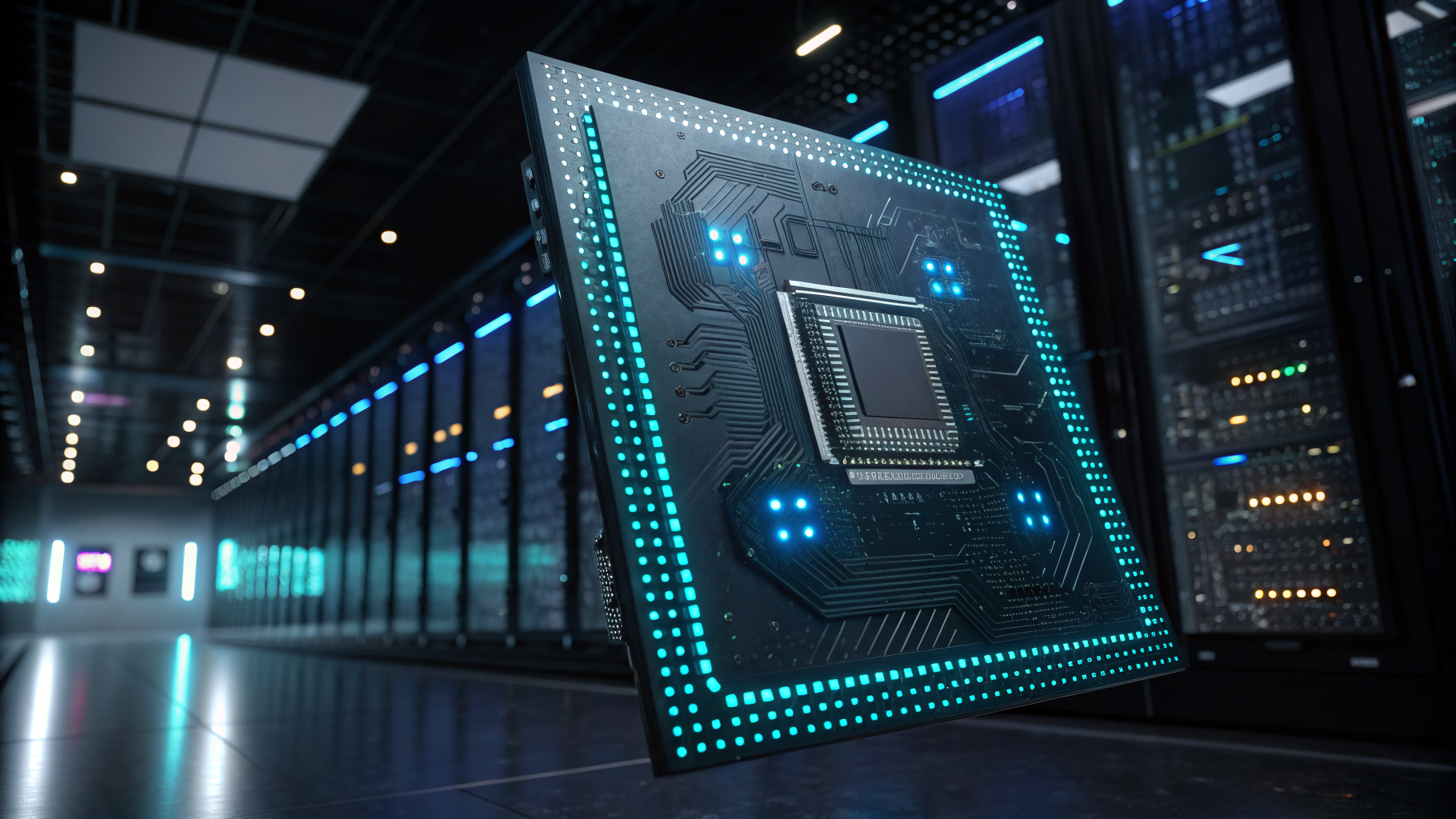
There’s a moment in every technology cycle when one company quietly solves a problem everyone else decided was unsolvable. This week, that company stepped out of the shadows and onto the Nasdaq — and Wall Street absolutely lost its mind. The cerebras giant chip just did what no one thought possible: it made the stock market sit up, blink twice, and realize that maybe, just maybe, the AI hardware race isn’t a one-horse show anymore.
The company is Cerebras Systems. And the problem they solved? Making a computer chip the size of a dinner plate, packed with more transistors than anything ever built before, specifically designed to power the AI models that are reshaping our world. When they went public this week, the opening bell wasn’t just a formality — it was a declaration. The cerebras giant chip just crashed the Nasdaq party, and Nvidia’s investors are suddenly checking their portfolios with a little more anxiety.
Why bigger actually means better here
Here’s the thing about running large AI models: the hardware bottleneck isn’t raw computing power anymore. It’s communication. When you spread a massive language model across hundreds of traditional GPUs, a surprising amount of time is wasted just moving data between chips — through cables, PCIe lanes, memory buses. That latency adds up fast at scale. It’s like trying to run a marathon while passing a baton every hundred meters. Sure, you’re fast, but you’re also constantly stopping to hand things off.
Cerebras had a straightforward but audacious answer: stop cutting the silicon wafer into small chips. Use the entire wafer as one single processor. No inter-chip communication. No bottlenecks. Just one enormous, unified piece of silicon doing everything at once. It sounds almost too simple, but that’s the kind of thinking that disrupts entire industries. They didn’t try to optimize the existing model — they threw it out and started from scratch.
The result is the WSE-3 (Wafer Scale Engine 3) — currently the largest chip ever manufactured for artificial intelligence. The specs are staggering, and I mean that in the most literal sense. They make you stagger back in your chair:
- 4 trillion transistors
- 900,000 AI-optimized cores
- 44 GB of on-chip SRAM cache
- 125 petaflops of FP16 compute
- A surface area of 462 cm² — roughly the size of a large dinner plate
To put that in perspective: Nvidia’s H100, the current industry benchmark, packs 80 billion transistors. The WSE-3 fits fifty times that on a single component. It’s not an incremental improvement. It’s a different category entirely. It’s like comparing a bicycle to a freight train — both get you from point A to point B, but the experience is wildly different.
OpenAI and AWS are already in
Flashy specs only matter if someone actually uses them. And that’s where things get really interesting. Cerebras hasn’t been sitting in a lab twiddling its thumbs. They’ve been quietly building relationships with the biggest names in AI and cloud computing. OpenAI is already running workloads on Cerebras hardware. Amazon Web Services (AWS) has integrated Cerebras systems into their cloud offerings. These aren’t pilot programs or experimental trials — they’re production deployments.
Imagine training a GPT-scale model without the nightmare of distributed computing. No sharding, no partitioning, no debugging communication bottlenecks across thousands of GPUs. Just one giant chip, one unified memory space, and one hell of a lot of compute. That’s what Cerebras is selling, and it’s a dream come true for AI researchers who’ve spent years wrestling with the complexity of multi-GPU setups. The cerebras giant chip just made their lives significantly easier, and that’s the kind of product that sells itself.
What this means for Nvidia
Let’s be real for a second: Nvidia isn’t going anywhere. They’ve got a massive moat with CUDA, their software ecosystem, and years of optimization. But the Cerebras IPO sent a clear signal: the monopoly is cracking. Investors are waking up to the fact that there’s room for more than one player in the AI hardware space. The WSE-3 isn’t a GPU replacement — it’s a different tool for a different job. But for the specific job of training massive models, it’s arguably better.
And here’s the kicker: Cerebras isn’t just competing on performance. They’re competing on simplicity. If you’re a startup trying to train a 100-billion-parameter model, do you want to spend six months tuning a cluster of 1,000 GPUs, or do you want to plug in one wafer-scale chip and start training tomorrow? The answer is obvious. That ease-of-use advantage is going to eat into Nvidia’s market share, especially among companies that don’t have armies of hardware engineers on staff.
How the cerebras giant chip just changed the conversation
Before this week, the AI hardware conversation was pretty boring. It was all about « how many H100s can you get? » and « when will the B100 ship? » Cerebras blew that up. Suddenly, people are asking different questions: « Do I even need a cluster? » and « What if I could train my model on a single chip? » That’s a fundamental shift in how we think about AI infrastructure.
The numbers from the IPO are telling. Cerebras opened at around $42 per share and shot up over 25% in the first day of trading. That’s not just hype — that’s a vote of confidence from the market. Investors are betting that the era of scaling out is giving way to the era of scaling up. And the cerebras giant chip just proved that scaling up is not only possible but commercially viable.
I’ve been covering tech long enough to know that hype cycles come and go. But this feels different. This isn’t a vaporware announcement or a press release with impossible promises. Cerebras has real customers, real revenue, and a real product that’s shipping today. The WSE-3 is already running in data centers, powering models that you and I interact with every day. That’s not a future story — that’s a now story.
What’s next for the wafer-scale revolution
Cerebras isn’t stopping at the WSE-3. They’re already talking about the next generation, and if history is any guide, they’ll push the boundaries even further. The company has filed patents for even larger wafers, improved cooling solutions, and software stacks that make the hardware even easier to use. They’re also expanding their CS-3 system, which packages the WSE-3 into a complete computing solution that fits in a standard server rack.
But the real story here isn’t just about one company or one chip. It’s about the democratization of AI compute. For years, the biggest models were the exclusive domain of tech giants with unlimited budgets and massive engineering teams. Cerebras is changing that. By reducing the complexity of training large models, they’re lowering the barrier to entry for startups, research labs, and even universities. The cerebras giant chip just opened the door for a whole new generation of AI innovation.
And let’s not forget the environmental angle. Training massive AI models consumes enormous amounts of energy, and a lot of that energy is wasted on inter-chip communication in traditional clusters. The WSE-3’s unified architecture is inherently more efficient. Less power, less heat, less waste. In an era where every tech company is scrambling to meet sustainability goals, that’s a massive selling point.
The bottom line
I’ll be honest: I went into this week skeptical. I’ve seen too many « Nvidia killers » come and go. But the Cerebras IPO felt different. It felt like a genuine inflection point. The cerebras giant chip just didn’t just make a splash on the Nasdaq — it made people rethink what’s possible in AI hardware. And that’s the kind of disruption that leaves a lasting mark.
Nvidia’s party isn’t over, but the music has definitely changed. There’s a new player on the dance floor, and they’re not asking for permission. They’re building chips the size of dinner plates, powering the most advanced AI models on the planet, and proving that sometimes the best way to solve a problem is to think bigger — literally. Wall Street noticed. The AI community noticed. And if you weren’t paying attention before, now you have no excuse. The wafer-scale revolution is here, and it’s just getting started.