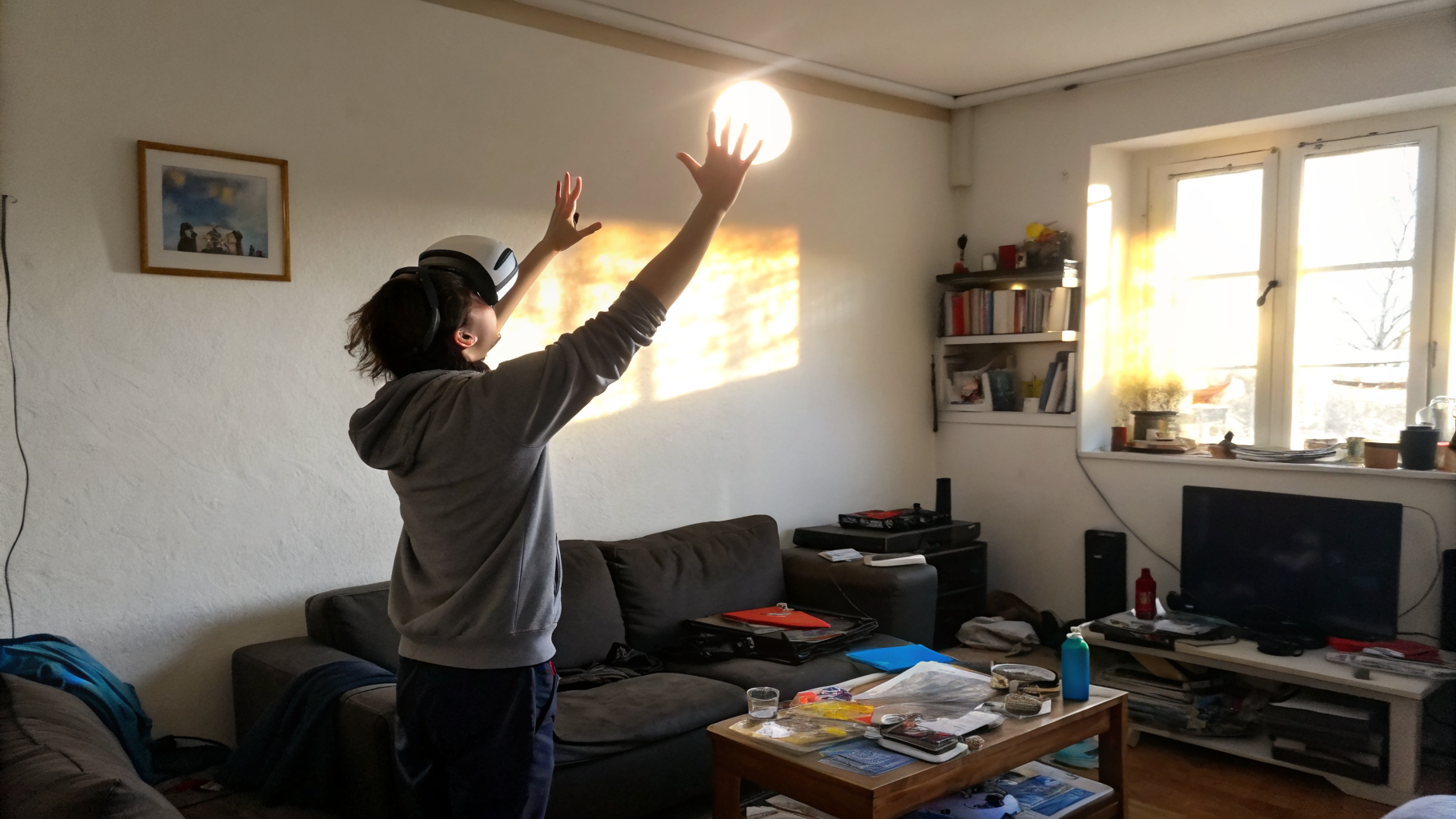
Wait, My Living Room Is a Platformer Level?
Here’s the pitch: You’re a pair of hands. No body, no legs, just floating mitts in a world that’s about to fall apart. That’s Disembodied, a mixed reality platformer coming to Quest 3 and 3S this October. And before you roll your eyes at yet another hand-tracking gimmick, hear me out. I’ve been writing about VR and AR since before the Oculus Rift was a Kickstarter dream, and this one feels… different.
The studio behind it, Something Something Games, has been quiet for a while. They made a few obscure SteamVR experiments that got buried in the flood of 2016-era shovelware. But this time they’re leaning hard into what makes MR actually work: the physical space around you. Not as a backdrop, but as a game mechanic. Your coffee table becomes a crumbling bridge. Your sofa turns into a spiky hazard. Your cat? Well, hopefully your cat stays out of the guardian boundary.
I’ve played a preview build. Briefly. And I walked away with more questions than answers — which, honestly, is a good sign. Let’s dig in.
What Is Disembodied Exactly?
On paper, it’s a 3D platformer where you control a pair of disembodied hands. You jump, grab, swing, and climb through levels that are plastered over your actual room. The game scans your environment and dynamically alters the level layout based on the furniture and walls it detects. So your living room might host a vertical climb one day, and a horizontal race the next.
The story, as far as I can tell, involves a digital consciousness that got fragmented across a collapsed simulation. You’re trying to piece yourself back together. It’s vague, but charmingly so. The art style is cel-shaded and slightly grotesque — think Psychonauts meets I Expect You to Die. The hands themselves have expressive fingers and a bit of personality. They can wave, give a thumbs up, or flip off the void. That last one is surprisingly cathartic.
But the real hook is the hand tracking. No controllers. Just your bare hands, floating there, grabbing onto virtual ledges that are mapped to your real-world walls. The developer claims it uses a new occlusion-resistant algorithm that keeps tracking stable even when your hands cross in front of your face or behind your back. In my demo, it worked about 85% of the time. The other 15% involved me flailing like a confused octopus.
Mixed Reality: The Goldilocks Zone
Let me level with you. I’ve been burned by MR before. The first wave of Quest mixed reality apps were glorified tech demos. Remember that one where you shot virtual aliens that peeked over your real couch? It was fun for ten minutes. Then you realised it was just a shooting gallery with extra steps.
Disembodied feels like it actually understands the medium. It’s not trying to trick you into thinking your room is a different world. It’s saying: “Your room is already interesting. Let’s break it.” The platforming segments force you to physically move around your space. You have to sidestep your coffee table, duck under a virtual beam that appears to hang from your ceiling, and reach up to grab a handhold that’s stuck to your wall. It’s part obstacle course, part interpretive dance.
I think that’s the secret sauce. Most VR games try to teleport you somewhere else. MR games, when done right, make you look at your own home with new eyes. Suddenly that cluttered bookshelf is a challenge. That rug is a potential death pit. It’s subversive in a quiet way.
But Does It Hold Up Beyond the Novelty?
Here’s where I get skeptical. The demo I played had three levels. Each took about five minutes. That’s fifteen minutes of content. The full game promises “dozens of handcrafted levels” plus a level editor. I’ve heard that promise before. “Dozens of levels!” they said. Then they shipped ten, and three of them were tutorials.
The developer told me they’re aiming for around twenty levels at launch, with free updates post-release. They’re also planning a level-sharing system where players can upload their own creations. That sounds great. But level editors in VR are notoriously finicky. Building a platforming course with your hands sounds like a recipe for frustration unless the UI is absolutely pristine.
I asked about locomotion. The game uses a combination of teleport and continuous movement, but the hand-tracking makes smooth locomotion feel weird. You’re essentially pulling yourself through the air like Spider-Man, but without the webs. It’s disorienting at first. The teleport option is safer, but it breaks the flow of the platforming. There’s a tension here that the developer hasn’t fully resolved yet.
Still, I respect the ambition. It’s easy to make a VR game where you stand still and shoot things. It’s much harder to make one where you have to physically navigate your own living room without tripping over a pair of shoes.
Hand Tracking: The Elephant in the Room
Let’s talk about the tracking itself. Meta’s hand tracking has gotten dramatically better over the past two years. Quest 3’s cameras are sharper, and the software can now handle fast movements and partial occlusions much better than Quest 2 ever could. But it’s still not perfect.
In my session, the game occasionally lost track of my fingers when they were close to my face or behind my back. The developer acknowledged this and said they’re working on predictive smoothing. I’ve heard that before too. Every hand-tracking game promises “predictive smoothing.” Few deliver it in a way that doesn’t feel like lag.
Here’s the thing, though: when the tracking works, it’s magical. Grabbing a virtual ledge that’s mapped to your actual wall, feeling your fingers close around nothing, and then pulling yourself up — it’s a genuinely new sensation. I haven’t felt that since the first time I reached out and touched a virtual object in early VR.
The question is whether the novelty can sustain a full game. The developer says the campaign will be about 4-6 hours long. That’s a lot of hand tracking. Fatigue is a real concern. Your arms get tired. Your shoulders ache. I played for twenty minutes and needed a break. But maybe that’s a feature, not a bug. A workout disguised as a platformer? Could be.
What About the Competition?
There aren’t many pure MR platformers out there. Puzzling Places is a puzzle game. Figmin XR is a sandbox. Disembodied is aiming for something more structured. The closest comparison might be Gorilla Tag, but that’s multiplayer and uses a completely different locomotion style. Or maybe Lone Echo II, but that’s PC VR and uses controllers.
So there’s a gap in the market. A genuine, unexplored niche. That’s rare in 2025, where most VR releases are either ports of flat games or sequels to established franchises. Disembodied is something new. That alone is worth paying attention to.
But new doesn’t mean good. I’ve seen dozens of “innovative” VR games that were innovative in the way a failed startup is innovative: they tried something different, and it didn’t work. The difference here is the developer seems aware of the pitfalls. They’re not promising the moon. They’re promising a weird, hand-tracked platformer that turns your living room into a playground. And they’re delivering that much, at least.
Pricing and Release Date
It’s coming to Quest 3 and Quest 3S on October 15th. No word on Quest 2 support — likely because the older headset doesn’t have the depth sensor and color passthrough that this game relies on. Price is tentatively set at $19.99. That’s reasonable for a niche indie title, especially if the level editor delivers on its promise.
Pre-orders open next week, and there’s a demo on App Lab right now if you want to try before you buy. I’d recommend it. This is the kind of game that clicks or doesn’t based on your space, your lighting, and your tolerance for flailing.
Final Thoughts: A Leap Worth Taking?
I’m cautiously optimistic. The hand tracking needs work. The level count is uncertain. The fatigue factor is real. But the core idea — a mixed reality platformer that uses your actual home as a level — is one of the most genuinely creative concepts I’ve seen in MR since the Quest 3 launched.
I think the developer is onto something. They’re not trying to replace reality. They’re not trying to escape it. They’re trying to play with it. That’s a rare and precious thing in an industry that’s obsessed with photorealism and hyper-immersive worlds. Sometimes you just want to jump around your living room with floating hands.
Will it be a classic? Too early to say. But it’ll be interesting. And in a year full of safe bets and sequels, interesting is enough to get my attention.
Further Reading
Read the original announcement on UploadVR: Mixed Reality Platformer Disembodied Is Coming To Quest This October
Original source: read the full article