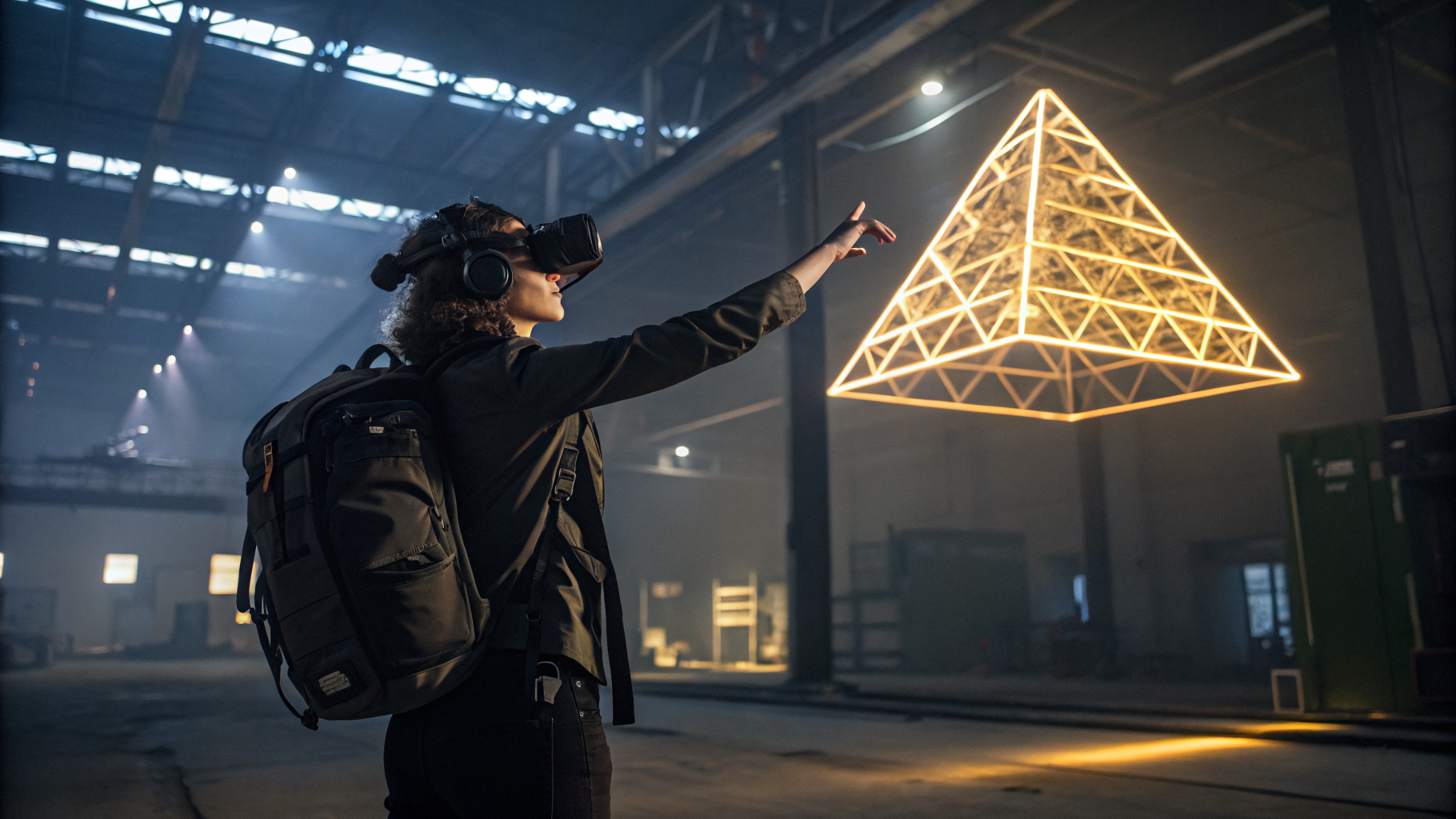
I walked into a pyramid. Then I walked into a Parisian café. Neither was real.
Let me set the scene. I’m standing in a warehouse in Tokyo, wearing a backpack PC and a headset that makes me look like a cybernetic ostrich. Around me, other visitors are gasping, pointing at nothing, and slowly bumping into each other. We’re inside Horizon of Khufu, a free-roaming VR experience from Excurio, a French company that has been quietly building some of the most ambitious location-based VR on the planet. And I’ll be honest: I went in skeptical.
I’ve been covering this stuff for over a decade. I’ve seen the hype cycles. I’ve watched VR go from “the next big thing” to “oh, that’s still a thing?” more times than I can count. Location-based VR in particular has a spotty track record. Remember the mall pop-ups with clunky headsets and nausea-inducing frame rates? Yeah, me too. So when UploadVR invited me to try Excurio’s latest experiences at Japan’s Immersive Journey, I packed my cynicism along with my passport.
But here’s the thing: Excurio isn’t trying to sell you a headset. They’re not pitching a metaverse where you can buy virtual real estate. They’re building walk-in, walk-around VR worlds that last about 45 minutes, and they cost about the same as a movie ticket. That’s a low bar, sure, but after Horizon of Khufu and Tonight With the Impressionists, I think they might actually clear it.
What Excurio Gets Right That Others Don’t
First, the tech. Excurio uses a system that tracks your physical movement through a large space—think warehouse scale, not living room scale. You wear a backpack that houses the computing, and a headset that’s tethered to nothing except your own two feet. No cables. No boundaries that snap you back to reality. You just… walk.
In Horizon of Khufu, that means you’re strolling through the Great Pyramid’s internal chambers, brushing past stone walls that your brain swears are real. You can crouch through narrow passages. You can peer over ledges into virtual pits. And because the space is mapped to the virtual environment, you never hit a wall. Or if you do, it’s because you wandered into another visitor, and you both laugh it off.
The fidelity is impressive. Not photorealistic—we’re not there yet—but stylized enough that your brain fills in the gaps. The lighting in Khufu shifts as you move, casting long shadows from unseen torches. Dust motes float in the air. I found myself holding my breath as I entered the burial chamber, which is absurd because I knew I was in a room with a bunch of strangers and a projector. But there it was.
What struck me here is the lack of gamification. There are no points, no leaderboards, no boss fights. You’re just exploring. In an industry obsessed with “engagement metrics,” that feels almost radical. Excurio trusts that the experience itself is enough. And for once, I agree.
Tonight With the Impressionists: A Different Kind of Immersion
The second experience, Tonight With the Impressionists, is a softer sell. You’re transported to 1870s Paris, specifically to a café where artists like Monet, Renoir, and Degas are gathering. You can walk around the tables, listen to snippets of conversation, and watch as paintings literally come to life around you. A still life of fruit starts to rot and bloom in fast-forward. A ballerina spins off the canvas and dances in the corner of the room.
It sounds twee. It could have been a gimmick. But what saved it for me was the attention to detail. The café smells like coffee—yes, they pump in scents—and the ambient noise includes horse hooves on cobblestones. The characters don’t look at you or interact; they’re absorbed in their own world. You’re a ghost, a fly on the wall. And that’s weirdly liberating.
I’ll admit, I rolled my eyes when the Degas figure started sketching a dancer in real time. But then I leaned in and saw the charcoal lines forming on the virtual paper. That’s the kind of detail that turns a skeptic into a believer. Not because it’s perfect, but because someone bothered to care.
The Elephant in the Room: Is This Scalable?
Here’s where I put my journalist hat back on. Excurio’s experiences are currently running in a handful of locations: Paris, Tokyo, and soon in a few more cities. They require a dedicated space, expensive equipment, and staff to manage the flow of visitors. This is not something you’re going to download on Steam next week.
So the question is: can this model survive? Location-based VR has a graveyard full of ambitious projects that burned bright and then fizzled. The Void, for example, had Star Wars and Ghostbusters licenses and still couldn’t make the economics work. Excurio is betting that cultural tourism—pyramids, art history, maybe next a walk through ancient Rome—has a longer tail than IP-driven experiences.
I think they might be right. But I also think the window is narrow. The hardware is getting cheaper and lighter every year. Inside-out tracking is improving. In five years, you might be able to have a similar experience in a smaller space with a lighter headset. Excurio needs to establish itself as the brand you trust for high-quality historical VR before the market gets flooded with cheaper knockoffs.
And they need to keep the price accessible. In Tokyo, a ticket runs about ¥3,800 (roughly $25 USD). That’s reasonable for a 45-minute experience, but it’s not cheap. If prices climb, the audience shrinks. And if the audience shrinks, the economics get ugly.
What I’d Change
No piece is complete without a little constructive griping, right? So here goes.
- Pacing: Both experiences have a slow middle section. You spend a lot of time walking through empty corridors or standing in rooms waiting for something to happen. I get that they want you to soak in the atmosphere, but a little more narrative momentum would help.
- Group dynamics: You’re in a group of up to six people, and you can see each other as ghostly avatars. That’s fine, but there’s no way to communicate beyond waving. A simple voice chat or even gesture-based pointers would make it feel less solitary.
- Replay value: Once you’ve seen the pyramid or the café, there’s not much reason to go back. Excurio could add Easter eggs or alternate paths to encourage return visits. Right now, it’s a one-and-done experience.
But these are quibbles. The core experience is solid, and in a world where most VR content still feels like tech demos, that’s worth celebrating.
The Bigger Picture: What Excurio Means for VR
I’ve been writing about the metaverse for long enough to know that “immersion” is a loaded word. Companies throw it around like confetti at a tech conference. But Excurio’s approach reminds me that true immersion isn’t about pixel count or frame rate. It’s about presence—the feeling that you are somewhere else.
And here’s the controversial take: I think the future of VR isn’t in your living room. It’s in these kinds of spaces. The fantasy of a lightweight headset that you wear all day, every day, is a technologist’s dream, not a human one. We don’t want to be jacked into a simulation 24/7. We want to visit other worlds the way we visit other countries—occasionally, intentionally, and with a ticket stub.
Excurio gets that. They’re building a kind of virtual tourism that doesn’t pretend to replace real travel. It’s a supplement, a way to see things that no longer exist or that you can’t afford to visit. And if they can keep the quality high and the prices reasonable, they might just carve out a niche that survives the hype cycle.
So, should you book a ticket? If you’re in Tokyo, Paris, or wherever they open next, yes. Go in with reasonable expectations. Don’t expect photorealism or a story that rivals The Last of Us. Expect a well-crafted 45-minute escape from reality. And if you close your eyes for a second in that pyramid, you might just forget where you are.
Further Reading
Read the original article on UploadVR: Excurio’s Immersive VR Locations Are Some of the Most Ambitious to Date
Original source: read the full article