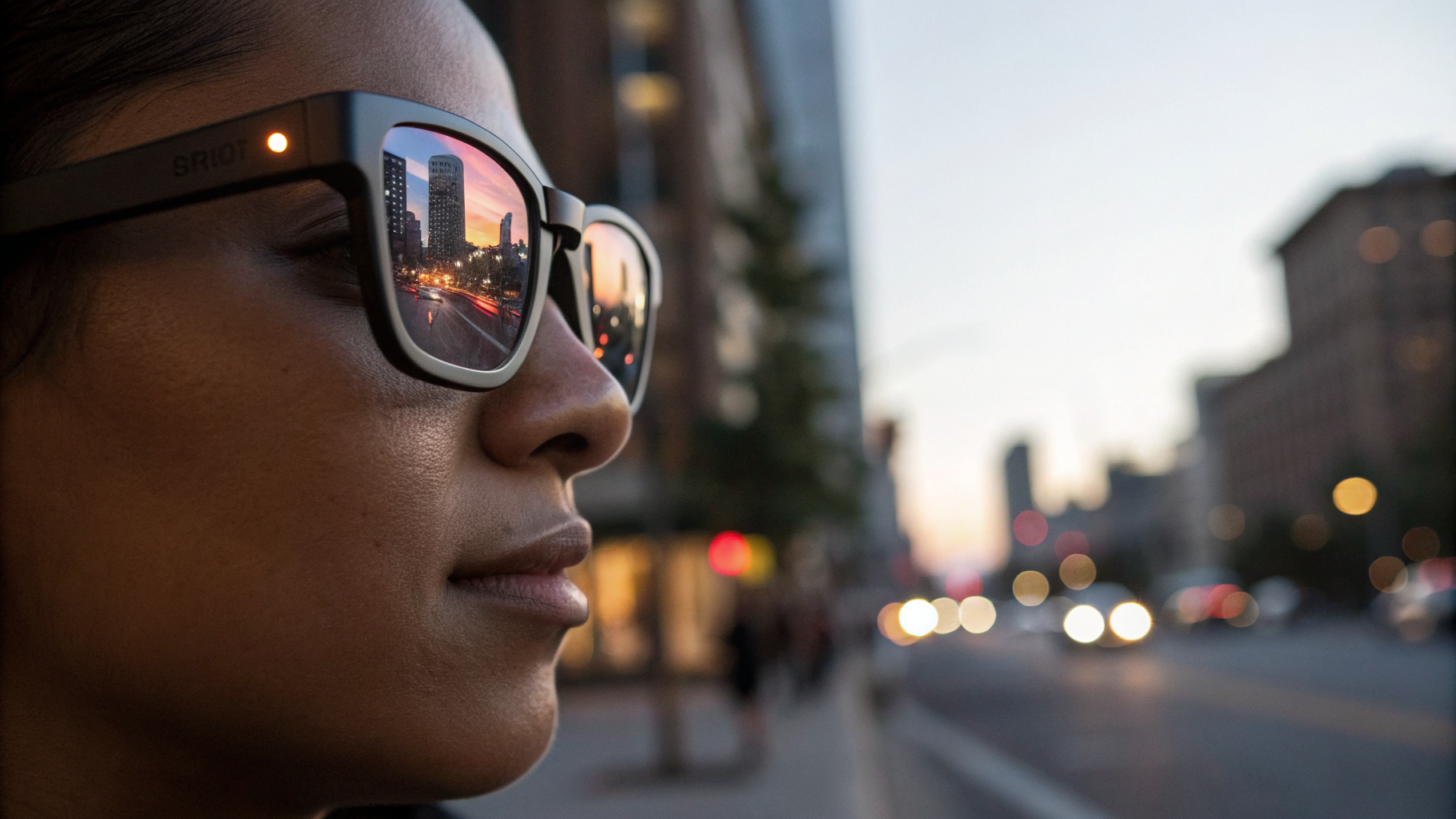
Google Wants You to Trust It With Your Eyeballs
Google announced its first Gemini-powered smartglasses this week, starting at $395, and the company is leaning hard on the privacy narrative. The pitch, as Ars Technica reported, is a four-way collaboration: Google, Samsung, Gentle Monster, and Warby Parker. That’s a hardware giant, a fashion-forward eyewear brand, and a mass-market optical retailer all sharing a stage with the company that once got caught slurping Wi-Fi payloads from residential routers. I’m not saying the trust deficit is insurmountable. I am saying the irony is thick enough to grind into a lens.
Let me be fair to Google for a second. The privacy messaging is not entirely cynical. The company clearly knows that the last smartglasses wave, the one that ended with Glasshole becoming a dictionary-adjacent slur, died not because the hardware was bad but because the social contract was nonexistent. People hated being filmed by strangers wearing a computer on their face. That was 2013. It’s 2026 now, and the ambient camera problem has only gotten worse. So Google’s decision to lead with privacy is, at minimum, an acknowledgment that the original sin of smartglasses was never the tech.
What struck me here is the pricing. $395 for a pair of glasses with a Gemini assistant baked in is aggressive. Not cheap, exactly, but well inside the range where a curious early adopter stops thinking of it as a gadget and starts thinking of it as a pair of glasses that happens to do tricks. Warby Parker and Gentle Monster in the same product line is a smart hedge: one brand signals accessibility, the other signals you don’t want to look like you’re wearing a developer kit to brunch. Samsung presumably handles the silicon. Google handles the brain. Everyone gets a slice.
The Privacy Story Is Doing a Lot of Heavy Lifting
Here’s where I get skeptical. Privacy as a marketing angle is easy to say and brutally hard to prove. Every company that has ever shipped a camera on a face has promised it would be responsible. Meta promised it. Snap promised it. Google itself promised it, and then Glass shipped and the world responded with a collective recoil that the company spent a decade pretending it didn’t hear.
So what does « privacy-first » actually mean for these Gemini smartglasses? The Ars summary doesn’t give us the granular detail I’d want before I tell anyone to preorder. Does the camera capture continuously, or only on explicit command? Is the Gemini assistant processing locally, or is your field of view getting shipped to a data center? Does the LED indicator that tells bystanders they’re on camera actually work, or does it have a hardware kill switch that the wearer controls? These are not gotcha questions. They are the questions. If Google answers them well, the product has a chance. If it hand-waves, we’re back to 2013 with better fashion.
I’ve covered this beat long enough to be tired of the pattern where privacy gets treated as a feature bullet rather than an architectural commitment. The companies that get it right build the constraints into the hardware, not the terms of service. A physical shutter. A hardwired indicator light. On-device processing for anything sensitive. If the Gemini smartglasses have those, great, say so loudly. If they don’t, the privacy pitch is just copy.
Gemini Is the Real Bet, and It’s a Risky One
The other thing worth pausing on is Gemini itself. Google is betting that an always-available AI assistant that can see what you see is the killer app for face computers. That’s a plausible bet. It’s also the bet that every AI hardware startup has made in the last two years, and most of them have shipped products that were interesting for a weekend and then went into a drawer. The Rabbit R1. The Humane pin. The cautionary tales are piling up.
What’s different here is the form factor and the distribution. Glasses are something you already wear. If the assistant is genuinely useful, you don’t have to remember to bring it. That’s a real advantage, and it’s the reason I think this category has legs even if this specific product stumbles. But usefulness is the whole ballgame. If Gemini on glasses is just a voice assistant with a camera, we’ve seen that movie. If it can genuinely augment what you’re looking at, translate a menu, identify a plant, remember where you parked, summarize a conversation in real time, then we’re talking about something else. The demos will tell us nothing. The third week of ownership will tell us everything.
And here’s the rhetorical question that keeps nagging at me: do people actually want an AI in their peripheral vision all day? Not in a demo, not in a keynote, but in the actual texture of daily life. The answer is not obvious. Google is pricing these at $395 because it wants the answer to be yes, and it wants to find out at scale rather than in a focus group.
The Fashion Play Is Smarter Than It Looks
I’ll give credit where it’s due: the Gentle Monster and Warby Parker partnership is the most interesting part of this announcement. Smartglasses have a design problem that nobody talks about enough. They have to look like glasses first and computers second. Google Glass failed that test catastrophically. Even the Ray-Ban Meta glasses, which are genuinely handsome, still read as tech to anyone who knows what they’re looking at.
Bringing in two eyewear brands with actual design credibility is an admission that Google can’t win this on silicon alone. It also means the product will be sold in places where people buy glasses, not just where people buy gadgets. That’s a distribution decision with real consequences. If you can try these on at a Warby Parker next to the frames you were already considering, the conversion math changes. The $395 price tag stops looking like a gadget premium and starts looking like a slightly expensive pair of glasses. That’s a much easier sell.
The risk is that fashion partners and platform partners have different incentives. Gentle Monster wants the frames to be desirable. Google wants the assistant to be ubiquitous. Those goals can pull in opposite directions, especially when it comes to things like battery life and visible hardware. I’ll be watching how much of the actual product is Google and how much is the eyewear brands. The answer will tell us who really controls the roadmap.
What Would Actually Convince Me
I’ve been doing this long enough that I don’t get excited about launch events. I get excited about specifics. So here’s what I’d need to see before I’d call the Gemini smartglasses a real step forward rather than a well-branded retread.
- A hardware camera shutter that the wearer cannot disable, with a recording indicator visible to bystanders at all times.
- Clear documentation of what gets processed on-device versus what goes to the cloud, written in language a normal person can understand.
- An independent privacy audit, not a self-reported blog post.
- Battery life that survives a full day of actual use, not a keynote demo.
- A Gemini experience that does something genuinely new, not just voice commands with a camera feed.
None of that is unreasonable. All of it is achievable. The question is whether Google treats privacy as a constraint it designs around or a message it wraps around the constraint. The company has the resources to do the former. It has the history to make me worry it’ll do the latter.
The Bottom Line
Google’s Gemini smartglasses are the most interesting thing to happen to face computers since the Ray-Ban Meta line proved the category wasn’t dead. The $395 price is right. The fashion partnerships are smart. The privacy pitch is necessary, even if it’s not yet convincing. But necessary isn’t the same as sufficient, and a decade of watching this industry trip over its own camera lenses has made me allergic to launch-day optimism.
I think these glasses will sell. I think they’ll be better than Glass by a wide margin. I also think the privacy conversation is just getting started, and Google is going to have to prove its intentions in the wild, not in a press release. The company that killed Glass with its own hubris has a chance to redeem the category. Whether it takes that chance depends on details we don’t have yet. I’ll be watching the third week of ownership, not the keynote. That’s where the truth lives.
Original source: read the full article