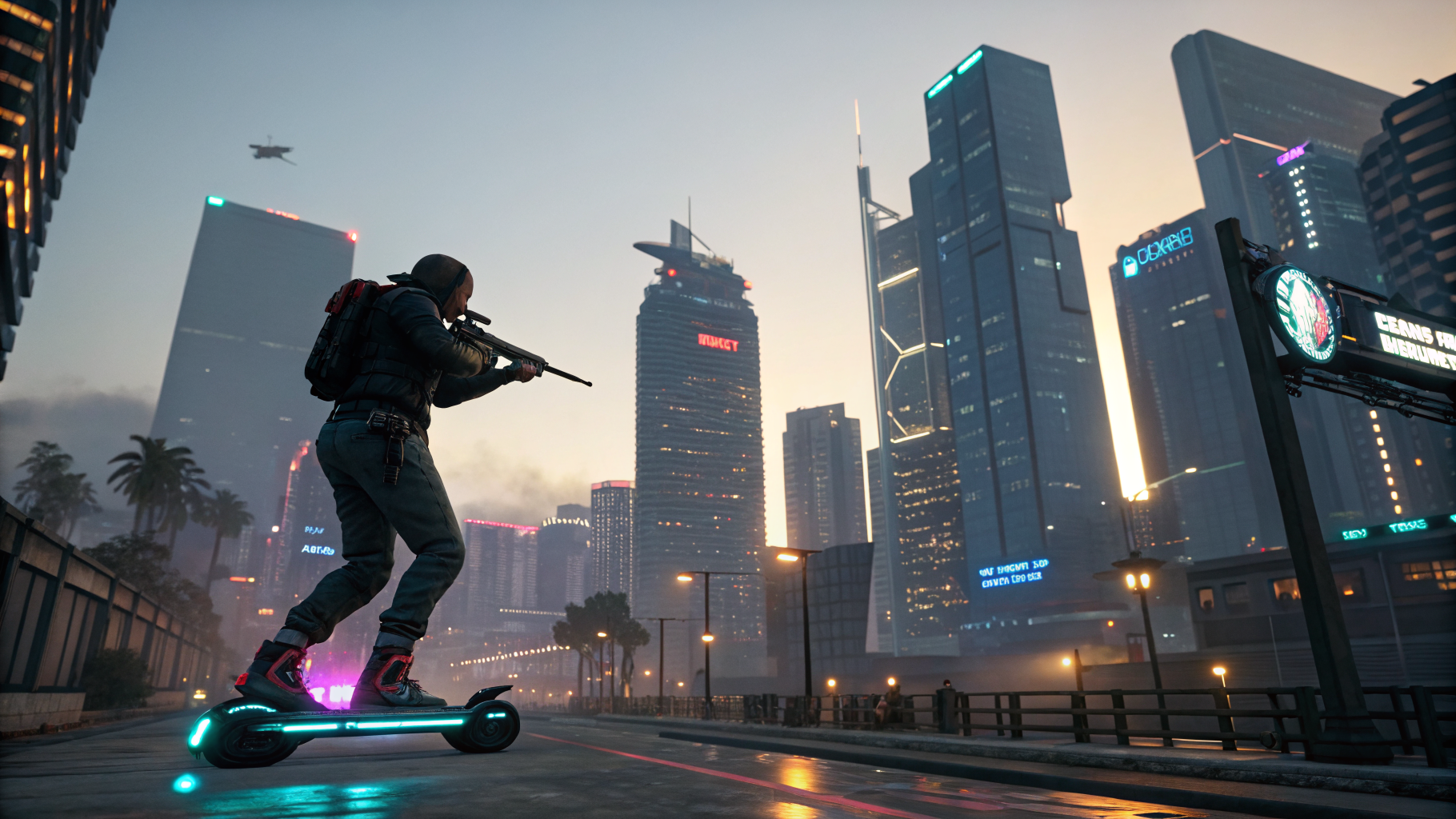
Remember when hoverboards were supposed to be real by now? We were promised a future of floating skateboards and flying cars, and instead we got electric scooters that occasionally catch fire. But maybe — just maybe — Hyperlane Highway is here to scratch that itch. At least virtually.
Developed by a team that clearly grew up on Tony Hawk’s Pro Skater and Doom in equal measure, this hoverboard roguelite FPS was first announced for SteamVR back in 2023. Now, in a move that surprised exactly no one who’s been watching the VR market, it’s also coming to Meta Quest. Later this year. Both platforms.
I’ve been covering this space long enough to remember when “Quest exclusive” meant “we took the PC version and made it look like a PS2 game.” Those days aren’t entirely behind us, but the gap is narrowing. And Hyperlane Highway looks like it might actually benefit from the trade-off.
What the hell is a hoverboard roguelite FPS?
It’s a good question. I asked it myself when I first saw the trailer. The answer, as far as I can tell, is a game that wants you to feel like you’re in Jet Set Radio crossed with RoboQuest, but with your own two hands holding the guns.
You ride a hoverboard. You shoot things. You die. You come back. You upgrade. You shoot more things. The loop is familiar — roguelite fans will recognise the DNA immediately — but the traversal is where it gets interesting. On a hoverboard, you’re not just walking around arenas. You’re grinding rails, boosting off ramps, and pulling tricks mid-air while trying to line up a headshot. It’s chaotic. It’s messy. It looks like a blast.
What struck me here is how naturally the hoverboard fits into VR. Motion sickness has been the elephant in the room for every fast-moving VR game since Echo Arena proved it could be done right. Hyperlane Highway seems to understand that your brain needs visual anchors — the board itself, the rails, the environment — to keep your stomach from staging a revolt.
Will it work for everyone? No. Nothing does. But the fact that they’re targeting both Quest and PC VR suggests they’ve thought about performance, comfort, and control schemes in a way that a flat-screen port rarely does.
Quest vs. PC VR: the eternal trade-off
Let’s not kid ourselves. There’s a power gap. The Quest 3 is impressive — genuinely impressive — but it’s not a gaming PC strapped to your face. Hyperlane Highway will look sharper, run smoother, and probably support higher draw distances on PC VR. That’s just math.
But here’s the thing: the Quest version might actually be more fun.
Why? Because wireless freedom matters. When you’re grinding a rail at 60 miles an hour and spinning around to blast a drone out of the sky, the last thing you want is a cable yanking you back to reality. I’ve played enough PC VR to know that tethered experiences can be immersive — but they can also be annoying. The Quest version lets you spin, duck, and pivot without worrying about tripping over a wire or wrapping it around your chair.
There’s also the install base argument. Meta has sold tens of millions of Quest headsets. SteamVR? Not so much. If Hyperlane Highway wants to find an audience, it needs to be where the people are. And right now, the people are on Quest.
That said, I hope the PC version doesn’t get treated as an afterthought. We’ve seen that movie before. A game launches on Quest, gets a half-baked PC port six months later, and everyone wonders why it feels like a mobile game on ultra settings. The developers have said both versions are coming “later this year,” which is vague enough to make me nervous. But they’ve also been transparent about the fact that this is a cross-platform release, not a port. That’s a good sign.
The roguelite angle: why it matters
I’ll be honest: I’m a little burned out on roguelites. Every indie game these days seems to have procedurally generated levels, permadeath, and a rune system that takes 40 hours to unlock. But Hyperlane Highway is doing something I haven’t seen before in VR: combining high-speed traversal with the genre.
Most VR roguelites — and there aren’t many — are slow, methodical affairs. You walk through corridors, you shoot enemies, you pick up loot. Hyperlane Highway says: forget walking. You have a hoverboard. Use it.
The speed changes everything. In a traditional roguelite, you have time to think. You can peek around corners, plan your approach, manage your resources. Here, you’re moving constantly. If you stop, you die. The hoverboard isn’t just transportation — it’s your shield, your momentum, your lifeline.
I’m curious to see how the upgrade system works. Roguelites live or die on their progression loops. If every run feels the same, the game gets old fast. The trailer shows different weapons, board upgrades, and maybe even skill trees. But trailers always show the good parts. The real test will be whether the randomness keeps runs feeling fresh after 10, 20, 50 hours.
And let’s be real: VR games have a retention problem. Most people play a VR title for a few hours, get motion sick, or bored, or both, and never come back. Hyperlane Highway needs a hook that keeps you strapping on that headset. A good roguelite loop — with meaningful upgrades, varied enemies, and satisfying combat — could be that hook.
What the trailer tells us (and what it doesn’t)
The trailer is short. Like, two minutes short. It shows a lot of grinding, a lot of shooting, and a lot of neon-soaked cityscapes that look like they were ripped straight out of a 90s anime. The aesthetic is pure cyberpunk-lite: bright colors, angular architecture, and more particle effects than a dubstep concert.
What it doesn’t show is depth. How many enemy types are there? How many levels? Is there a story, or is it just “shoot until you die”? I’m not expecting Disco Elysium here, but a little context goes a long way. The best VR games — Half-Life: Alyx, Boneworks, Resident Evil 4 VR — all have worlds that feel lived in. Hyperlane Highway looks like it has style. I hope it has substance too.
There’s also the question of comfort. I’ve seen the comments on UploadVR’s article. People are worried. “This looks like vomit city,” one user wrote. Another said, “I’ll wait for the PC version with higher framerate.” These are legitimate concerns. High-speed movement in VR is notoriously difficult to get right. Even Jet Island, which is basically the gold standard for fast VR traversal, made some players sick.
My take? If you’re prone to motion sickness, wait for reviews. If you’ve got your VR legs, this could be the most fun you have all year.
The bigger picture: VR needs more weird games
Look, I love Beat Saber. I’ve spent hours in Pavlov. But VR has a sameness problem. Shooters, rhythm games, and social apps dominate the storefronts. Anything that breaks the mold — especially something as quirky as a hoverboard roguelite — deserves attention.
We’re at a point where VR hardware is good enough. The Quest 3 is a solid device. The PSVR 2 has potential. Even PC VR, despite its niche status, offers experiences you can’t get anywhere else. What’s missing is software that takes risks. Hyperlane Highway is a risk. It’s fast, it’s weird, and it doesn’t fit neatly into any existing category. That’s exactly the kind of game VR needs.
Will it be a hit? I don’t know. The market is fickle. But I do know that the developers — a small team, from what I can gather — are putting their energy into something that feels fresh. That counts for something.
Final thoughts: keep an eye on this one
I’m not going to tell you to pre-order. I’m not going to tell you this will be the best VR game of 2025. What I will say is this: Hyperlane Highway has my attention. It’s ambitious. It’s weird. And it’s coming to the two biggest VR platforms in the same year. That alone is worth paying attention to.
If the developers can nail the controls, balance the difficulty, and keep the runs varied, they might have something special. If they stumble — if the Quest version looks like a blurry mess or the PC version feels like an afterthought — it’ll be another cautionary tale in the VR graveyard.
But I’m rooting for them. Because a hoverboard FPS roguelite in VR sounds like the kind of game I dreamed about as a kid, watching Back to the Future Part II and thinking, “Why can’t we have that?”
Well, we can’t have the real thing. But maybe, just maybe, this is the next best thing.
Further Reading
Original announcement on UploadVR: Hyperlane Highway Announces Meta Quest Release Alongside PC VR Later This Year
Original source: read the full article