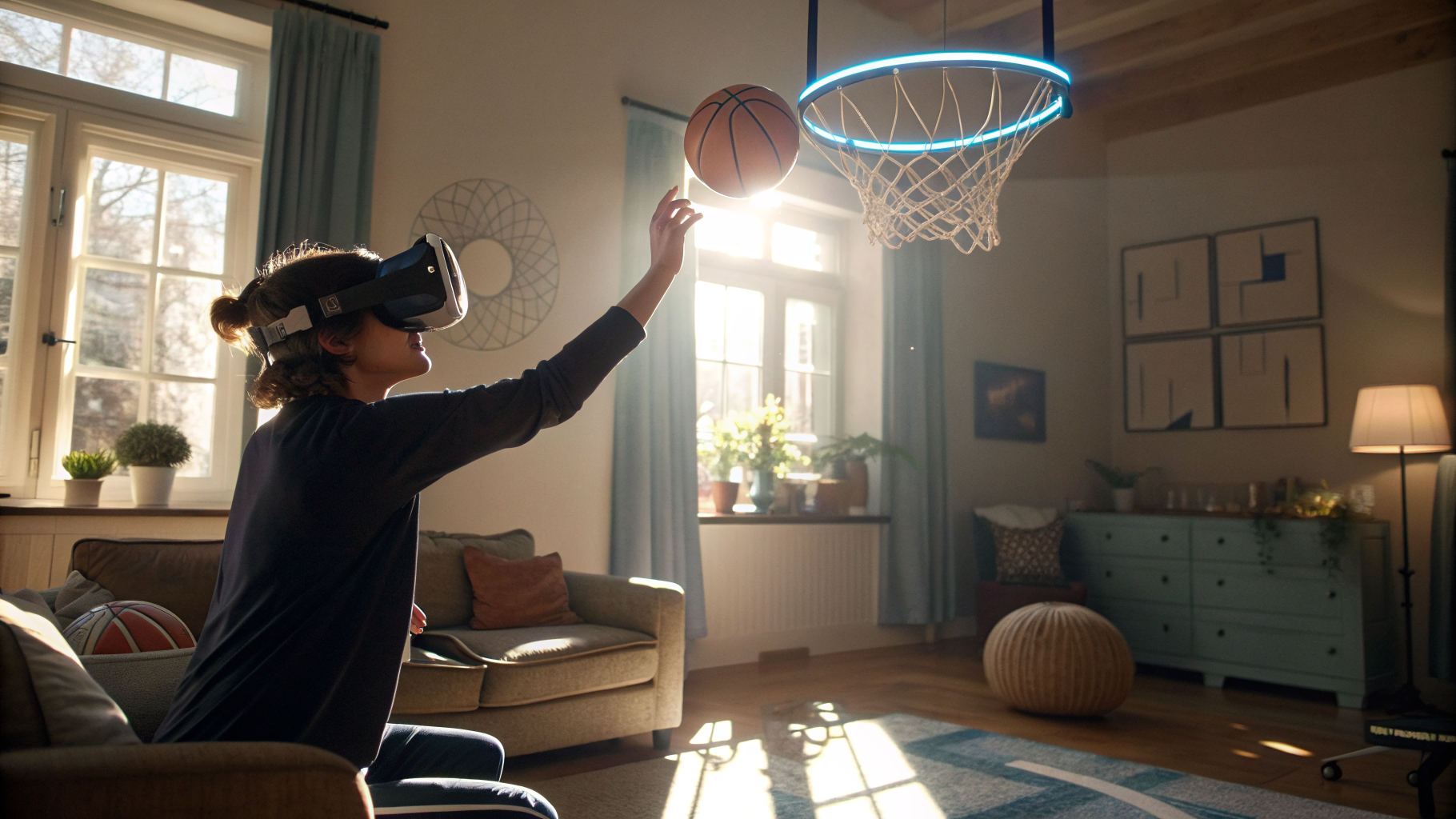
Just Hoops 2.0: When Hand Tracking Stops Being a Party Trick
I’ve been reviewing VR basketball games since the era when controllers felt like clumsy oven mitts. So when UploadVR dropped the news that Just Hoops 2.0 is live on Quest with a heavy emphasis on hand tracking and accessibility, I didn’t roll my eyes. I actually nodded. Because for once, a developer seems to understand that throwing a virtual ball should feel like throwing a real one — not like operating a forklift.
Here’s the thing: hand tracking in VR has been the industry’s favorite broken promise for years. Every headset launch comes with a slick demo of someone pinching the air to grab a virtual object. Then you put the thing on and realize you can’t even reliably pick up a cup without your fingers phasing through it. Just Hoops 2.0, at least on paper, is trying to fix that. And the early word is that it mostly works.
What struck me here isn’t the mixed reality playground mode — we’ve seen that trick before. It’s the accessibility push. More on that in a minute. First, let’s talk about why this update matters more than your average patch notes.
The Hand Tracking Problem Nobody Wants to Admit
Let’s be honest. Most VR basketball games are controller games with a basketball skin. You flick a stick, you press a trigger, the ball flies. It’s fine. It’s also completely disconnected from the physical act of shooting a hoop. Your brain knows you’re not really shooting. That’s why so many sports VR titles feel like tech demos after ten minutes.
Hand tracking changes that equation. When it works, you’re not pressing buttons — you’re extending your arm, flicking your wrist, following through. The proprioception lines up. The immersion jumps. Just Hoops 2.0 apparently rebuilt its shooting mechanics around this, and that’s a bigger deal than the marketing copy suggests.
But — and this is a big but — hand tracking still has a latency and occlusion problem. When your hand crosses in front of your face, or when the lighting is weird, the tracking can stutter. I haven’t gone hands-on with 2.0 yet, so I’m going off the reports. If the developers have genuinely smoothed that out, they’ve done something Meta itself has struggled with for years.
Is it perfect? Probably not. Is it a meaningful step forward? I think so. And I’m usually the first person to call hand tracking a gimmick.
Accessibility Isn’t a Buzzword Here — It’s the Whole Point
Here’s where Just Hoops 2.0 earns my respect. The update includes a slew of accessibility features aimed at casual players. That phrase — « casual players » — usually makes me groan, because it often means dumbing down. But in this case, it seems to mean opening up.
Think about who gets left out of VR sports games. People with limited mobility in their arms. People who can’t stand for long periods. People who find controller-based motion sickness triggers. People who just want to play without a 20-minute tutorial on grip buttons.
The update reportedly adds options like adjustable shot assist, seated play modes, and alternative control schemes that don’t require full-range arm motion. That’s not charity. That’s smart design. The more people who can actually play your game, the more people who will buy it. It’s not complicated.
And yet, how many VR developers still ship games with zero accessibility options? Too many. I’ve lost count of the number of Quest titles that assume you have two working hands, full range of motion, and a tolerance for artificial locomotion that would make a fighter pilot queasy.
Just Hoops 2.0 isn’t the first game to do this, but it’s one of the few sports titles to treat accessibility as a core feature rather than a patch note afterthought. That deserves attention.
The Mixed Reality Playground: Fun Gimmick or Real Value?
Now, the mixed reality playground mode. This is where I get a little skeptical. MR is the hot new thing — Meta won’t shut up about it — but most MR experiences I’ve tried feel like a tech demo you show your friends once and never open again.
You scan your room, a virtual hoop appears on your wall, you shoot a few baskets, you think « neat, » and then you go back to playing something with actual depth. The novelty wears off fast.
That said, a basketball game is actually a decent fit for MR. You’ve got a physical space, you’ve got a hoop, you’ve got a ball. It’s one of the few genres where putting virtual objects in your real room doesn’t feel forced. If Just Hoops 2.0 lets you turn your living room into a practice court without clearing out the furniture, that’s genuinely useful for people who don’t have a dedicated VR play space.
Will it be a system seller? No. Will it be a nice option for people who already own the game? Probably. I’ll reserve judgment until I’ve spent time with it, but I’m not holding my breath for a revolution.
Why This Update Matters Beyond One Game
Here’s the bigger picture. Just Hoops 2.0 is a small game from a small studio. It’s not going to move millions of headsets. But it’s a signal. It shows that hand tracking is finally good enough to build core mechanics around. It shows that accessibility features can be a selling point, not an obligation. And it shows that mixed reality can be more than a bullet point on a store page.
I’ve been covering this space for over a decade. I’ve seen countless updates that promised to change everything and delivered nothing. This one feels different. Not because it’s flashy, but because it’s practical. It’s a developer saying: we know the hardware can do this now, so let’s actually use it.
That’s the kind of incremental progress VR needs. Not another metaverse moonshot. Not another Web3 integration nobody asked for. Just a basketball game that works better than it did before, for more people than it did before.
The Verdict (So Far)
Just Hoops 2.0 isn’t going to win game of the year. It’s not going to dominate your feed. But if you’ve got a Quest and you’ve been curious about hand tracking, or if you’ve been waiting for a VR sports game that doesn’t assume you’re an Olympic athlete, this update is worth a look.
I’ll be going hands-on soon. If the tracking holds up and the accessibility options are as robust as they sound, this could be a quiet milestone. If not, well, at least someone tried. And in VR, trying is half the battle.
One more thing: the fact that UploadVR covered this at all tells you something. The industry is watching. Hand tracking is no longer a side feature. It’s becoming the main event. And Just Hoops 2.0 might just be the game that proves it.
Now if you’ll excuse me, I’ve got a virtual hoop to miss.
Original source: read the full article