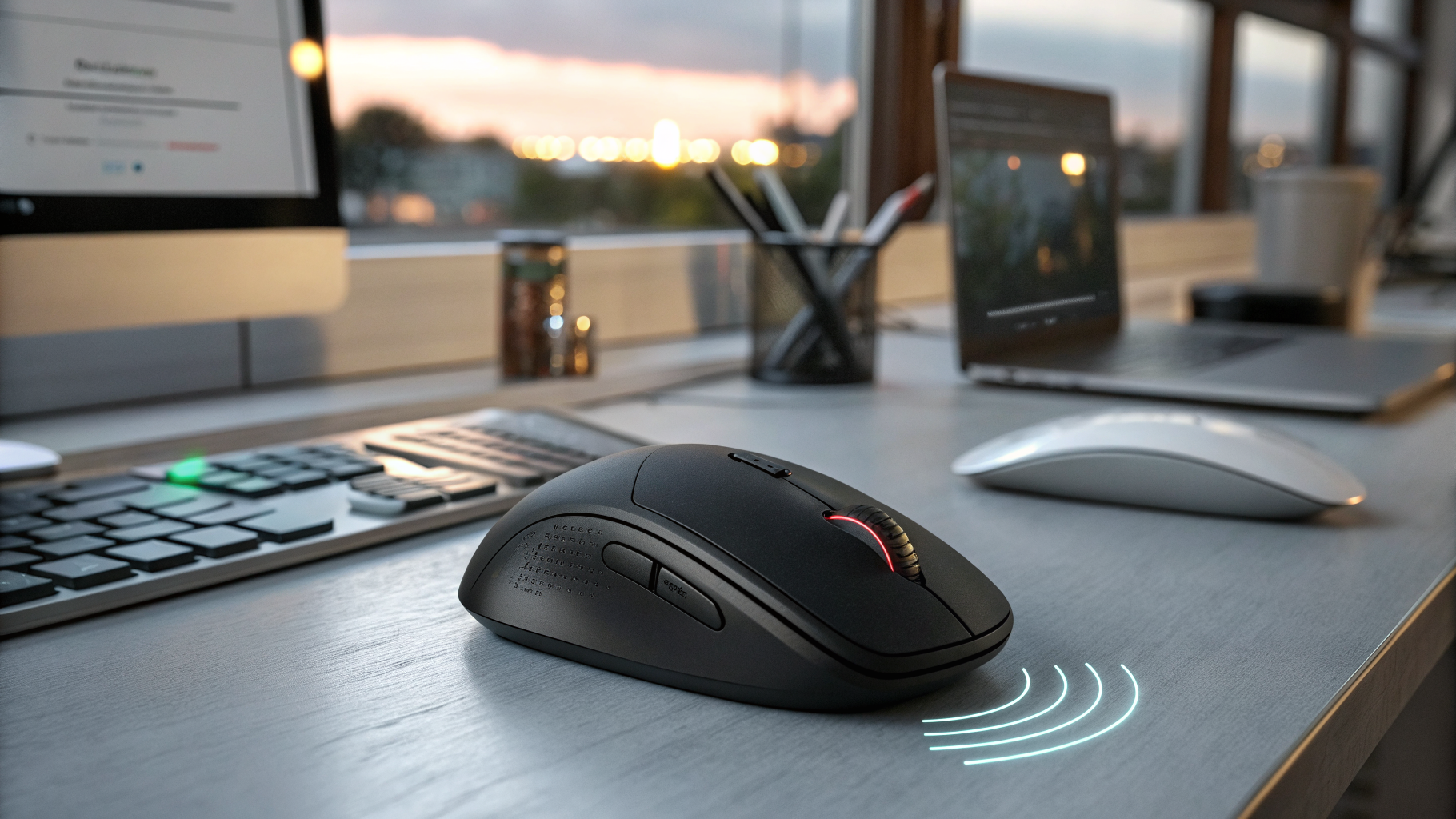
Microsoft’s Surface Mouse Is Back, and It’s Whispering Sweet Haptics in My Ear
I’ve been covering VR, AI, and the metaverse long enough to remember when “haptic feedback” meant a controller that buzzed like a dying phone. So when I saw Microsoft quietly drop a new Surface mouse with haptics for $80, I didn’t roll my eyes. I sat up. Because this isn’t about gaming gimmicks or metaverse hype. It’s about the one input device we all still touch every single day — and Microsoft just gave it a pulse.
Let me be blunt: most mice are boring. They click. They scroll. They collect dust. The new Surface mouse, due October 13, promises something different. It packs customizable haptic feedback, meaning the mouse can physically respond to what’s on screen. Imagine scrubbing a timeline in Premiere and feeling tiny detents. Or dragging a slider in Photoshop and getting a subtle resistance. That’s not a gimmick. That’s a quiet revolution for anyone who works with their hands.
I want one. Not because I need it. Because I’ve been waiting for someone to make a mouse that feels like it belongs in 2024, not 2004.
The Haptic Thing: More Than a Buzzword
Haptics have been the red-headed stepchild of consumer tech for years. We got HD rumble in the Switch, adaptive triggers in the PS5, and then… nothing. PC peripherals largely ignored the trend. Why? Because adding motors and sensors to a mouse costs money, and most companies would rather spend that budget on RGB lighting that looks like a unicorn sneezed on your desk.
Microsoft, to its credit, didn’t just slap a vibration motor in there and call it a day. From what ZDNET reports, the haptics are customizable. That’s the key word. You can tune the feedback per app, per action, or per your own twitchy preferences. That means the mouse doesn’t just buzz — it communicates. A soft tick when you snap a window. A deeper thud when you delete a file. A gentle pulse when your AI assistant finishes generating that 4,000-word blog post you didn’t want to write anyway.
Is that overkill? Maybe. But I’d rather have overkill than under-delivery. The last Surface mouse was fine. Fine is the enemy of interesting. This one is interesting.
What struck me here is the timing. Microsoft is launching this mouse right as Apple keeps pretending the Magic Mouse isn’t a ergonomic disaster. Logitech keeps churning out variations of the same shape. Razer is busy making mice for people who scream at 14-year-olds in Valorant. Nobody is making a mouse for the hybrid worker who spends eight hours a day in spreadsheets, Slack, and Figma. Until now.
Why I’m Actually Excited (and Why You Should Be Skeptical)
Let’s get the skepticism out of the way. $80 is not cheap. You can buy a perfectly good Logitech for $25. You can buy a mediocre Microsoft mouse for $15. So what does that extra $55 buy you? Haptics, yes. But also build quality, presumably. And the promise of software that doesn’t feel like it was coded by an intern in 2012.
Here’s my concern: Microsoft has a spotty track record with peripheral software. Remember the Microsoft Mouse and Keyboard Center? It was fine. Just fine. If the haptic customization lives inside a clunky settings menu that requires a Microsoft account and three reboots, the whole thing falls apart. Haptics only work if they’re effortless. If I have to think about configuring them, I won’t use them.
But I’m willing to give Microsoft the benefit of the doubt. Why? Because the company has been quietly getting better at hardware. The Surface line, the Surface Headphones, even the Surface Dock — they’re not perfect, but they show a willingness to experiment. And experimentation is what this industry needs. We’ve been stuck in a mouse-and-keyboard paradigm for forty years. A little haptic feedback might be the nudge that gets us unstuck.
Also, let’s be honest: the metaverse needs better input. I’ve written about this before. You can’t build a compelling virtual world if your only way to interact with it is a plastic brick with two buttons. Haptic mice are a small step toward a future where digital objects have weight, texture, and resistance. That future might be overhyped, but it’s not wrong. It’s just early.
The Competition Is Sleeping
Here’s the part that annoys me. Logitech could have done this. Razer could have done this. Even Apple could have done this, if it cared about anything other than thinness. But they didn’t. Microsoft did. That’s worth noting, even if the execution ends up being flawed.
I’ve tested dozens of mice over the years. The best ones — the Logitech MX Master series, the Razer DeathAdder — are great because they nail the fundamentals. Comfort. Precision. Battery life. None of them try to reinvent the wheel. Microsoft is trying to reinvent the wheel. Sometimes that ends in disaster. Sometimes it ends in a product that changes how you think about a category.
Which will this be? I don’t know yet. I haven’t touched one. But I’m intrigued. And in a world where every tech launch feels like a rehash of last year’s rehash, intrigued is a rare emotion.
What I’ll Be Watching For
When the Surface mouse ships on October 13, I’ll be looking for three things. First, battery life. Haptics drain power. If I have to charge this thing every other day, it’s dead to me. Second, software. If the customization app is a mess, the haptics become a novelty. Third, feel. Does the haptic feedback actually help, or does it just feel like a phone vibrating in your pocket? That’s the difference between a tool and a toy.
I’ll also be watching the price. $80 is a lot for a mouse. But if it lasts three years and makes my daily workflow even 5% more pleasant, that’s worth it. We spend thousands on monitors and chairs and keyboards. Why not spend a little on the thing that actually moves the cursor?
There’s a larger point here about the state of tech journalism. We get excited about AI that writes poetry and headsets that make us dizzy. We forget that the most important innovations are often the smallest. A mouse that talks back. A keyboard that adjusts. A webcam that doesn’t make you look like a potato. Those are the things that change our lives, not the metaverse. The metaverse is a destination. The mouse is the vehicle.
The Bottom Line: I Need It, You Probably Don’t
Let’s be clear. You do not need a haptic mouse. You need food, water, shelter, and a decent Wi-Fi connection. But if you’re a creative professional, a developer, or just someone who spends too much time in front of a screen, you might want one. And wanting is okay. Consumer tech is built on want, not need. The best products make you feel something. This mouse might make you feel a tiny tick when you scroll past a boring email. That’s something.
I’ll be ordering one. I’ll probably complain about the software. I’ll definitely complain about the price. But I’ll also be paying attention. Because for the first time in years, a mouse has my attention. And that’s more than I can say for most of the gadgets that cross my desk.
Microsoft, don’t screw this up. The haptic hype is real. Now prove it.
Original source: read the full article