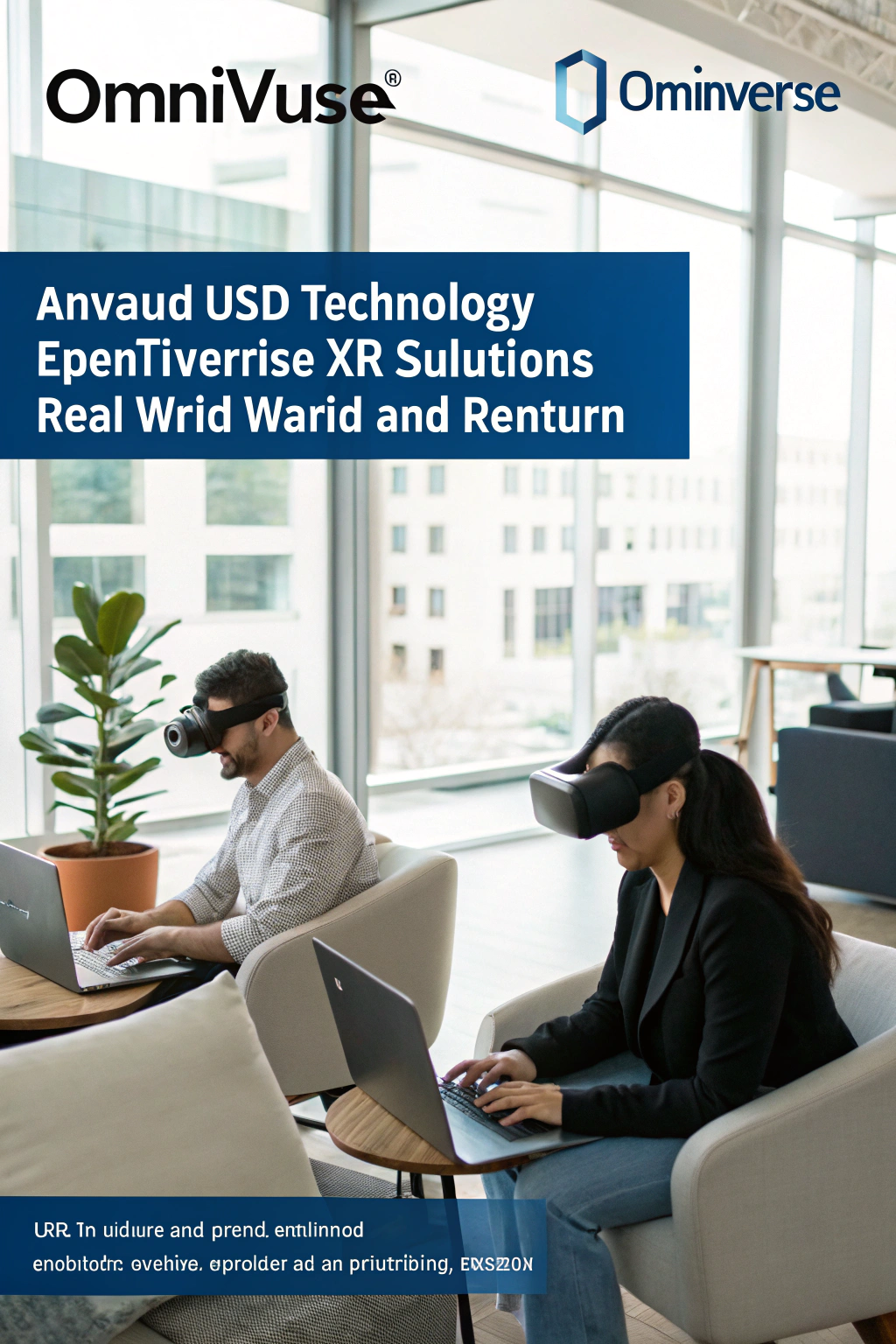
Omniverse, OpenUSD, & Enterprise XR: Crafting Digital Twins With Real ROI
Introduction: Why Omniverse, OpenUSD, and Enterprise XR Are the New Standard
Imagine a factory floor that reorganizes itself for maximum efficiency, a city that tests its emergency response to a hurricane before the storm ever forms, or a surgical robot that has practiced a complex procedure a thousand times in a simulated environment. This isn’t science fiction; it’s the tangible business reality being built today on a powerful trifecta of technologies: NVIDIA Omniverse, OpenUSD, and digital twins. For any Enterprise serious about scaling industrial metaverse applications, mastering Omniverse, OpenUSD, and Enterprise XR workflows is no longer optional—it’s the key to unlocking real, measurable ROI. These tools converge to create a persistent, physically accurate virtual space where organizations can design, simulate, and optimize complex systems, slashing costs and accelerating innovation.
The Evolution from Static Models to Live Simulations
For decades, 3D modeling has been a staple in design and engineering. However, these models were often trapped in proprietary software, creating digital siloes. An architectural file from one program couldn’t easily talk to an engineering simulation in another, making collaboration cumbersome and inefficient. This « tower of Babel » of 3D formats has been a significant bottleneck to progress, especially for large Enterprise teams working across global offices.
Enter OpenUSD (Universal Scene Description), the technology pioneered by Pixar Animation Studios. Initially created to streamline the production of complex animated films, OpenUSD is now an open-source framework that acts as a universal translator for the 3D world. It doesn’t convert files; instead, it allows different applications to collaborate on a single, unified scene non-destructively. As tech analysts have noted, open standards like this are critical for building a truly interoperable metaverse. OpenUSD provides the common language that every Enterprise tool can speak.
NVIDIA Omniverse is the platform that brings this language to life. It’s a development platform built from the ground up to leverage OpenUSD. Omniverse connects a company’s existing 3D tools (like CAD software from Autodesk or design tools from Adobe) into a shared virtual space. Here, teams can collaborate in real-time on a single source of truth, creating and operating physically accurate, AI-enabled digital twins. For any Enterprise looking to break down data silos, this integration is a game-changer.
Omniverse, OpenUSD, and Enterprise XR: Practical Applications Delivering Real-World Value
The synergy between Omniverse, OpenUSD, and Enterprise XR is not just theoretical. Major industries are already deploying these virtual replicas to solve tangible problems and boost their bottom line. The key differentiator? These aren’t static models—they are live, data-driven simulations that update in real-time, feeding back into physical operations.
Use Case 1: Advanced Manufacturing and Robotics
Companies like BMW Group are utilizing NVIDIA Omniverse to build digital twins of their factories. Before a new assembly line is physically constructed, it is built and simulated in a virtual environment. Engineers can optimize the layout, test robotic workflows, and train AI models—all within a shared OpenUSD scene. The result? A 30% reduction in planning time and a significant decrease in costly physical rework. For the Enterprise, this means faster time-to-market and higher production quality from day one.
Use Case 2: Energy and Infrastructure Management
Energy giants like Siemens Energy are leveraging Omniverse to create digital twins of power plants and wind farms. By integrating sensor data into an OpenUSD-based twin, operators can monitor equipment health, predict failures, and simulate maintenance procedures in a risk-free environment. This proactive approach reduces unplanned downtime by up to 40%, delivering a direct, measurable ROI for the Enterprise. XR interfaces allow field technicians to overlay these twins onto physical equipment, guiding repairs with holographic instructions.
Use Case 3: Retail and Supply Chain Optimization
Retail giants are using Omniverse to simulate entire supply chains—from warehouse layout to last-mile delivery. By building an OpenUSD twin of a distribution center, managers can test different storage configurations, robot routing algorithms, and staffing levels. The result is a leaner, more responsive operation that adapts to demand spikes. For the Enterprise, this translates directly into lower operational costs and higher customer satisfaction.
Why Omniverse, OpenUSD, and Enterprise XR Deliver Real ROI
The ROI of these technologies goes beyond simple efficiency gains. It’s about fundamentally changing how an Enterprise operates. Here’s how the numbers stack up:
- Reduced Prototyping Costs: Virtual testing eliminates the need for expensive physical prototypes. Companies report savings of 50-70% on early-stage development.
- Faster Time-to-Market: Real-time collaboration across global teams, powered by OpenUSD, cuts design cycles by weeks or even months.
- Improved Safety and Training: XR-based training on digital twins allows employees to practice dangerous procedures without risk, reducing workplace incidents and insurance costs.
- Predictive Maintenance: Live sensor data fed into Omniverse twins enables predictive analytics, slashing unplanned downtime and extending equipment lifespan.
For any Enterprise leader, the question is no longer « if » to adopt these tools, but « how fast » they can integrate Omniverse, OpenUSD, and Enterprise XR into their core operations.
Getting Started: Building Your First Omniverse, OpenUSD, and Enterprise XR Twin
Ready to move from theory to practice? Here’s a straightforward roadmap for any Enterprise looking to deploy a digital twin with real ROI:
Step 1: Identify a High-Impact Use Case
Start small. Pick a single process or asset that is costly, complex, or safety-critical. This could be a factory line, a data center, or a logistics hub. The goal is to prove value quickly.
Step 2: Build Your OpenUSD Data Pipeline
Gather your existing 3D models, CAD files, and sensor data. Use OpenUSD to unify them into a single, interoperable scene. NVIDIA provides connectors for major tools like Autodesk Revit, Siemens NX, and Adobe Substance.
Step 3: Deploy on Omniverse
Set up your Omniverse Nucleus server to host your twin. This becomes your single source of truth. Enable real-time collaboration so your team can work on the twin simultaneously, regardless of location.
Step 4: Integrate XR and AI
Add XR capabilities using Omniverse XR apps. Allow users to walk through the twin in VR or overlay it onto the physical world in AR. Then, layer in AI agents to simulate traffic, predict failures, or optimize workflows.
Step 5: Measure and Iterate
Track key metrics: time saved, costs reduced, and errors eliminated. Use this data to refine your twin and expand to new use cases. The ROI compounds as you integrate more systems.
The Future of Omniverse, OpenUSD, and Enterprise XR
We are only scratching the surface of what’s possible. As hardware improves and AI becomes more sophisticated, Omniverse twins will become autonomous—self-optimizing factories, self-healing infrastructure, and self-learning supply chains. OpenUSD will continue to evolve as the backbone of the industrial metaverse, enabling seamless data exchange across every Enterprise tool. The companies that invest today in Omniverse, OpenUSD, and Enterprise XR will be the ones leading their industries tomorrow. Don’t get left behind—start building your digital twin now and unlock the real ROI that the industrial metaverse promises.