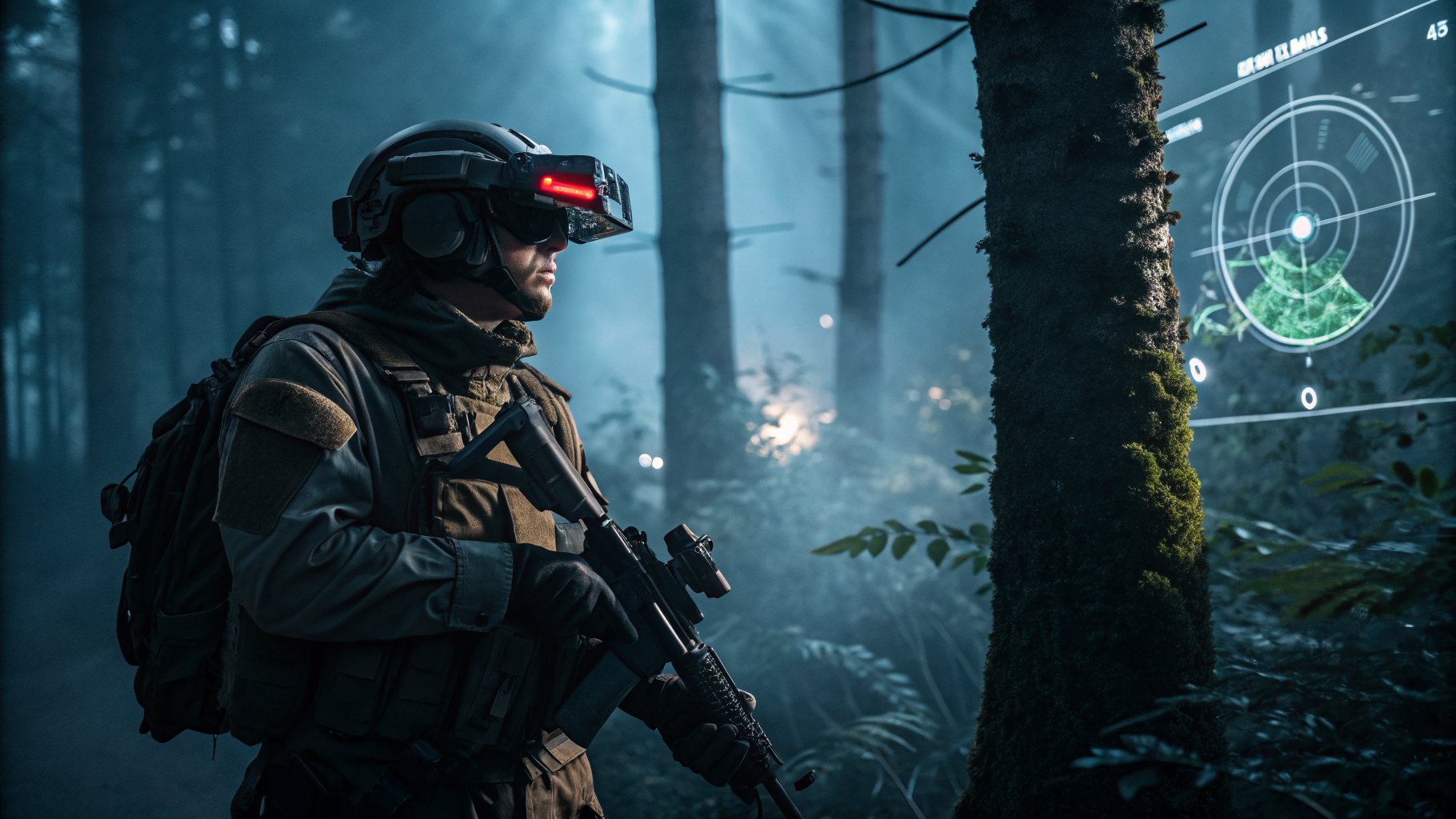
Night Vision, But Make It Cinematic
Let’s be honest: when Palmer Luckey shows up with new hardware, you pay attention. The Oculus founder turned defense contractor has been quietly — or not so quietly — building Anduril into a juggernaut of military tech. And his latest toy? The EagleEye augmented reality glasses. They’re not for playing Beat Saber. They’re for seeing in the dark, wide, and probably in ways that make you feel like a predator.
Late last year, Anduril teased EagleEye with a set of capabilities that felt like a Black Mirror episode waiting to happen. Now, the company has released a fresh glimpse: wide field-of-view night vision. And I have to say, what struck me here is not just the tech — it’s the tone. This is not a gadget for campers. This is a tool for soldiers. And it’s terrifyingly good.
The video footage, shared via Road to VR, shows a soldier wearing EagleEye goggles while walking through a dark environment. The display overlays a bright, crisp, almost daylight-like image onto the user’s view. But here’s the kicker: the field of view is wide. Really wide. We’re talking close to peripheral vision, which is the holy grail for night vision systems. Traditional night vision tubes give you a narrow, green tunnel. EagleEye gives you a panoramic, full-color, augmented window into the dark.
In my view, that’s a bigger deal than most people realize. Anyone who has used military-grade night vision knows the struggle: you see clearly, but you feel blind. Your head swivels like an owl, and your situational awareness drops. EagleEye seems to solve that by merging a wide-FOV camera feed with AR overlays — targeting data, maps, friend-or-foe markers. It’s not just seeing in the dark. It’s seeing the battlefield as a video game HUD.
The Return of the AR Visionaries — With a Side of Dystopia
I’ve been covering AR and VR for over a decade now. I watched the hype cycle inflate and pop more times than I can count. But there’s something different about the current wave. It’s not coming from Silicon Valley startups with foam headsets and vague promises of a “spatial computing future.” It’s coming from defense contractors, industrial firms, and the military. The use cases are brutal, specific, and funded.
EagleEye is a perfect example. Anduril isn’t trying to sell you a pair of smart glasses for your morning jog. They’re building a system that turns a human soldier into a networked sensor node. The wide-FOV night vision is just one piece of a larger puzzle: the ability to see, share, and act on information faster than the enemy. That’s the real product. And yeah, it’s a little scary.
But let’s not pretend this is new. Palmer Luckey has been open about his shift from consumer VR to defense tech. He’s said, more or less, that he wants to build the tools that keep America safe. Whether you agree with that or not, the man delivers hardware. The EagleEye demo shows a level of optical integration that consumer AR companies like Magic Leap or even Apple have struggled to achieve. Low latency, high brightness, wide FOV, all in a ruggedized package. It’s impressive engineering.
What I find ironic is how many of the core technologies — waveguide displays, eye tracking, sensor fusion — were developed with consumer VR in mind. Luckey himself helped kickstart that revolution with the Oculus Rift. Now, those same breakthroughs are being repurposed for something far more serious. The consumer market couldn’t sustain the investment. The Pentagon can.
Wide Field-of-View: The Spec That Matters Most
Let’s get into the weeds for a moment, because the FOV thing is genuinely important. Most night vision devices, whether the classic PVS-14 or the newer ENVG-B, have a narrow field of view — typically around 40 degrees. That’s like looking through a paper towel roll. You have to scan constantly, and your brain gets tired. Peripheral vision is nonexistent. In a firefight, that’s a death sentence.
EagleEye’s wide FOV, based on the footage, appears to be well over 70 degrees, possibly approaching 90. That’s a massive leap. The image is also full-color, not the traditional green phosphor. Anduril uses a combination of image intensification and thermal sensors, fused together with AI, to produce a clear, natural-looking picture. The AR overlays — navigation, target indicators, threat warnings — are rendered with low enough latency that they don’t cause disorientation.
I’ve tried similar systems from other defense contractors. They’re usually bulky, heavy, and prone to overheating. EagleEye looks comparatively sleek. The battery pack is worn on the belt, and the goggles themselves seem no larger than a standard pair of binoculars. That’s no small feat. The thermal management alone for a wide-FOV, full-color, AR overlay system is a nightmare of heat dissipation and power draw. Anduril seems to have cracked it.
But here’s the question that keeps nagging at me: how much of this is real, and how much is a demo? Anduril is a private company, so we don’t get detailed specs or independent reviews. The footage is controlled. The context is curated. I’d love to see a third-party test in actual combat conditions. Mud, rain, fog, smoke, the kind of chaos that breaks most electronics. That’s the real test. Until then, I’m impressed but skeptical.
What This Means for the Rest of Us
If you’re a civilian, you might be wondering: why should I care about a military AR headset? Fair question. But the history of consumer tech is littered with examples of military research trickling down. GPS, the internet, even the touchscreen interface — all started in defense labs. EagleEye’s wide-FOV, low-latency AR could eventually find its way into firefighting helmets, search and rescue gear, or even industrial maintenance.
And let’s not forget: Palmer Luckey still has a foot in the consumer world. He’s hinted at non-military applications for EagleEye’s underlying technology. I wouldn’t be surprised if, five years from now, we see a stripped-down version of this system aimed at outdoor enthusiasts or first responders. The core components — the display, the sensor fusion, the battery — are all generalizable.
But there’s a darker side. The same technology that lets a soldier see in the dark and identify a target from 500 meters away can be used for mass surveillance. The same AI that filters out noise and enhances thermal signatures can be tuned to recognize faces. The same wide-FOV cameras can be mounted on drones. Anduril has already sold AI-powered surveillance towers to the U.S. border patrol. The EagleEye is just the next step in a continuum of seeing more, seeing farther, and seeing without consent.
I’m not saying we should ban the tech. I’m saying we should be honest about what it is: a powerful tool that amplifies human vision and decision-making. Whether that’s used for good or ill depends entirely on who holds the power. And right now, that’s a defense contractor with a founder who once wore a Hawaiian shirt to a congressional hearing. Make of that what you will.
The Bottom Line: Impressive, Intimidating, Inevitable
Look, I’m a tech journalist. I’m supposed to be objective. But I’ll tell you straight: the EagleEye demo gave me chills. Not just because the night vision looks incredible — it does — but because of the casual way Anduril presents it. Here’s a system that can turn a human into a super-soldier, and they show it off like it’s a new iPhone feature. No hand-wringing about ethics. No discussion of civilian impact. Just “we built this, it works, next.”
That’s the Palmer Luckey way, I suppose. He’s always been a provocateur. Remember the “non-lethal” VR headset that kills rats? That was him. Remember the Oculus Rift prototype duct-taped to a circuit board? Also him. He builds things because he can, and he lets the rest of us sort out the consequences. EagleEye is no different. It’s a masterful piece of engineering wrapped in a moral vacuum.
But I can’t deny the tech. The wide FOV, the full-color night vision, the AR integration — this is genuinely ahead of anything I’ve seen from consumer or military suppliers. If Anduril can deliver on the promise, the U.S. military will have a significant advantage. And if the price comes down, we might all be wearing EagleEye-derived glasses in a decade. Whether that’s a future we want is a question worth asking. But the future is coming, whether we ask it or not.
For now, I’ll watch the demos, read the specs, and keep one eye on the horizon. The other eye? It’s watching in the dark.
Further Reading
Original article: Anduril Shows a Glimpse of EagleEye’s Wide Field-of-view Night Vision Imaging on Road to VR
Original source: read the full article