Every few months, some corner of the VR world decides to throw its own mini-E3. Usually, these showcases are a mixed bag of early-access shovelware, earnest indie experiments, and the occasional surprise that makes you glad you tuned in. The Ruff Talk VR Showcase, which streamed earlier today, was exactly that kind of event. And I mean that as a compliment.
Ruff Talk has carved out a niche as the scrappy younger sibling of the bigger VR events. It doesn’t have the budget of Meta’s Connect or the sheer volume of UploadVR’s own showcases. What it has is taste. Or, at least, a willingness to platform weird stuff that the bigger shows might overlook. Today’s lineup leaned heavily into action, horror, and the kind of physics-based chaos that makes VR feel like a playground again.
Let’s get into it. I watched the whole thing so you don’t have to. But honestly, you probably should have watched it yourself. There were some genuine highlights.
The Headliner That Almost Wasn’t
The show kicked off with a trailer for Into the Dark, a horror game from the studio behind The Exorcist: Legion. If you’ve played that, you know the studio knows how to do jump scares. The teaser showed a flashlight beam cutting through absolute blackness, a door creaking open on its own, and the kind of breathing that suggests someone — or something — is standing right behind you.
I’ve seen this setup a hundred times. But I’ll admit, the audio design in the trailer was sharp enough to make me lean forward. Horror in VR lives or dies on sound. If Into the Dark can deliver that same tension across a full game, it could be a solid Halloween-season release. No release date yet, but the studio said « soon. » That could mean anything.
What struck me here, though, was the tone. The trailer didn’t feel like it was trying to reinvent the genre. It felt like a studio saying, « We know how to scare you. Let us do our job. » I respect that. Not every game needs to be a genre-bending masterpiece. Sometimes you just want to be terrified in your living room.
The Wobbly Duck
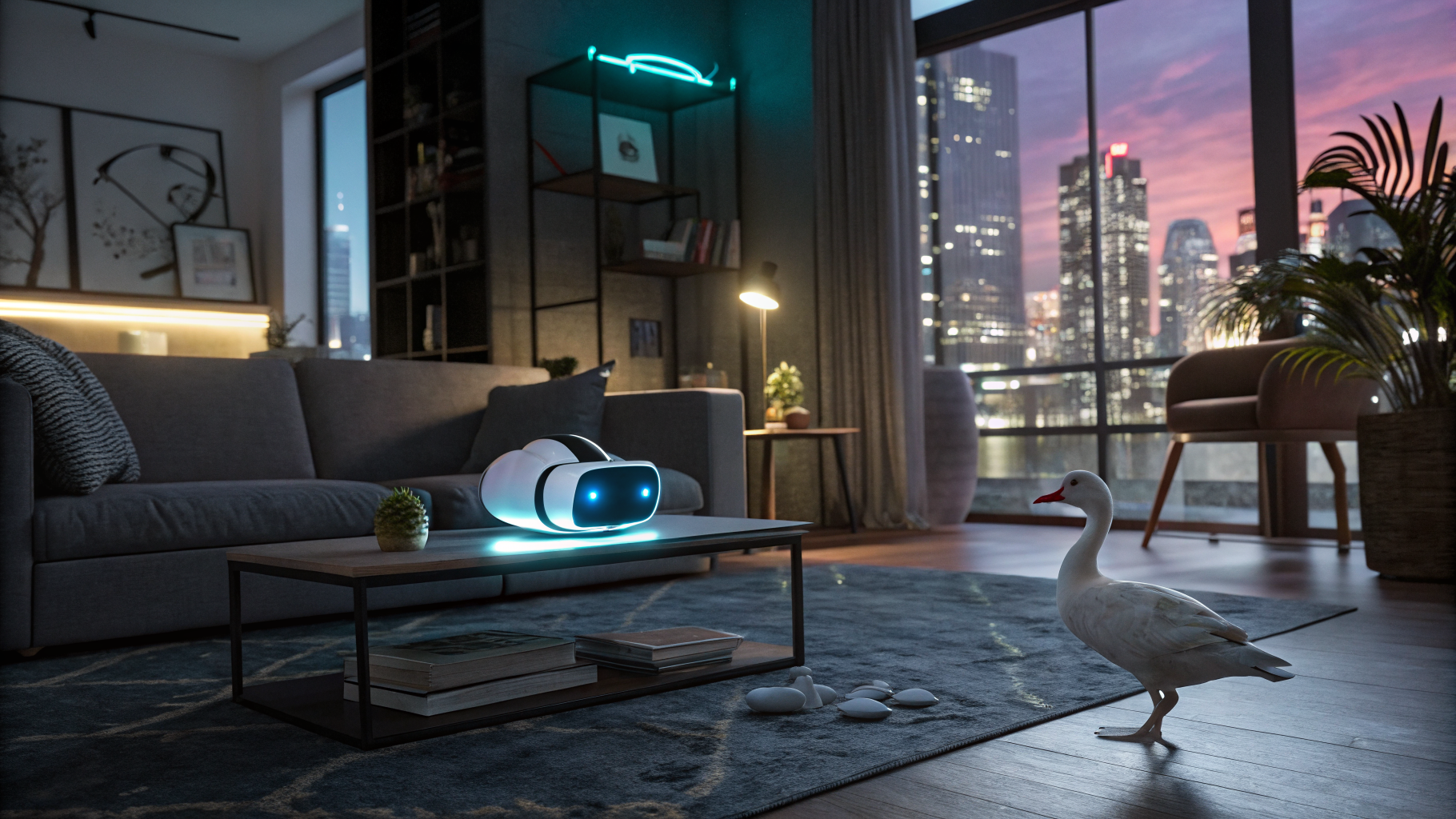
Look, I’m not above admitting when a trailer makes me laugh out loud. Duck Duck Goose is a physics-based party game where you play as a goose. Yes, a goose. You waddle around, honk at people, steal things, and generally cause mayhem. It’s Untitled Goose Game meets Gorilla Tag, and I have no idea if it will be any good. But the trailer had me at the moment a goose stole a VR headset from a player’s face.
Is this the future of VR? Probably not. But it’s the kind of silly, physical fun that the medium does better than any other. If the physics are tight and the multiplayer works, this could be a sleeper hit for parties. Or it could be a janky mess. Either way, I’m curious.
Ruff Talk knows its audience. The crowd that watches these showcases lives for the weird stuff. Duck Duck Goose is weird. And I mean that as a compliment.
Shooters That Actually Look Fun
There were a few shooters in the lineup, and I’m happy to report that most of them didn’t look like generic cover-shooter number 47. Frostpoint — no, not the Frostpoint VR from a few years ago — is a new tactical shooter set in a frozen wasteland. The trailer showed players sliding across ice, using environmental hazards, and freezing enemies solid before shattering them. The ice physics looked legitimately interesting. I’ve played too many VR shooters where you just stand still and shoot. Movement-based combat is where the genre needs to go, and Frostpoint seems to understand that.
Then there’s Breach & Clear, a tactical shooter with a focus on planning. You set up your approach before executing it in real time. The trailer showed a player marking targets, setting breaching charges, and coordinating with a squad. It looked like Rainbow Six but in VR, which is something I’ve wanted for years. The question is whether the planning phase feels like a gimmick or a genuine addition. I’ll reserve judgment until I play it, but the concept has legs.
What I didn’t see was a lot of innovation in the gunplay itself. Most of the shooters still rely on the standard two-handed aiming and reload mechanics. That’s fine for now, but I’m starting to feel like we’re in a plateau. The hardware is capable of more. Where’s the game that uses finger tracking for reloading? Where’s the shooter that makes you actually feel the weight of a weapon? Maybe next year.
Horror Gets Intimate
Horror was a strong theme today. Beyond Into the Dark, we saw Home Scan, a game that uses your real room as the environment. The premise is simple: you scan your living space, and the game generates a horror experience around it. In the trailer, a player’s own couch became a hiding spot for a creature. Their bookshelf became a portal. Their kitchen became a labyrinth.
I’ve seen room-scanning tech before, but Home Scan looks like it’s doing something more personal. There’s something uniquely unsettling about being hunted in your own living room. The game knows where you sit. It knows where you sleep. That’s a level of intimacy that flat horror games can’t touch. I’m genuinely excited for this one, but I’m also a little worried. I don’t want to be afraid of my own couch.
Another horror title, The Static, promised a psychological thriller set in a crumbling apartment building. The trailer leaned on glitchy visuals, distorted audio, and a sense of unreality. It reminded me of Layers of Fear, but in VR. That’s a high bar. Layers of Fear worked because it didn’t just scare you — it messed with your perception. The Static seems to be aiming for the same effect. We’ll see if it lands.
Rhythm Games Keep Marching
No VR showcase is complete without a rhythm game. Today’s entry was Beat the Beat, a game that bills itself as a « rhythm RPG. » You fight enemies by hitting notes in time with the music. It’s Beat Saber meets Crypt of the NecroDancer. The trailer showed colourful enemies, boss fights, and a soundtrack that leaned heavily on electronic music.
I’m a little tired of rhythm games in VR. They’re everywhere. But Beat the Beat at least tries to differentiate itself by adding RPG mechanics. You level up, unlock skills, and customize your playstyle. Whether that actually works in practice is another question. Most rhythm games fail when they try to add complexity. The genre is at its best when it’s pure. But I’ll give it a chance.
What I do appreciate is the accessibility. The trailer showed a one-handed mode and adjustable difficulty. That’s good. VR needs more games that don’t require you to be a professional athlete to enjoy them.
The Social Side
There was a noticeable push toward social experiences in today’s showcase. Neon Horizon is a virtual hangout space that looks like a cyberpunk nightclub. You can dance, chat, play mini-games, and customize your avatar. It’s Rec Room meets Blade Runner. The visuals were genuinely impressive — neon lights, reflective floors, floating holograms. But I have to ask: do we need another social platform? VRChat, Rec Room, Horizon Worlds, Bigscreen… the list goes on. The barrier to entry for a new social space is high. You need a critical mass of users to make it work. Neon Horizon looks pretty, but pretty isn’t enough.
That said, the developer mentioned cross-platform support and a focus on user-generated content. If they nail the creation tools, maybe they can carve out a niche. I’m skeptical, but I’ve been wrong before.
Tech and Tools
A few non-game announcements caught my eye. One was AnimVR, a tool for creating 3D animations in VR. The update showed improved rigging, better timeline controls, and integration with Blender. This is the kind of thing that matters more than any single game. VR’s long-term viability depends on giving people tools to create, not just consume. AnimVR has been around for a while, but the updates look substantial. If you’re an aspiring animator, this might be worth trying.
Another tool, SpaceCraft, is a modular building system for designing virtual environments. Think of it as Minecraft for professional world-building. The demo showed a user constructing a detailed medieval village in minutes. The potential for rapid prototyping is obvious. Game developers, take note.
The Big Picture
So what did I learn from today’s showcase? A few things.
- VR indie development is alive and weird. The big studios are still cautious, but the indie scene is experimenting with physics, horror, and social spaces in ways that keep the medium interesting.
- We’re in a holding pattern on hardware. None of the games shown today seemed to push the boundaries of what current headsets can do. That’s fine — not every game needs to be a tech demo — but I’m starting to wonder when the next leap will come. The Quest 3 is great, but it’s been out for a while. Where’s the Quest 4? Where’s the affordable PCVR headset that doesn’t require a second mortgage?
- Physics-based games remain the most fun. Duck Duck Goose and Frostpoint both rely on physics in clever ways. That’s where VR shines. When you can pick up a goose and throw it at your friend, or slide across ice to dodge bullets, you’re doing something that no other medium can replicate. That’s the magic.
I also noticed what wasn’t there. No big announcements from Meta or Sony. No surprise ports of AAA flat games. No hardware reveals. This was a showcase for the little guys, and honestly, that’s refreshing. The VR industry spends too much time chasing the mainstream. Sometimes it’s good to remind ourselves that weird, small, experimental games are what make this platform worth investing in.
Will any of these games be the next Beat Saber or Half-Life: Alyx? Probably not. But that’s not the point. The point is that people are still making things. They’re still taking risks. They’re still putting a duck in a VR headset and calling it a game. And I love that.
Ruff Talk didn’t break the internet today. But it did remind me why I still care about VR after all these years. It’s not the polished blockbusters. It’s the wobbly duck.
Further Reading
Check out the full list of announcements at UploadVR: Everything Announced At The Ruff Talk VR Showcase Today
Original source: read the full article