Free Puzzle on Quest: Don’t Roll Your Eyes Yet
Another free game on Meta Quest. I know, I know. The store is a graveyard of half-baked experiences, shovelware dressed up in VR gimmicks, and titles that feel like they were designed by a committee of MBAs who’ve never actually put a headset on. But every so often, something slips through the noise. Something that makes you remember why you bought that expensive piece of plastic strapped to your face in the first place.
Squingle Arcade is out today on Meta Quest, and it’s free. That’s not a typo. It’s a fast-paced VR and MR puzzle game with hand tracking support, and it’s asking for exactly zero dollars from your wallet. I’ve been burned before by “free” VR content, but I’ll admit: after spending an hour with it, I’m cautiously optimistic. Let’s dig into why.
The Gist: Squingle Me This
If you’ve never heard of Squingle, you’re not alone. The original Squingle was a mobile puzzle game—think sliders, tubes, and colored balls that you guide into matching holes. It was simple, meditative, and surprisingly addictive. The VR/MR version, Squingle Arcade, takes that core loop and wraps it in a spatial computing package. You’re not just tapping a screen; you’re physically reaching into a 3D space, grabbing pathways, and rerouting flows with your actual hands. Or controllers. Your call.
What struck me here is the pacing. Most VR puzzle games lean into “relaxing” — slow music, gentle visuals, the kind of thing you play before bed. Squingle Arcade does not. It’s arcade-style, meaning you’ve got a ticking clock, a score multiplier, and the pressure of a leaderboard breathing down your neck. It’s the difference between a lazy Sunday afternoon and a Friday night at the pinball hall. Both can be fun, but one gets your heart rate up.
Hand Tracking: Finally, It Works (Mostly)
Let’s talk about the elephant in the room: hand tracking on Quest. Meta has been pushing this feature for years, and for good reason. It’s the closest thing we have to true VR nativity — no controllers, no learning curve, just you and the digital world. But historically, hand tracking has been janky. Fingers clip through objects. Gestures get misinterpreted. You wave at a menu and accidentally summon Cthulhu.
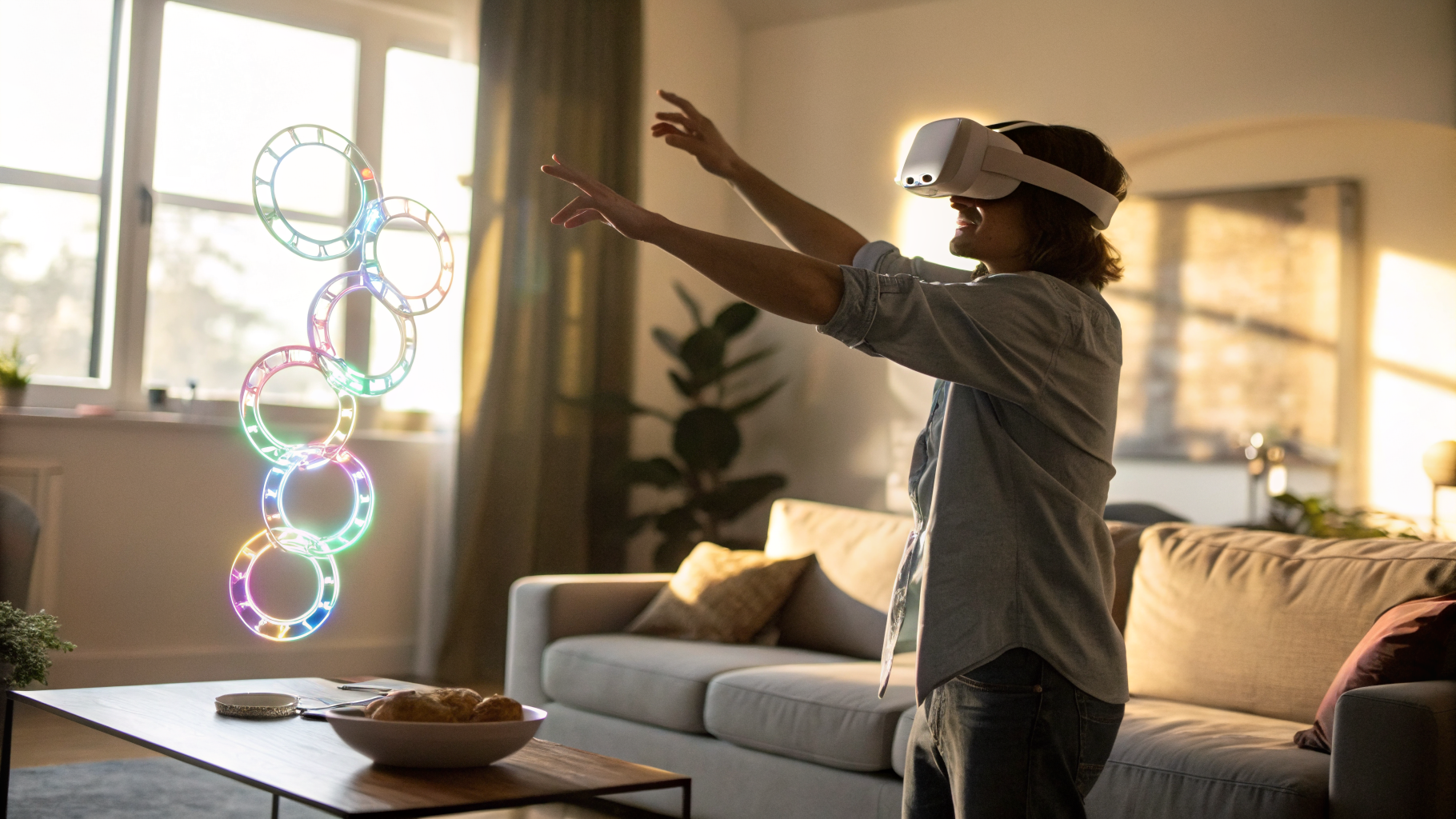
In Squingle Arcade, hand tracking actually feels… good. Not perfect, but good. The game is designed around grab-and-drag mechanics: you pinch to pick up a pipe segment, then pull to rotate or reposition it. It’s intuitive. I tested it in both VR and mixed reality modes, and the tracking held up in moderate lighting. There’s a slight delay — maybe 100 milliseconds — but your brain adapts quickly. For a free game, this is impressive. For a paid game, it would still be respectable.
Does it beat controllers for precision? No. If you’re chasing high scores, you’ll want the tactile feedback of the Touch controllers. But for casual play, especially in MR where you can see your real-world surroundings, hand tracking is the way to go. It makes you feel like a wizard rearranging the universe. Or at least a plumber with very clean hands.
Mixed Reality: Not Just a Gimmick Here
I’ve been critical of mixed reality on Quest. Too many apps just slap a virtual window in your living room and call it a day. Squingle Arcade does something smarter: it places the puzzle on your actual table or floor, and you walk around it. The game scans your room, finds a flat surface, and anchors the playfield there. You can circle it, lean in, and peer at angles that a 2D screen could never offer.
This changes the puzzle solving. In VR, you’re locked into a fixed perspective — you can look around, but the game world is a bubble around you. In MR, the puzzle becomes a physical object in your space. I found myself crouching to see under a bridge of tubes, stepping left to align a path, and accidentally kicking my coffee table. (Note to self: clear the room before playing.) It’s more active, more embodied, and frankly more fun.
Is this the killer app for MR? No. But it’s a strong proof of concept. If more developers design for room-scale mixed reality instead of just porting flat UI into passthrough, we might actually get somewhere.
What’s the Catch? Monetization and Depth
You’re probably thinking: “It’s free, so where’s the catch?” Fair question. Squingle Arcade is ad-free and doesn’t shove in-app purchases in your face — at least not yet. The current model is straightforward: you get a set of levels, and you play them. There’s a leaderboard for bragging rights, and that’s it. No energy systems, no loot boxes, no “watch an ad to unlock a hint.” I appreciate that.
But the depth is limited. I cleared the initial batch of levels in about 45 minutes. The difficulty ramps up — later puzzles require multi-step planning and quick reflexes — but I’m not sure how long the content will hold. The developer, Ben Follington, has a history of updating his games post-launch (the original Squingle got several content drops), so I’m hopeful. But as of today, if you’re a hardcore puzzler, you might exhaust it in an evening.
That said, 45 minutes of polished, free entertainment is nothing to sneeze at. How many times have you paid $10 for a VR game that you played for 20 minutes and never touched again? At least here, the only risk is your time.
Visuals and Sound: Clean, Not Cutting-Edge
Let’s not pretend Squingle Arcade is a visual showcase. The aesthetic is clean, minimalist, and colorful — think Monument Valley meets a 3D logic puzzle. The textures are flat, the lighting is simple, and there’s no ray tracing or fancy particle effects. But that’s not a criticism. In VR, clarity and frame rate matter more than polygon counts. The game runs at a solid 90Hz on Quest 2 and 3, with no noticeable stutter. That’s the kind of optimization I respect.
The sound design is where it shines. Each tube connection clicks satisfyingly. The background music is a low-key synthwave that builds as the timer runs low. It’s not going to win a Grammy, but it keeps you in the zone. I played with headphones and noticed the spatial audio: when a ball moves through a tube behind you, you hear it shift from left to right. Small touch, big immersion.
Who Is This For? And Who Should Skip It?
Let’s get specific. If you’re a VR veteran who owns a Quest and has a shelf full of puzzle games, Squingle Arcade is a no-brainer download. It’s free, it’s polished, and it gives you a solid reason to dust off your headset. If you’re new to VR and want something that doesn’t require a PhD in controller mapping, this is a gentle on-ramp. Hand tracking means you can show it to friends without explaining buttons.
Skip it if you hate timed puzzles. I know some people prefer to solve at their own pace. The arcade timer adds stress — not everyone’s cup of tea. Also skip it if you’re looking for a narrative. There’s no story here, no characters, no emotional arc. It’s just you, the tubes, and the clock. That’s either liberating or hollow, depending on your mood.
The Bigger Picture: Free Games and the Quest Store
I’ve been writing about this industry for over a decade, and I’ve seen the Quest store evolve from a Wild West of indie experiments to a curated (but still chaotic) marketplace. Free games are a double-edged sword. They lower the barrier to entry, but they also flood the store with low-effort content. Squingle Arcade sits in a sweet spot: it’s free, but it doesn’t feel free. It feels like a real game that happens to cost nothing.
That matters. In a world where Meta is spending billions on the metaverse and VR is still fighting for mainstream adoption, we need entry points that don’t feel like a scam. Squingle Arcade is one of those rare birds. It’s not going to sell headsets, but it will make existing headset owners smile. And sometimes, that’s enough.
Final Verdict: Download It, But Don’t Expect a Masterpiece
I’m not going to tell you that Squingle Arcade is the best VR game of the year. It’s not. It’s a clever, well-executed puzzle game with excellent hand tracking and a genuinely fun MR mode. It’s free, it’s short, and it respects your time. In 2024, that’s almost a radical statement.
So go download it. Spend an hour twisting tubes and chasing high scores. If you hate it, you’ve lost nothing but a bit of storage space. If you love it, you’ve found a hidden gem. And if you’re like me, you’ll be refreshing the store page for the next content update, hoping the developer keeps the momentum going.
Because in the end, that’s what this space needs: not hype, not promises, but games that just work. Squingle Arcade works. And for free, that’s a deal you don’t see every day.
Original source: read the full article