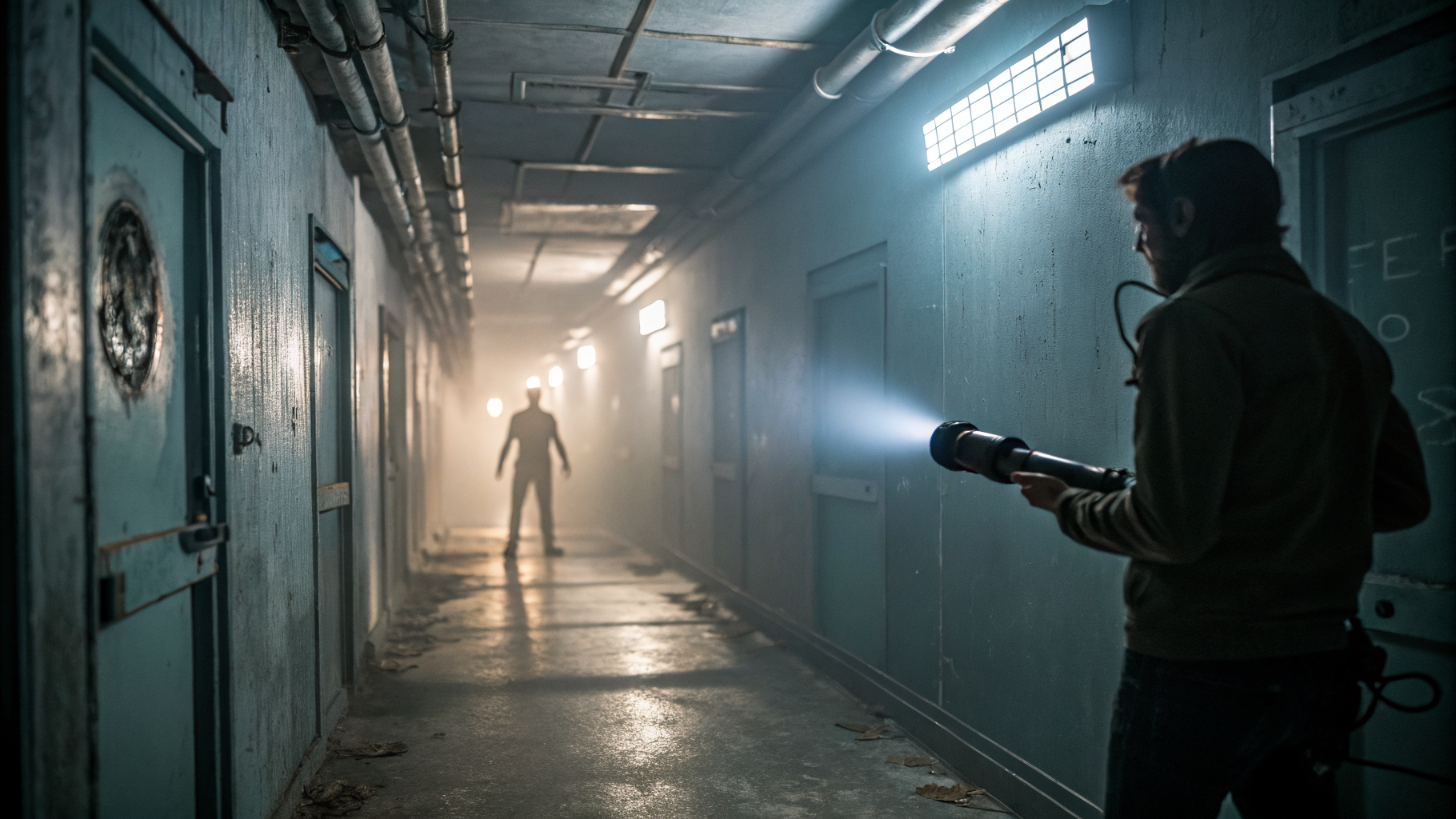
There’s a particular kind of dread that only VR can deliver. It’s not jump scares — those are cheap, and your lizard brain gets wise to them after the third or fourth loud noise. No, the good stuff is when you’re standing in a dimly lit hallway, and you know something is behind you, but you’re too terrified to turn around. That’s the territory The Obsessive Shadow Chapter 2 claims to inhabit.
Announced this week for PC VR, PlayStation VR2, and Meta Quest, Chapter 2 of this survival horror series is making the rounds again. The original chapter landed with a quiet thud in 2022 — a decent proof of concept, but not exactly the second coming of Alien: Isolation in VR. So why should anyone care about this sequel? I’ll tell you: because the trailer, sparse as it is, suggests the team has learned from its mistakes.
The premise is simple, and that’s a good thing. You’re stalked by a shadowy creature. Not a monster with glowing eyes and giant teeth. Not a zombie horde. Just a shadow. Something that moves when you don’t look at it. Something that breathes — if shadows can breathe — right behind your shoulder. It’s the kind of minimalist horror that works brilliantly in VR, where your peripheral vision becomes a liability rather than an asset.
Let me be blunt: most VR horror games rely on the same tired tricks. A dark corridor. A flickering light. A monster that lunges from a locker. Rinse and repeat. The Obsessive Shadow series, at least in its second chapter, seems to understand that the real horror is anticipation. The waiting. The not-knowing. That moment when you’ve been safe for two minutes and your brain starts whispering, “Maybe it’s gone.” It’s not gone. It’s never gone.
What’s New in Chapter 2 (Besides the Obvious)
According to the announcement, Chapter 2 introduces a new environment — something about an abandoned research facility. I’ll be honest, that description made me roll my eyes at first. Abandoned research facilities are the pumpkin spice lattes of horror settings. But the developers claim the layout is designed around the creature’s AI, meaning the shadow can stalk you through vents, under floorboards, and across ceilings. If they pull that off, it could be genuinely unsettling.
The other big addition is interactivity. In Chapter 1, you could mostly just hide and run. Now you can throw objects to create distractions, barricade doors, and even use a UV light to temporarily repel the creature. The UV light thing sounds a bit gamey to me — like a boss mechanic from a 2010s shooter — but I’m willing to give it a chance if it’s used sparingly. The best horror games make you feel powerless, not like a ghostbuster with a fancy flashlight.
What struck me here, reading between the lines of the press material, is that the developers are leaning hard into the “psychological” angle. They talk about the creature learning your patterns. If you always hide in the same closet, it will eventually check that closet. If you sprint everywhere, it will start cutting off your routes. This is the kind of adaptive AI that made Alien: Isolation a masterpiece, and if a smaller studio can replicate even a fraction of that, we’re in for a treat.
Platforms, Performance, and the Quest Question
The game is confirmed for PC VR (SteamVR), PlayStation VR2, and Meta Quest. That’s a wide net, and it raises the usual questions about parity. Can the Quest version, running on mobile hardware, really deliver the same atmospheric lighting and shadow physics that make this concept work? Or will it end up looking like a PS2 game with a VR headset strapped to it?
I’ve seen too many promising horror titles get kneecapped by Quest limitations. Into the Radius managed it well, but that game was built from the ground up with Quest in mind. The Obsessive Shadow started on PC, and I worry the sequel might have to cut corners to fit into that 8GB RAM envelope. The developers haven’t released specs yet, but I’d advise PC VR players to wait for performance benchmarks before pre-ordering. PS VR2 owners, on the other hand, should be in good shape — the headset’s OLED panels and haptic feedback could make the shadow’s presence feel almost tactile.
There’s also the question of PlayStation VR2 adoption. Sony’s headset is still struggling to find a large audience, and horror games are a niche within a niche. But if The Obsessive Shadow Chapter 2 launches with solid eye-tracking features — like the creature only moving when you blink, or the game knowing exactly where you’re looking — it could become a showcase title. That would be a smart move for the developers, because PS VR2 needs exclusives that actually use the hardware.
Why This Matters (Beyond the Scares)
I’ve been covering VR horror for over a decade, and I’ve seen the genre evolve from tech demos to legitimate art. The Obsessive Shadow series represents something I think the industry needs more of: focused, small-scale experiences that don’t try to be the next Half-Life: Alyx. Not every VR game needs to be a 20-hour epic with voice acting and set pieces. Sometimes all you need is a single room, a shadow, and the knowledge that you can’t outrun it.
That said, I’m wary of the “Chapter” model. Releasing a horror game in episodic chunks is risky. If Chapter 2 is only 90 minutes long and ends on a cliffhanger, players will feel cheated. The developers need to ensure that each chapter feels like a complete story, even if the larger narrative continues. The Walking Dead: Saints & Sinners did this well — each chapter had a beginning, middle, and end, with a satisfying gameplay loop. If The Obsessive Shadow can pull off the same trick, it could build a loyal following.
But here’s the thing: I’m tired of VR horror games that promise “psychological terror” and deliver “hide under a desk simulator.” The genre is overcrowded with titles that mistake darkness for depth. What sets The Obsessive Shadow apart, potentially, is its focus on a single, persistent antagonist. The creature isn’t a scripted event; it’s an AI that lives in the game world with you. That’s rare in VR, and it’s hard to pull off. When it works, it’s unforgettable. When it fails, you get a janky mess where the monster gets stuck on a chair.
What I Want to See in the Final Build
- No hand-holding. Don’t give me a tutorial. Throw me into the facility with nothing but a dying flashlight and let me figure it out. The best horror is disorienting.
- Substance over length. I’d rather have two hours of tightly designed terror than six hours of padding. Quality over quantity, always.
- Smart audio design. VR horror lives and dies by its sound. I want to hear the shadow breathing, scratching, moving through vents. I want to question whether that creak is the building or the creature.
- No inventory puzzles. Please, for the love of all that is holy, do not make me combine a rubber duck with a keycard to open a door. Just let me survive.
The Verdict (So Far)
I’m cautiously optimistic. The Obsessive Shadow Chapter 2 has the right ingredients — a strong concept, adaptive AI, and a clear vision for what it wants to be. But the execution is everything. We’ve been burned before by VR horror that looked great in trailers and fell apart at launch. I’m thinking of The Persistence, which was solid but never quite scary, or Paranormal Activity: The Lost Soul, which was more frustrating than frightening.
What gives me hope is that the developers seem to understand the value of restraint. They’re not promising a 10-hour campaign or multiplayer modes. They’re promising a focused, single-player horror experience that respects your time and your nerves. In an industry that’s constantly shouting “bigger, better, more,” that quiet confidence is refreshing.
Will I buy it on day one? Probably not. I’ve learned to wait for reviews, especially for VR horror. But I’ll be watching closely. And if the shadow really does learn my patterns — if it really does stalk me through that abandoned facility, adapting to my every move — then I’ll be the first to admit I was wrong to be skeptical. I’ll be too busy screaming.
Further Reading
Read the original announcement on UploadVR
Original source: read the full article