Let me be blunt: most VR action games feel like you’re running through molasses while wearing someone else’s prescription glasses. The feedback loops are off, the movement systems betray the promise of presence, and by the time you’ve figured out the controls, you want to throw the headset across the room. I’ve covered this stuff for over a decade. I know the pattern.
So when DreamVR, the studio behind a truckload of location-based VR experiences, dropped The Rifted Skies during today’s VR Games Showcase, I leaned in. Not because I expected much — location-based VR has its own set of compromises — but because there’s a hunger in this community for something that doesn’t feel like a tech demo dressed up as a game. And this one? It might just deliver.
What Exactly Is This Thing?
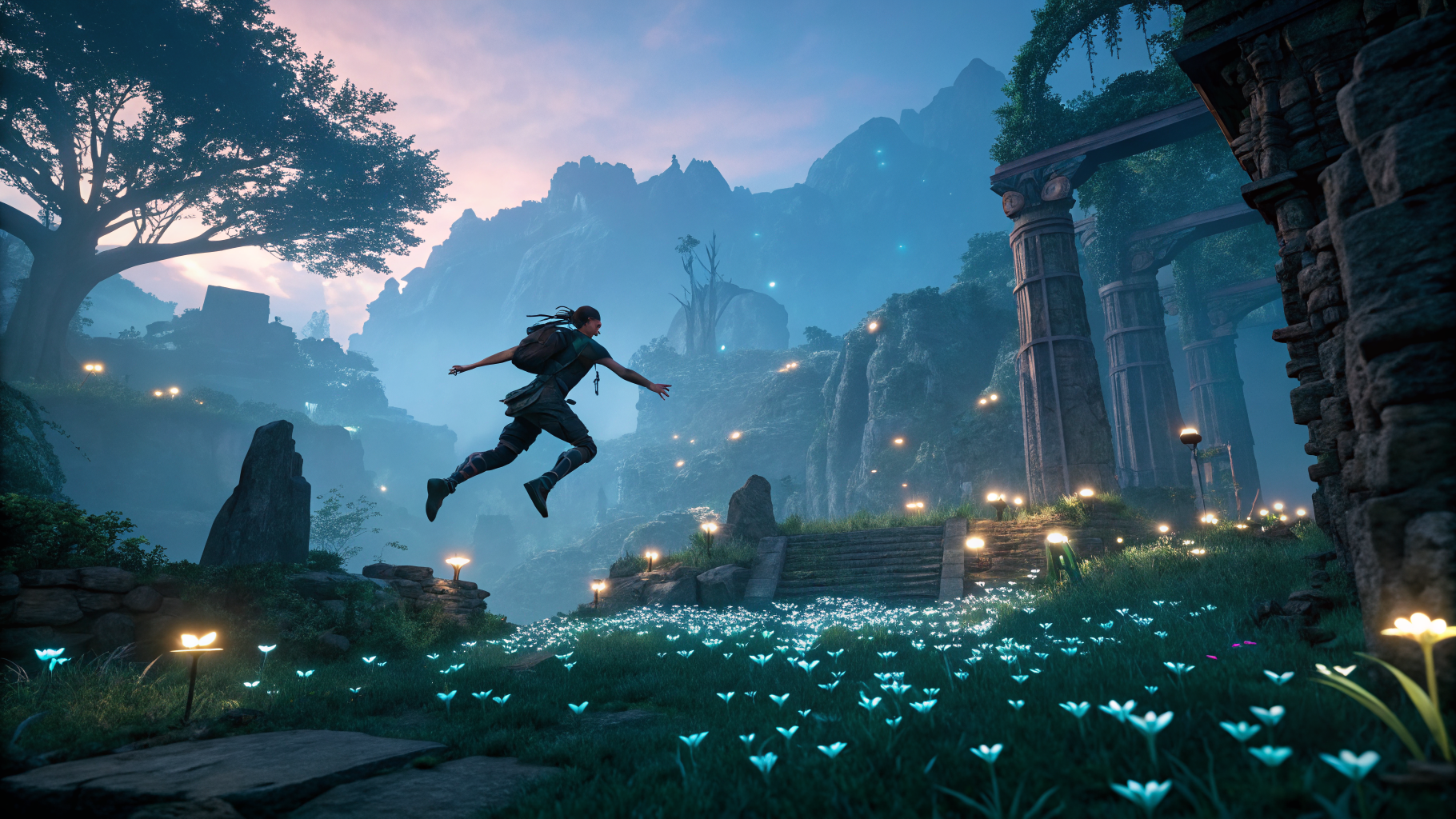
The Rifted Skies is a high-speed parkour roguelite. You leap, vault, slide, and grapple through procedurally generated sky-island environments, fighting enemies with a mix of melee and ranged combat. Death resets your run. You unlock upgrades. You try again. Sound familiar? It should. The roguelite formula has been done to death in flat-screen gaming, but in VR, it’s still a frontier. And that’s where things get interesting.
DreamVR isn’t some garage-startup outfit. They’ve been in the VR trenches since before the Rift CV1 shipped. Their location-based work — think arcade-scale VR experiences with bespoke hardware — has given them a unique perspective on what makes movement in VR actually work. Not just what looks good on a trailer, but what keeps your inner ear from staging a revolt.
The Movement Problem, and Why This Might Solve It
Here’s the thing about VR parkour: it’s hard. Harder than most developers admit. The disconnect between your physical body and your virtual one is a chasm that most games try to paper over with comfort vignettes, teleportation, or snap turning. All of which kill the immersion. You can’t feel like a parkour master if you’re blinking from ledge to ledge like a nervous turtle.
What struck me about The Rifted Skies is how they’re approaching the problem. The game uses a combination of arm-swinging locomotion — you pump your arms to run — and contextual grabs. Want to vault over an obstacle? Reach out and pull yourself up. Need to slide under a crumbling arch? Crouch in real life and your character mirrors it. It’s not new tech, but the application matters. The rhythm of movement, the flow state, the sense that you’re not just pressing buttons but performing — that’s what separates a good VR game from a great one.
I asked myself: is this just another wave of hype? Maybe. But DreamVR has a track record of shipping polished, physically demanding experiences in their location-based work. They understand that VR isn’t a spectator sport. You have to sweat a little.
Roguelite Mechanics: A Perfect Fit or a Cop-Out?
Roguelites thrive on repetition with variation. You die, you learn, you get a little stronger, you try a different build. In VR, that loop could be a godsend. The problem with most VR action games is length — they’re either too short to justify the price or padded with filler. A roguelite sidesteps that entirely. Each run is a self-contained arc. Fifteen minutes of adrenaline, then a reset.
But there’s a risk. Roguelites in VR can feel punishing in the worst way. Losing progress after a 40-minute run because of a janky hitbox or a tracking glitch isn’t fun. It’s infuriating. The Rifted Skies promises a « wide variety of upgrades » and « branching paths » through its sky-island biomes. I want to believe them. But I’ve been burned before. The proof will be in the pacing — how quickly you get back into action, how meaningful the upgrades feel, and whether the procedural generation creates variety or just noise.
What gives me hope is the studio’s background. Location-based VR experiences are ruthlessly optimized for throughput. You have four people waiting for their turn. The experience has to be polished, intuitive, and reliable. That discipline translates well to a consumer roguelite where first impressions matter.
Visuals and Worldbuilding: Sky Islands Done Right?
The trailer shows floating islands, ancient ruins, and bioluminescent flora. It’s not trying to be photorealistic — it’s stylized, with a painterly approach that should age well and run smoothly on Quest hardware. Smart. Trying to push photorealism on a standalone headset is a fool’s errand. You end up with muddy textures and compromised frame rates. The Rifted Skies seems to know its lane.
I’m more interested in the verticality of the spaces. Parkour games live or die on their level design. If the islands feel like narrow corridors with a few ledges, it’ll fail. If they open up into multi-path playgrounds where you can chain wall-runs, swings, and slides in fluid sequences? That’s the dream. DreamVR hasn’t shown enough to confirm which direction they’re leaning, but the studio’s past work suggests they understand spatial storytelling — how to guide players through physical space without handholding.
Combat: More Than a Distraction
Let’s talk about the enemies. You’re not just parkouring through empty space. There are hostile creatures — floating drones, crystalline constructs, maybe something with tentacles (the trailer was coy). Combat is a mix of a sword and a ranged weapon. The roguelite upgrades will presumably let you specialize: become a glass-cannon sniper, a brawler, a mobility-focused ninja.
But here’s my concern: combat can easily become a speed bump in a parkour game. You’re flying along, feeling the flow, and then you have to stop and whack a few enemies before you can progress. That kills momentum. The best parkour games — Mirror’s Edge, for instance — let you take out enemies while moving. A slide into a kick, a wall-run into a takedown. The Rifted Skies needs to nail that seamless integration. If combat feels like a separate minigame, it’ll drag the whole experience down.
I’ll give DreamVR the benefit of the doubt for now. Their location-based titles often featured acrobatic combat sequences, and they have the motion-capture data and design experience to pull this off. But I’ll be watching the early previews closely.
Quest vs. PC VR: The Inevitable Compromise
The game is confirmed for both Quest and SteamVR headsets. That’s smart from a business perspective — Quest is where the install base is, SteamVR is where the enthusiasts are. But let’s be real: there will be compromises. The Quest version will almost certainly have lower poly counts, fewer particle effects, and a reduced draw distance. The PC VR version will look sharper and run smoother, assuming you have a rig that can handle it.
What worries me is whether the game’s core mechanics are designed around Quest’s limitations. If the parkour system is built for Quest’s tracking volume and then scaled up for PC, it might feel great on both. If it’s the other way around — PC-first with Quest as an afterthought — the Quest version could feel cramped and janky. DreamVR has experience with multiple hardware configurations from their location-based work, so I’m cautiously optimistic. But I’ve seen too many promising VR games stumble on Quest’s tracking boundaries.
The Roguelite Saturation Problem
I’m going to say something that might get me yelled at: the roguelite genre is overcrowded. Steam has thousands of them. Every indie developer with a pixel-art aesthetic and a procedurally generated dungeon seems to think they’ve invented sliced bread. Most are forgettable. A few — Hades, Dead Cells, Risk of Rain 2 — transcend the genre by adding something unique: narrative, movement, or systemic depth.
The Rifted Skies needs to find its hook beyond « parkour in VR. » The hook is the physicality. The feeling of actually reaching out and pulling yourself over an obstacle, of ducking under a swinging blade, of wind rushing past your ears as you leap into the void. That’s something no flat-screen roguelite can replicate. If DreamVR leans into that physicality hard — if they make you feel every jump, every near-miss, every recovery — they’ll have something special.
But if they rely too heavily on the roguelite structure as a crutch, if the runs feel samey after ten hours, if the upgrades are just percentage increases to damage and health… then it’s just another game in an endless sea of them. VR deserves better than that.
Release Window and Expectations
The game is slated for later this year. No specific date. That could mean anything from a polished launch in October to a rushed December release that gets patched for six months. I’d rather they take the time. VR launches are brutal — a buggy framerate or a broken tracking system can kill a game’s reputation overnight. DreamVR has the resources to do this right, but they also have the pressure of a market that’s still finding its footing.
I’ll be honest: I want this game to succeed. Not because I’m a fanboy, but because the VR gaming ecosystem needs a win in the action genre. We’ve had shooters. We’ve had horror. We’ve had rhythm games. But a truly great, replayable action game that makes you move your whole body? That’s the missing piece. The Rifted Skies could be that game. Or it could be another ambitious project that falls short of its trailer. I’m rooting for the former. But I’ve been covering this industry long enough to keep my expectations measured.
What do you think? Are you ready to sweat through another roguelite, or has the genre worn out its welcome? Drop a comment. I read them. I might even reply.
Further Reading
Original announcement on Road to VR.
Original source: read the full article