The Lara Croft That Never Was
I’ve been covering VR long enough to know that the graveyard of canceled projects is bigger than most launch lineups. But every now and then, a rumor surfaces that makes you stop scrolling. This one hits different. According to a report from UploadVR, the now-shuttered Vertigo Games Amsterdam was quietly developing a full-blown Tomb Raider VR game. Not a tech demo. Not a rail shooter. A proper, first-person Lara Croft adventure.
Let that sink in for a second. Lara Croft, the most iconic archaeologist in gaming history, was about to step into your living room. You’d be the one swinging across chasms, solving ancient puzzles, and dual-wielding pistols in 360 degrees. And then—poof. The studio closed. The project vanished. And we’re left with crumbs and speculation.
What struck me here is the timing. Vertigo Games Amsterdam was the team behind Arizona Sunshine and After the Fall—two titles that proved VR shooters could be more than gimmicks. They understood pacing, locomotion, and the kind of tactile feedback that makes VR feel real. Pair that with a franchise built on exploration and tombs, and you’ve got a recipe that could’ve been genuinely special.
Why This Hurts More Than Most Canceled VR Games
Look, VR has had its share of high-profile cancellations. Half-Life: Alyx was a miracle, not the norm. But Tomb Raider VR felt inevitable. The series has already dabbled in VR—remember the Rise of the Tomb Raider 20th anniversary celebration mode on PSVR? That was a small, on-rails teaser. It was fine, but it wasn’t the real thing. This was supposed to be the real thing.
Vertigo Games Amsterdam wasn’t some fly-by-night port house. They were acquired by Embracer Group in 2020, and by all accounts, they had the resources and talent to pull off a AAA VR experience. The studio had around 70 people at its peak. They’d shipped multiple VR titles across PC, PlayStation, and Quest. They knew the hardware and the audience.
So what happened? The usual suspects. Embracer Group’s restructuring in 2023 hit hard. Vertigo Games Amsterdam was closed as part of a broader cost-cutting wave. The Tomb Raider VR project, if it existed, was likely still in pre-production or early development. It never had a chance to see the light of day.
What We Actually Know
UploadVR’s reporting is thin but credible. They cite “multiple sources familiar with the project” and confirm that the game was in development before the studio’s closure. No gameplay footage leaked. No concept art surfaced. Just the ghost of a great idea. I’ve reached out to former employees but haven’t heard back yet—off the record, one person said “it would’ve been something special.” That’s the kind of quote that haunts you.
For context, Vertigo Games Amsterdam was working on this alongside other projects. The studio was also reportedly developing a new IP and a VR port of a popular flatscreen game. But Lara Croft was the crown jewel. The one that could’ve brought mainstream attention back to VR at a time when the industry desperately needs it.
The State of VR in 2025: A Bleeding Wound
Let’s not sugarcoat it. VR is in a weird place right now. Meta’s Quest 3 is selling okay, but the hype train has derailed. Apple Vision Pro is a $3,500 curiosity. PlayStation VR2 is gathering dust on shelves. The biggest VR news this year has been about layoffs, studio closures, and hardware price cuts. We need tentpole franchises. We need Lara Croft, Master Chief, and Nathan Drake to show up and tell the world: “This is worth your time.”
Instead, we get cancellations. Tomb Raider VR wasn’t just another game—it was a potential system seller. Imagine the marketing: “Become Lara Croft. Explore the lost city of Kitezh in VR.” That’s a headline that moves headsets. That’s a trailer that gets shared. That’s the kind of IP that makes your mom ask, “Wait, I can play that?”
And now it’s gone. Because corporate cost-cutting doesn’t care about your dreams.
The Hard Truth About AAA VR Development
Building a game like Tomb Raider VR is brutally expensive. You’re not just making a game—you’re designing for comfort, motion sickness, hand tracking, room scale, and a dozen different headsets. The audience is tiny compared to console or PC. The return on investment is uncertain. Most publishers look at the numbers and walk away. Embracer Group looked at the numbers and walked away with a sledgehammer.
But here’s the thing: the audience exists. Half-Life: Alyx proved that. Asgard’s Wrath 2 proved that. Even Horizon Call of the Mountain, for all its flaws, showed that big-budget VR can move units. The problem is that publishers want instant hits. They don’t want to nurture a platform. They want Tomb Raider VR to sell 5 million copies on day one, and when that doesn’t happen, they pull the plug.
It’s a chicken-and-egg problem. No big games mean no headset sales. No headset sales mean no big games. And in the middle, projects like this one get buried.
What Could Have Been: A Thought Experiment
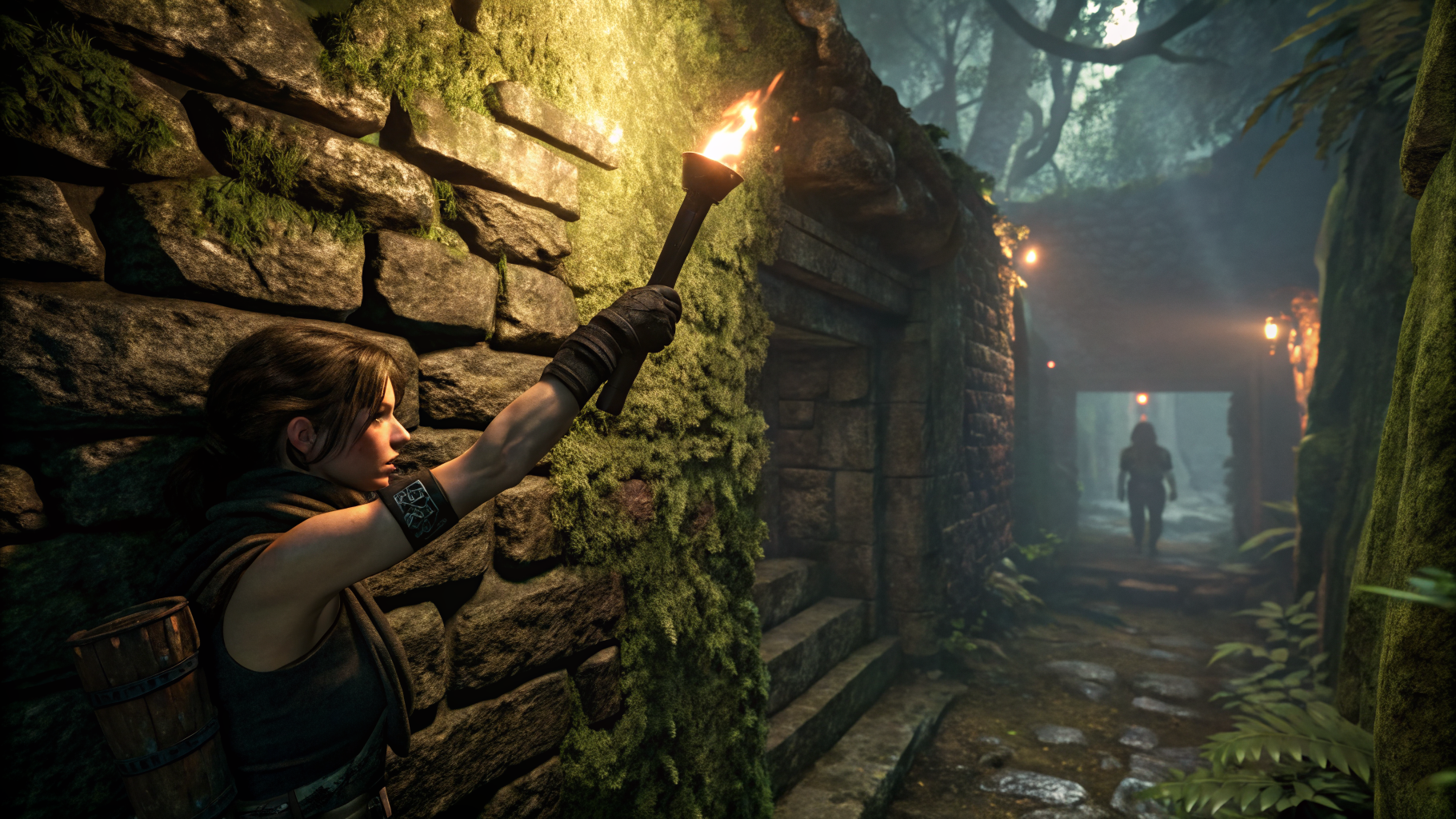
I can’t stop imagining it. The opening sequence: Lara in a dark cave, torch flickering, the sound of water dripping. You reach out and touch the wall—it’s wet, mossy. You look down and see your own hands, gloves worn from years of climbing. A puzzle looms ahead: rotating pillars, a pressure plate, a hidden door. You solve it with your actual hands, not a button prompt. That’s Tomb Raider VR.
Vertigo Games knew how to do this. Arizona Sunshine had that visceral, “oh crap, I’m really here” feeling. After the Fall nailed co-op shooter chaos. Apply that same design philosophy to Lara’s world—the tombs, the traps, the wildlife, the lore—and you’d have something that rivals any flatscreen entry in the series.
Would it have been perfect? Probably not. VR still has jank. Locomotion in a game that requires running, jumping, and climbing is a nightmare to get right. But I’d rather see a flawed attempt than nothing at all.
The Meta Connection
Here’s a wrinkle: Meta was reportedly interested in funding the project. They’ve been throwing money at VR exclusives for years—Resident Evil 4 VR, Assassin’s Creed Nexus, Beat Saber. A Tomb Raider VR game funded by Meta would’ve been a massive get. It would’ve given Quest owners a reason to brag. It would’ve pressured Sony and Valve to respond. Instead, the deal fell through alongside the studio.
I don’t know the details. Maybe Meta got cold feet. Maybe Embracer wanted too much. Maybe the project was still too early to pitch. But the fact that it was even on the table tells you something: the hunger for big IP in VR is real. The money is there. The execution is the problem.
What’s Next for Tomb Raider in VR?
Crystal Dynamics, the current stewards of the franchise, haven’t commented on this rumor. They’re busy with the next mainline Tomb Raider game, which is supposedly a unified timeline reboot. They’ve also got a Netflix animated series and a live-action Amazon show in the works. VR is probably not on their priority list.
But it should be. The Tomb Raider VR project is dead, but the concept isn’t. Someone will eventually make this game. Maybe a smaller studio will license the IP. Maybe Sony will resurrect it for PSVR 2. Maybe a modder will do it themselves—I’ve seen the VR mods for the Survivor trilogy, and they’re surprisingly functional.
Still, it’s not the same. Vertigo Games Amsterdam had the expertise, the track record, and the passion. They understood what makes VR tick. Losing them—and their Tomb Raider VR game—is a loss for the entire medium.
A Eulogy for a Game That Never Was
I’m not going to pretend this was going to be the second coming of VR. We’ll never know if it was good or bad. But I know this: the industry is poorer for its absence. Every canceled VR project sends a signal to developers that big risks aren’t worth it. Every time a studio closes, a dozen ideas die with it. And every time a franchise like Tomb Raider passes on VR, it becomes harder to convince the next one to try.
So here’s to the Tomb Raider VR game we almost got. The one that would’ve let us stand in Lara’s boots, feel the cold stone, and hear the click of an ancient mechanism. The one that might’ve convinced a few more people to put on a headset and believe. Rest in pieces.
I’ll be watching the modding community closely. And if you’re listening, Crystal Dynamics—call me. I’ve got ideas.
Original source: read the full article