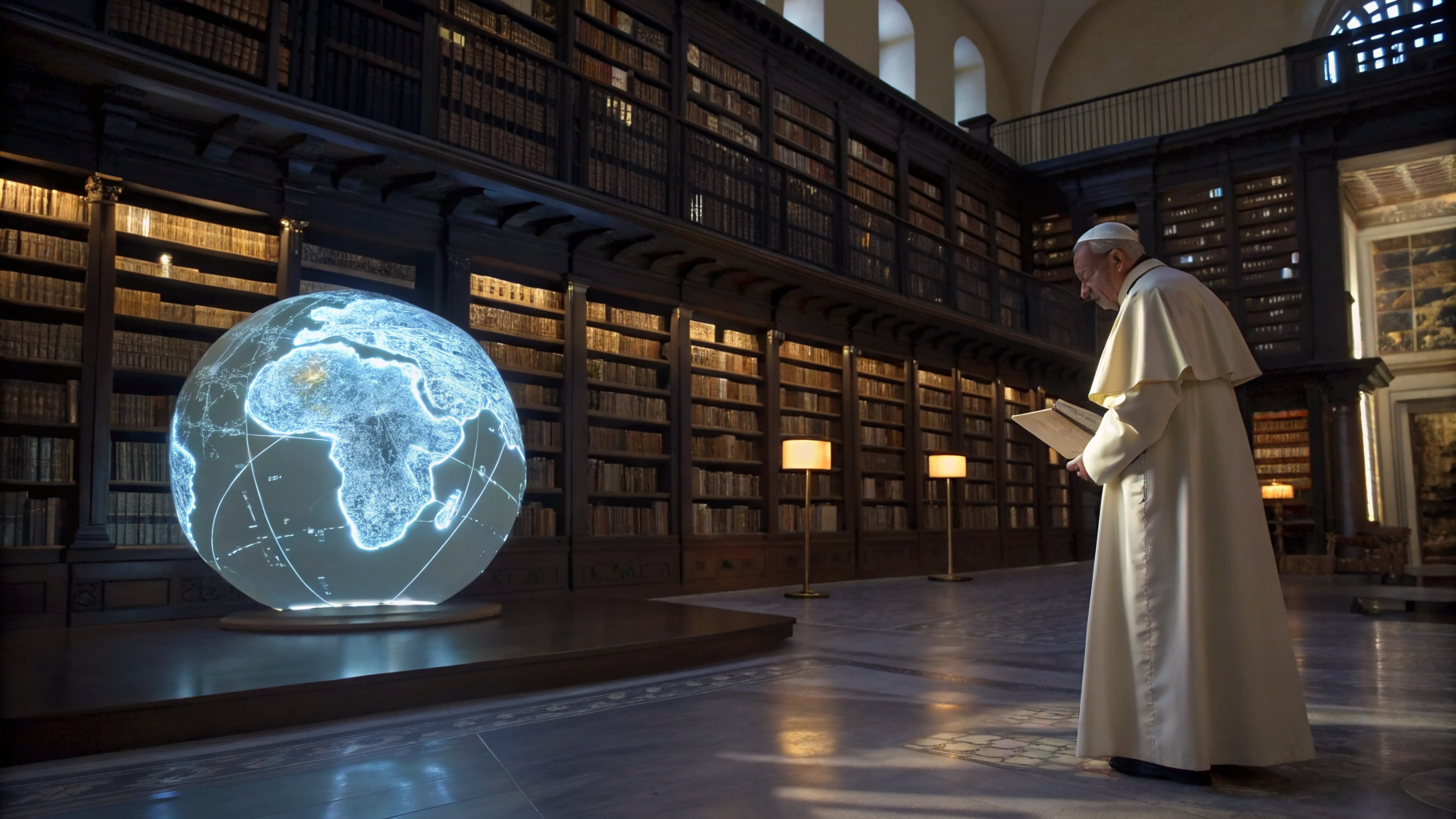
Let’s be honest. When I first saw the headline — Pope Leo calls for being ‘profoundly human’ in the age of AI — I braced myself for a predictable sermon. You know the type: tech is bad, the old ways are good, return to the garden. Another Luddite manifesto wrapped in incense.
But then I read the actual document. Magnifica Humanitas. And I have to admit: this thing has teeth. The pope isn’t just wringing his hands about chatbots. He’s talking about autonomous weapons, labor displacement, and something even more unsettling — the quiet way we’ve already started outsourcing our moral judgment to machines.
I’ve spent over a decade watching the tech industry promise utopia and deliver surveillance, gigification, and a whole lot of hype. So when a 2,000-year-old institution drops a 40,000-word critique of techno-solutionism, I pay attention. Not because I agree with everything — I don’t — but because the questions he’s asking are exactly the ones Silicon Valley refuses to answer.
The Warfare We’re Not Talking About
The section on AI-powered warfare is where the document earns its keep. Pope Leo doesn’t mince words: “To delegate life-and-death decisions to algorithms is to abandon the very foundation of moral responsibility.”
This isn’t abstract theology. We’ve already seen autonomous drones used in Libya. We’ve seen AI targeting systems that can’t distinguish between a child and a truck. The Pentagon is spending billions on “decision support” tools that nudge humans toward faster, deadlier choices. And every major tech company that builds AI for defense insists it’s purely “defensive.” Right.
What struck me here is the pope’s framing. He doesn’t just say “war is bad.” He says the act of delegating moral choice to a machine is a sin against human dignity. Not just a policy error — a sin. That’s a category shift. It reframes the debate from “how do we regulate this?” to “should we ever build this at all?”
I think that’s a useful provocation. We’ve spent years arguing about kill switches and meaningful human control. But the deeper question — the one that makes defense contractors uncomfortable — is whether any autonomous weapon can ever be ethical. The pope’s answer is a firm no. I’m not sure I’d go that far, but I appreciate the clarity. It forces the rest of us to pick a lane.
The Labor Question: Beyond the Talking Points
Let’s talk about work, because this is where the document gets really interesting — and where I start to disagree.
Pope Leo warns that AI is “turning workers into appendages of machines” and calls for a “new humanism of labor.” He’s worried about surveillance, algorithmic management, and the erosion of craft. He’s worried that we’re optimizing people out of jobs instead of designing systems that augment human capabilities.
All fair points. But here’s my pushback: the pope’s vision of labor feels a bit pre-industrial. He talks about work as a form of self-expression and community participation, which sounds lovely. But what about the millions of people whose jobs are genuinely tedious and dangerous? Do we really want to preserve the role of the warehouse worker who walks 15 miles a day picking boxes? Or the data entry clerk whose spine is ruined by 50 years of sitting?
I’ve interviewed enough Amazon warehouse workers to know that many of them would happily hand over the soul-crushing parts of their job to a robot. The problem isn’t automation itself — it’s that the gains from automation go to shareholders, not workers. It’s that we don’t have a social safety net. It’s that we treat productivity increases as an excuse to fire people rather than shorten their workweeks.
The pope is right to call for dignity in labor. But I think he underestimates how many people would welcome being freed from grueling work — if the system were designed to share the benefits. That’s not a critique of his values. It’s a critique of his imagination.
The Anthropic Paradox
One of the more surprising passages in Magnifica Humanitas is a direct reference to the AI company Anthropic. The pope praises their “constitutional AI” approach — training models to follow a set of ethical principles — but then warns that “no constitution written by humans can replace the living conscience formed by community, tradition, and grace.”
This is a sophisticated argument. It’s not anti-AI; it’s anti-AI-as-god. The pope is saying that ethics isn’t a set of rules you can code into a chatbot. It’s a practice, a relationship, a messy human process. You can’t outsource moral reasoning to a large language model any more than you can outsource prayer.
I’ve written about Anthropic’s approach before, and I generally admire their transparency. But the pope’s point lands: constitutional AI is a band-aid on a bullet wound. No matter how carefully you train a model, it doesn’t understand suffering. It doesn’t have a body. It doesn’t age, or grieve, or feel joy. It can simulate empathy, but that’s not the same as being in relationship with another person.
This is where the tech industry’s language fails us. We talk about “alignment” as if it’s a technical problem. The pope insists it’s a spiritual one. I’m not religious, but I think he’s onto something. The question isn’t just “does the AI do what we want?” It’s “do we know what we want?” And do we have the wisdom to pursue it?
What About the Metaverse?
Given that I write for a metaverse-focused publication, you’d expect me to dig into the document’s take on virtual worlds. The pope mentions “immersive digital environments” only briefly, but his warning is blunt: “When the virtual replaces the real, the soul begins to atrophy.”
Ouch.
I’ve spent years watching the metaverse hype cycle — from Facebook’s rebrand to the collapse of crypto land prices. And I’ve seen how these platforms can be isolating, addictive, and deeply alienating. But I’ve also seen genuine connection: a disabled artist finding community in VRChat, a historian recreating destroyed cultural sites, a therapist using VR to treat PTSD.
The pope’s critique is fair as a caution. But I think it misses the nuance. The problem isn’t the technology — it’s the business model. Most metaverse companies want to capture your attention, extract your data, and sell you digital junk. That’s what atrophies the soul. But a metaverse built on cooperation, accessibility, and genuine human connection? That could be something else entirely.
I wish the document had spent more time distinguishing between the tool and the system that deploys it. But then again, the pope isn’t a tech critic. He’s a moral philosopher. And from that perspective, his skepticism is understandable. After all, how many metaverse evangelists have actually delivered on their promises?
The Real Target: Techno-Feudalism
Underneath all the theology and ethics, Magnifica Humanitas is really about power. The pope calls out “unconstrained technological power” as a threat to democracy, human flourishing, and the common good. He’s not just talking about AI. He’s talking about the concentration of wealth and influence in a handful of tech monopolies.
This is where the document feels most urgent. We’ve seen how platforms like Meta and Google shape public discourse. We’ve seen how AI systems can reinforce bias, spread disinformation, and automate discrimination. We’ve seen how the people making these decisions are overwhelmingly young, male, rich, and disconnected from the communities they claim to serve.
The pope calls this “a new form of feudalism” — not with lords and serfs, but with platform owners and data subjects. I think that’s exactly right. We’ve traded physical chains for algorithmic ones. And we’ve done it voluntarily, one terms-of-service agreement at a time.
What’s the solution? The document offers some suggestions: stronger regulation, investment in public-interest technology, and a renewed emphasis on education that teaches critical thinking and moral reasoning. But the pope also calls for something harder: a change of heart. He asks us to resist the seduction of convenience, to value presence over efficiency, to remember that technology should serve humanity, not the other way around.
Is that naive? Maybe. But after a decade of watching tech companies promise the moon and deliver a data breach, I’m not sure we have the luxury of cynicism. Something has to change. And if a papal encyclical can help shift the conversation, I’m not going to sneer at it.
My Take: The Pope is Right (Mostly)
Look, I’m not a Catholic. I don’t believe in papal infallibility. And there are parts of Magnifica Humanitas that feel too nostalgic — a longing for a past that never quite existed. But on the big questions, the pope is asking the right things.
- Should we build autonomous weapons? Probably not.
- Should we let algorithms manage workers like cattle? No.
- Should we replace human relationships with AI companions? Absolutely not.
- Should we concentrate power in a few unaccountable corporations? Hell no.
These are not radical positions. They’re common sense. And yet, in the current climate, saying them out loud feels almost subversive. That’s how far the Overton window has shifted. We’ve normalized so much techno-determinism that a basic statement of human dignity sounds like a radical manifesto.
So I’ll end with this: Read the document. Or at least read the summaries. You may not agree with the theology. You may find some of the language flowery or outdated. But the core argument — that we need to be “profoundly human” in the age of AI — is not a platitude. It’s a challenge. And in a world where every startup promises to “disrupt” its way to a better future, a little profound humanity might be exactly what we need.
Further Reading
Original source: read the full article