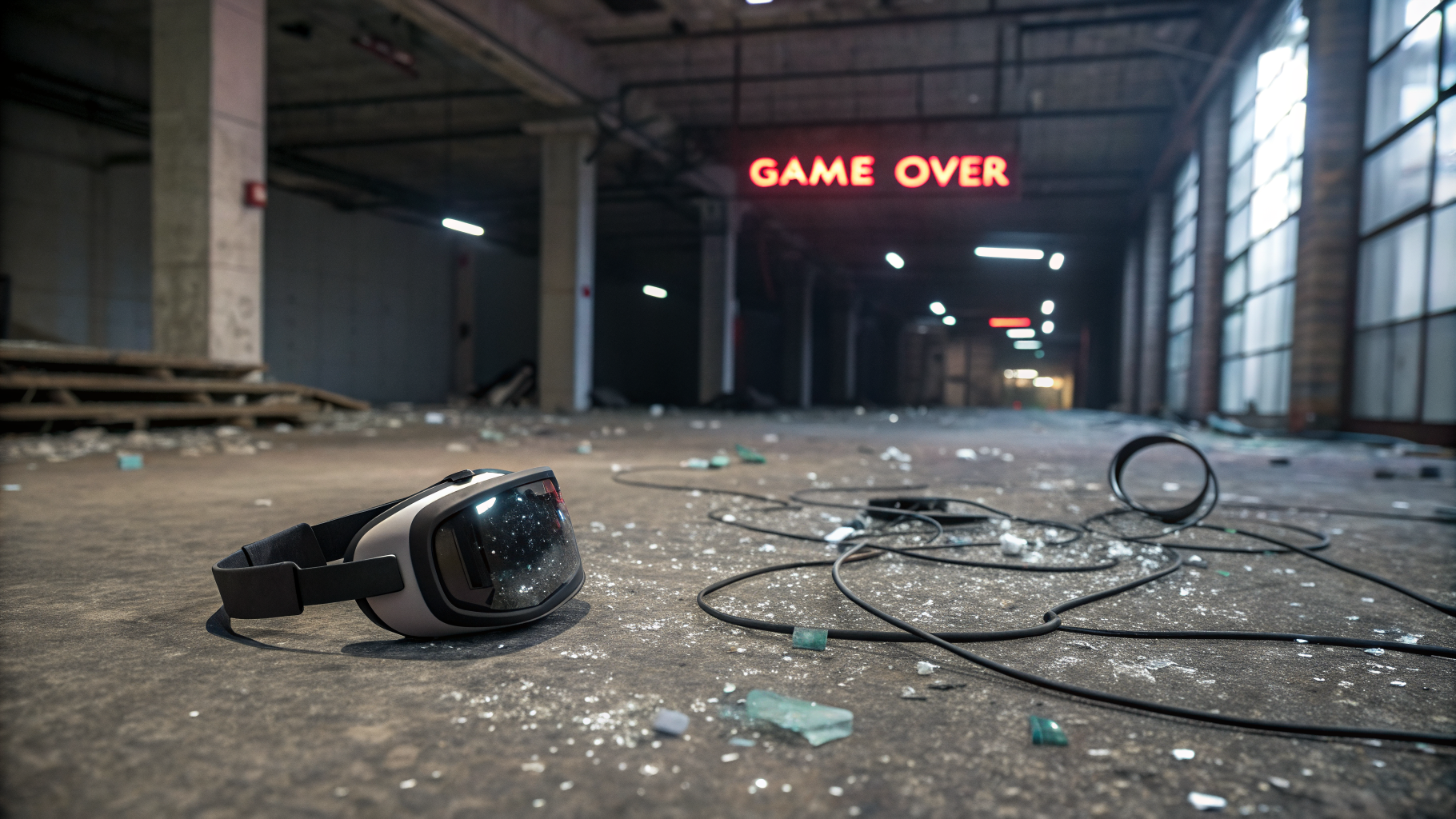
Another Week, Another Bloodbath
If you’ve been following VR long enough, you know the drill by now. A splashy headline, a round of funding, a roadmap full of promises — and then, silence. Then the layoffs. Then the shutdown notices. This week, we got a fresh batch of bad news that cut across genres, budgets, and platforms: Ghosts of Tabor’s developer announced a staff reduction; Quantaar and A Township Tale are shutting down; and Memoreum, a sci-fi FPS, is out of full-time development after poor sales.
Let’s be honest: none of this is surprising. But that doesn’t make it any less depressing.
I’ve been covering this space for over a decade. I’ve seen the peaks — the Facebook acquisition, the Quest 2 boom, the brief moment when everyone thought the metaverse would save retail — and I’ve seen the troughs. This feels like a trough. But not the kind where you wait for spring. This feels like a structural shift, the kind where the ground beneath your feet actually changes.
Ghosts of Tabor: The Extraction Shooter That Couldn’t
Let’s start with the biggest name in the bunch. Ghosts of Tabor is one of those rare VR success stories — a gritty extraction shooter that actually found an audience. It wasn’t a polished AAA release; it was scrappy, buggy, and demanding. And people loved it for that. It felt like Escape from Tarkov in VR, which is exactly the kind of hardcore niche that hardcore VR users crave.
So when the developer announced a staff reduction this week, I felt that familiar knot in my stomach. The official line was something about “restructuring to focus on core development.” Which is corporate-speak for: we ran out of runway, and we’re trying to keep the lights on.
What struck me here is the timing. Ghosts of Tabor isn’t some unknown indie experiment. It’s been in early access for a while, has a dedicated player base, and even made some noise on Steam and the Quest store. But extraction shooters are expensive to maintain — constant updates, anti-cheat measures, server costs. And in VR, the addressable market is still too small to support that kind of ongoing investment unless you’re backed by a platform giant.
I’m not saying the game is dead. But when a studio reduces headcount, the remaining team is stretched thin. Features get delayed. Bugs pile up. Community trust erodes. It’s a slow bleed, and I’ve seen it happen too many times to be optimistic.
Quantaar and A Township Tale: Two Games, One Sad Story
Then we have Quantaar and A Township Tale. One is a colorful multiplayer brawler that tried to capture the Super Smash Bros. magic in VR. The other is a social crafting game that built a genuinely cozy community around building villages together. Both are shutting down.
Why? The reasons are depressingly familiar.
Quantaar had a cool concept — asymmetric combat, a vibrant art style, cross-play support. But it launched into a market already crowded with VR fighting games, and it never found a big enough audience to sustain ongoing development. The servers are going dark, and with them, any chance for new players to experience it.
A Township Tale is the one that hurts more, in my view. This was a game that understood what VR does best: presence, collaboration, and the simple joy of working together to build something. I remember spending an afternoon in a Township Tale server, just chopping wood and chatting with strangers. It felt like the VR equivalent of a campfire. And now that campfire is being extinguished.
The developer cited “unsustainable operational costs” and a player base that was too small to justify keeping the servers running. Which is a polite way of saying: we couldn’t make the numbers work. And in a world where venture capital is drying up and publishers are risk-averse, that’s a death sentence for any game that isn’t a guaranteed hit.
What bothers me most is the pattern: these aren’t bad games. They’re not shovelware. They’re creative, ambitious projects that tried to do something interesting in VR. But interesting doesn’t pay the bills. And the VR market, for all its growth, still punishes ambition unless it’s backed by a marketing budget that could fund a small country.
Memoreum: When ‘Full-Time Development’ Is a Euphemism
And then there’s Memoreum. A sci-fi FPS that promised a blend of narrative exploration and combat, with a moody, atmospheric style. It’s now out of full-time development because sales were poor.
Let’s call a spade a spade: “out of full-time development” means the team is either disbanded or working on something else. The game might get an occasional patch, but don’t expect new content, expansions, or any of the things that keep a live-service title alive. It’s effectively on life support.
Memoreum’s story is, in some ways, the most emblematic. It’s a single-player-focused experience in a market that has been aggressively pivoting toward multiplayer and social features. VR players are a fickle bunch — they want deep, immersive worlds, but they also want to play with friends. And when a game tries to straddle that line without a clear hook, it often falls into the void.
I played Memoreum’s demo a while back. It was fine. Competent. But “fine” doesn’t cut it in a market where players have limited time and even more limited money. You need to be exceptional, or at least memorable. And Memoreum, for all its ambition, just didn’t leave a lasting impression.
Here’s the uncomfortable truth: VR is a hit-driven business. The top 10% of games capture 90% of the revenue. The rest fight over scraps. And if you’re not one of the lucky ones — if you don’t get that viral moment, that streamer endorsement, that algorithmic push — you’re probably going to fail.
The Bigger Picture: Is VR’s Middle Class Dying?
I’ve been wrestling with a question for the past few months, and this week’s news only sharpens it: Is the VR middle class dying?
Think about it. We have the blockbusters — Beat Saber, Half-Life: Alyx, Gorilla Tag, Boneworks. These are the games that sell headsets. They have huge communities, ongoing support, and cultural cachet. Then we have the indie experiments — the short experiences, the tech demos, the passion projects that cost nothing to make and nothing to play. They’re fine because they don’t need to make money.
But the middle? The games that need a team of 10 to 50 people, that require ongoing server costs, that aim for a premium price point but don’t have the marketing muscle of a Meta or a Valve? Those games are getting squeezed.
Look at the numbers. The Quest 2 sold well, sure. But the attach rate — the number of games bought per headset — is still low compared to traditional consoles. Players are spending more time in free-to-play social apps and less time buying $30 games. And with the economy tightening, disposable income for VR is one of the first things to get cut.
I’m not saying VR is dead. Far from it. The hardware is getting better. The installed base is growing. But the business model is broken for everyone except the top tier and the bottom feeders. And until that changes, we’re going to keep seeing these announcements.
What Can Developers Do? (Spoiler: It’s Not Easy)
I get asked this a lot: “What advice do you have for VR developers?” And I usually give some platitude about focusing on a niche, building community early, and keeping costs low. But the truth is, there’s no magic formula. If there were, everyone would use it.
That said, I do think there are some patterns worth noting:
- Don’t chase the live-service dragon. Server costs are a killer. If you can make a single-player game that doesn’t require ongoing backend support, you’ll have a much better chance of surviving.
- Cross-play is not optional. If your game is multiplayer, it needs to work on Quest, PC VR, and ideally PlayStation VR2. Fragmenting the player base is a death sentence.
- Launch small, then expand. Too many VR games try to do everything at once. Start with a core experience, get it in players’ hands, and iterate based on feedback. The “early access” model works, but only if you’re transparent about it.
- Don’t bet on the metaverse. I know it’s the buzzword du jour, but the metaverse is not a market. It’s a concept. Build a game, not a platform.
But even with all that, luck plays a huge role. Among Us was a flop for two years before it blew up. Gorilla Tag was a weird experiment that accidentally became a phenomenon. You can do everything right and still fail. That’s the brutal reality of game development, amplified by the smallness of the VR market.
A Personal Note: Why I Still Care
I’ll be honest: weeks like this make me want to give up on VR. Not as a technology — I still think it’s the most exciting medium since the invention of the joystick — but as an industry. The constant cycle of hype and disappointment is exhausting. The layoffs, the shutdowns, the promises that never materialize. It wears you down.
But then I remember why I started covering this beat in the first place. It’s not the corporate press releases or the funding announcements. It’s the moments — the first time I put on a headset and felt like I was somewhere else; the time I played a cooperative game with a friend on the other side of the world and forgot we weren’t in the same room; the indie developer who spent three years building a game because they believed in it, even though everyone told them it was a bad idea.
That’s the stuff that matters. And that’s the stuff that will survive, even if the market is cruel.
So yes, this week’s news is bad. But it’s not the end. It’s a correction. A painful one, sure. But the VR industry has been through corrections before. The ones who survive are the ones who adapt, who listen to their players, and who refuse to give up.
And if you’re a developer reading this, struggling to keep your game alive: I see you. I appreciate you. And I’ll keep writing about your work, even when the headlines are grim.
Because someone has to.
Further Reading
Read the original story on UploadVR: Layoffs At Ghosts Of Tabor Developer & Shutdowns For 3 Other VR Games
Original source: read the full article