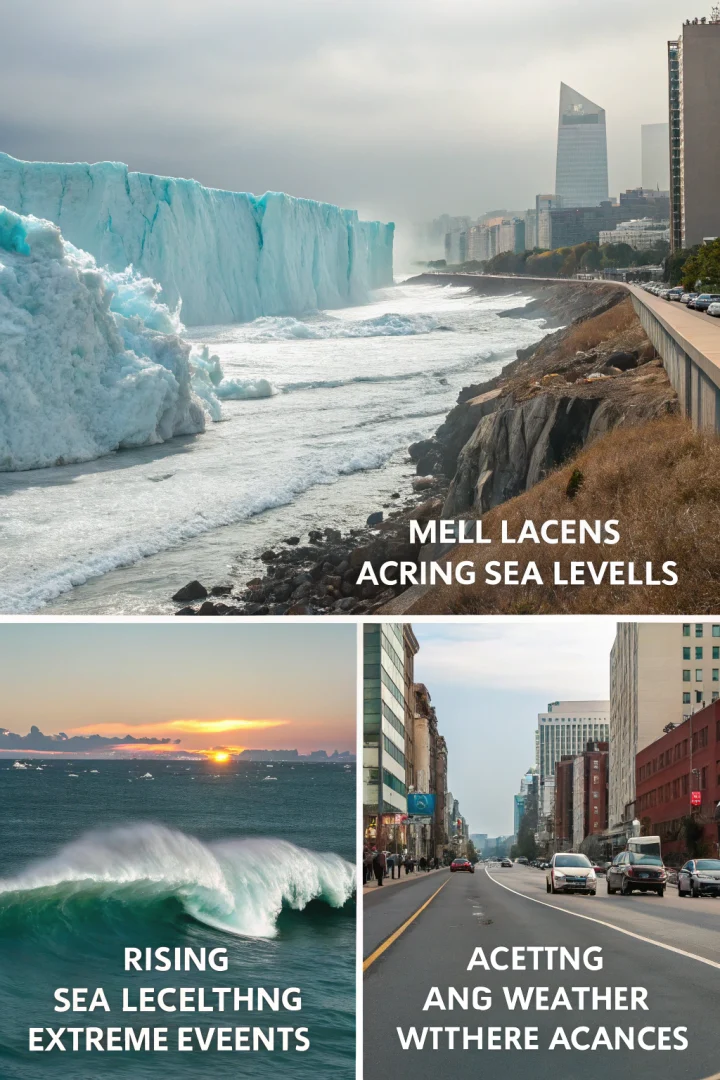
Why Climate Change Is Accelerating Faster Than Predicted
Let’s be real for a second: the climate conversation has shifted. It’s no longer a distant warning about what might happen to our grandchildren. It’s happening now, and it’s happening faster than most of us—including many scientists—expected. When we talk about climate acceleration, science is showing us that the gears of our planetary system are grinding faster, with feedback loops and human activity combining to push us into uncharted territory at a shocking pace. I’ve been covering tech and the environment for years, and honestly, the data coming out lately feels less like a gradual trend and more like a red alert that’s been stuck on repeat.
This isn’t about doom-mongering. It’s about understanding why the old models—the ones that predicted a slow, steady warming—are being rewritten in real time. We’re seeing ice sheets collapse, ocean temperatures spike, and weather patterns go haywire in ways that even five years ago seemed like worst-case scenarios. So, what’s actually driving this acceleration? And why does it feel like we’re running on a treadmill that keeps getting faster? Let’s break it down, no fluff, just the mechanics. For a deeper look at how virtual worlds can help visualize these shifts, check out our guide on climate simulations in the metaverse.
The Feedback Loop Machine: Why Warming Feeds on Itself
Here’s the thing about climate systems: they’re not linear. You don’t add one unit of CO2 and get one unit of warming. You get two, or three, because the planet starts amplifying its own heating. This is where climate acceleration, science gets both fascinating and terrifying. The classic example is the albedo effect. Ice and snow are bright—they reflect sunlight back into space. But as temperatures rise, that ice melts, exposing darker ocean or land, which absorbs more heat, which melts more ice. Rinse and repeat.
We’re seeing this play out brutally in the Arctic. Sea ice extent has been shrinking by about 13% per decade since satellite records began. That’s not just a number—it’s a feedback loop that’s been cranked up to eleven. In 2023, Antarctic sea ice hit a record low, and scientists were genuinely scratching their heads. The models didn’t predict it happening this fast. What we’re learning is that these feedbacks are more sensitive than we thought. Permafrost is another big one. As it thaws, it releases methane—a greenhouse gas way more potent than CO2 in the short term. That methane traps more heat, which thaws more permafrost. It’s like a slow-motion bomb that’s ticking louder every year.
Oceans: The Silent Sponges That Are Starting to Drip
If you want to understand climate acceleration, science points straight to the oceans. They’ve absorbed about 90% of the excess heat from global warming for decades. That’s why we didn’t feel it as much in the air—until now. But oceans have limits. In 2023, global sea surface temperatures smashed records by a staggering margin. We’re talking about heat that’s literally cooking marine life, bleaching coral reefs, and supercharging hurricanes. Warmer oceans also hold less CO2, meaning more of it stays in the atmosphere. That’s a double whammy: less carbon storage, more warming.
This isn’t just a scientific curiosity. It’s a direct driver of climate acceleration, science is now linking to extreme weather events. Take the Atlantic Meridional Overturning Circulation (AMOC), for example—the system that moves warm water north and cold water south. It’s showing signs of slowing down. If it collapses, we’re looking at rapid cooling in Europe and accelerated sea-level rise on the U.S. East Coast. That’s not a sci-fi plot; it’s a real risk that’s being studied right now. Want to see how these ocean changes could reshape coastlines? Explore our interactive sea-level visualizer.
Human Activity: The Accelerator Pedal We Can’t Let Go Of
Let’s not kid ourselves—natural feedback loops are powerful, but humans are the ones stomping on the gas. We’re still burning fossil fuels at near-record levels. In 2023, global CO2 emissions from energy hit an all-time high. That’s not a typo. Despite all the solar panels and wind turbines, demand for oil, coal, and gas keeps climbing. And it’s not just CO2. Methane leaks from agriculture and drilling are skyrocketing. Nitrous oxide from fertilizers is another hidden beast. These aren’t minor leaks; they’re systemic failures in how we produce food and energy.
What’s worse is the lag effect. Even if we cut emissions tomorrow, the heat already trapped in the system will keep warming the planet for decades. That’s why climate acceleration, science is so urgent. We’re not just dealing with current emissions; we’re dealing with the accumulated load. Think of it like filling a bathtub with the drain partially closed. The water level rises slowly at first, then faster as the pressure builds. That’s where we are now—the tub is overflowing, and we’re still turning the tap.
What This Means for You and the Planet
So, what does all this acceleration mean in practical terms? For starters, expect more “once-in-a-century” events every few years. Wildfires in Canada that smoke out New York. Floods in Pakistan that submerge a third of the country. Heatwaves in Europe that kill thousands. These aren’t anomalies anymore; they’re the new baseline. And they’re hitting harder because the system is moving faster than our infrastructure can adapt.
But here’s the kicker: understanding climate acceleration, science isn’t just about fear—it’s about action. The same feedback loops that amplify warming can also amplify solutions. For example, planting forests and restoring wetlands can pull CO2 out of the air and cool local climates. Renewable energy is getting cheaper and more efficient every year. The window is closing, sure, but it’s not slammed shut yet. The key is to stop treating climate change as a slow, distant problem and start treating it like the emergency it is.
Three Things You Can Do Right Now
- Cut your carbon footprint: Switch to a renewable energy provider, drive less, and eat more plant-based meals. Every ton of CO2 counts.
- Demand systemic change: Vote for leaders who prioritize climate action. Push companies to disclose and reduce their emissions. Individual action matters, but policy shifts are what move the needle.
- Stay informed: Follow the science, not the spin. Climate acceleration, science is evolving fast, and the more you know, the better you can advocate for real solutions.
The truth is, we’re in a race. Not against nature, but against our own inertia. The planet is sending us signals—record heat, collapsing ice, raging fires. The question isn’t whether we can stop the acceleration entirely; it’s whether we can slow it down enough to build a future that’s livable. And that starts with facing the facts, no sugarcoating. So let’s get to work.