I Put on a Headset and Ended Up at the Beacon Theatre
Let me be blunt: I’ve sat through more VR concerts than I care to count. Most of them feel like watching a screensaver with a soundtrack. You float in some pastel void, a digital avatar bobs awkwardly in front of you, and the whole thing leaves you wondering why you didn’t just pull up YouTube on a bigger screen.
So when I heard Meta was dropping a Goo Goo Dolls concert into Horizon TV, filmed live at New York City’s historic Beacon Theatre, I snorted. A 90s alt-rock band, famous for power ballads and a string of radio hits, beamed into a social VR platform that still feels half-finished? Sure. Sign me up for disappointment.
But I put on the Quest 3 anyway. And here’s the thing: I was wrong. Not entirely wrong—the platform still has rough edges—but wrong enough that I want to talk about why this particular concert worked. Because it reminded me, sharply, that live music and VR are a match made in a very specific kind of heaven. Or at least a very specific kind of living room.
The Secret Ingredient: A Real Venue
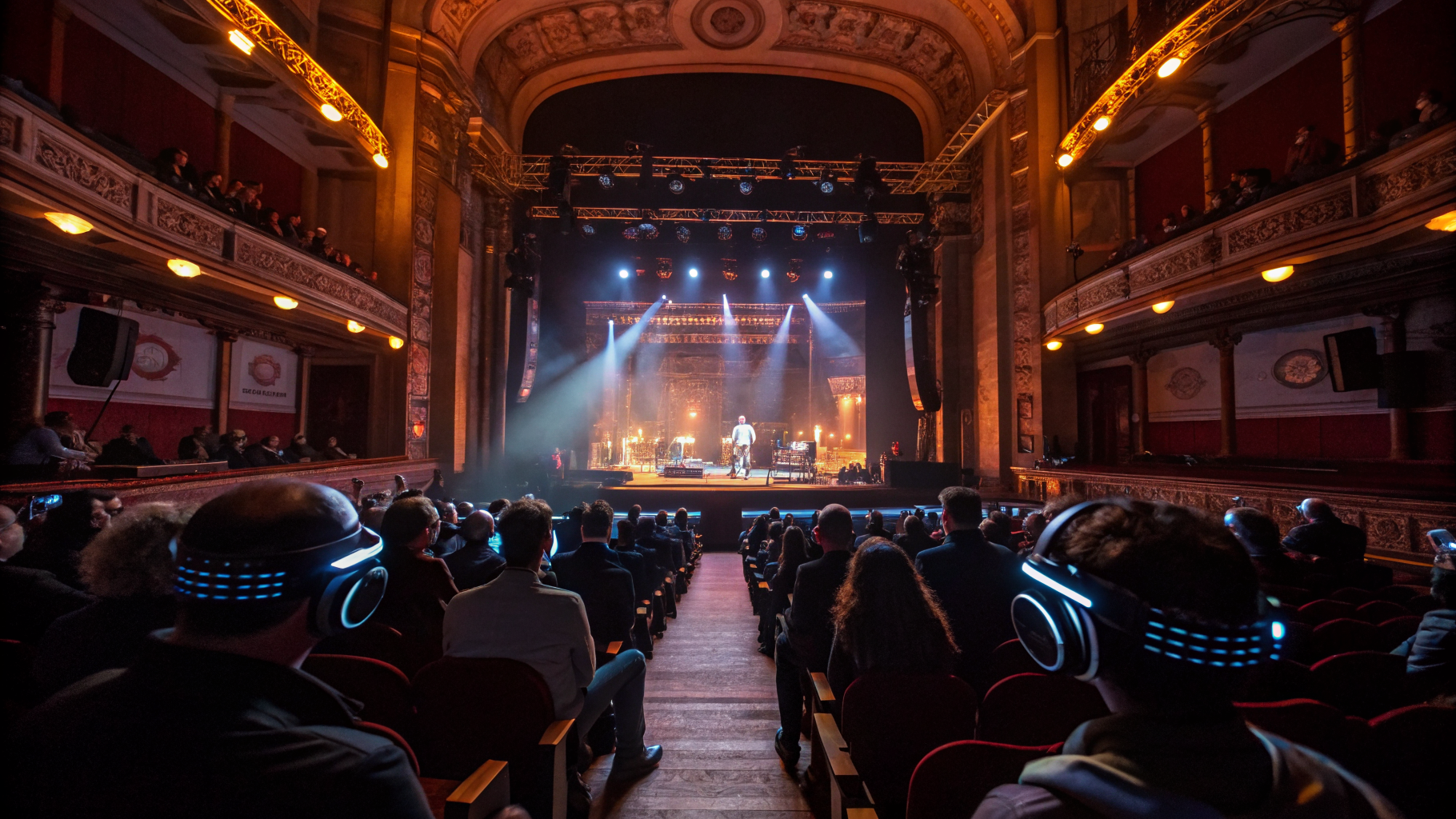
What struck me first was the setting. The Beacon Theatre isn’t some generic virtual space. It’s a real place, with real history, real balconies, real velvet seats. The volumetric capture—Meta’s term for filming in 3D with multiple cameras—pulled that space into my headset with surprising fidelity. I could glance left and see the ornate molding on a pillar. I could look up and catch the chandeliers.
Most VR concerts drop you into a void. A flat stage, a digital crowd of floating torsos, and a performance that feels like it’s happening in a vacuum. The Goo Goo Dolls set, by contrast, gave me a sense of place. I wasn’t just watching a band. I was in the room where they were playing. That shift—from abstract to anchored—makes all the difference.
In my view, this is the single most important lesson for anyone trying to build live music in VR: venue matters. You can have the best hologram of a singer in the world, but if they’re performing in a white box, your brain never buys the illusion. Put them in a real theatre, a real club, a real stadium, and suddenly the suspension of disbelief clicks into place.
What the Goo Goo Dolls Actually Did Right
I’m not going to pretend the Goo Goo Dolls are my favorite band. I respect the craft. “Iris” is a perfectly constructed power ballad. “Name” still hits a certain nostalgic nerve. But I came for the technology, not the setlist.
What I found was a performance that understood the medium. The band didn’t just stand there and play. They moved. They engaged the cameras. The director cut between angles—close-ups on guitarist John Rzeznik’s fingers, wide shots of the full stage, sweeping pans across the audience—in a way that felt more like a concert film than a static cast.
And the audience was real too. Not digital stand-ins. Actual humans, filmed on the night, reacting, cheering, singing along. That sounds obvious, but it’s not. Most VR concerts populate the crowd with generic avatars or leave the space empty. Here, the crowd gave the performance energy. When the band hit the chorus of “Slide” and the real audience roared, I felt a little of that collective buzz. Even alone in my living room.
Let me ask you a rhetorical question: When was the last time a VR event made you feel like you were at something, rather than just watching something? For me, it’s been a while. This one came close.
The Tech Behind the Magic
Meta shot this with what they call “volumetric video.” That’s a fancy way of saying they used a bunch of cameras to capture the performance from every angle, then stitched the footage into a 3D model you can walk around. It’s not true holography—you can’t walk behind the band and see the back of their heads—but it’s light-years beyond 360 video.
On the Quest 3, the resolution holds up. The lighting is warm, the colors are rich, and the audio—spatialized, of course—makes you feel like you’re standing in the middle of the orchestra. I’d still prefer a lossless stereo mix for pure fidelity, but for a social VR experience, the sound design is smart. It prioritizes immersion over audiophile perfection.
One thing that bugged me: the avatar integration. Horizon TV lets you watch with friends, your little digital bodies floating in the same virtual space. In theory, that’s cool. In practice, my friends’ avatars kept glitching, their mouths out of sync with their voices. The social layer felt bolted on, not baked in. I ended up muting everyone and just watching solo. Your mileage may vary.
Why Live Music Fits VR Better Than Anything Else
I’ve covered VR for over a decade now. I’ve been to virtual boardrooms, virtual art galleries, virtual yoga classes. Most of them are fine. None of them feel essential. But live music? That’s different.
Think about what a concert is. It’s a shared moment in a specific place, experienced through sound and light and physical presence. VR can’t give you the physical presence—not yet—but it can give you the sense of it. The spatial audio. The crowd reaction. The ability to look around and see the same room from any angle. Those are the elements that translate.
And crucially, concerts don’t require interaction. You don’t need to grab a virtual object or navigate a menu. You just need to stand (or sit) and absorb. That’s the sweet spot for current VR hardware. The moment you ask a user to do something complex—like, say, assemble a virtual IKEA shelf—the illusion shatters. But passive experiences with high production value? That’s where the medium shines.
I think this is why Meta keeps investing in concerts. They’ve done sets with Post Malone, with DJ Snake, with a bunch of others I’ve half-forgotten. Some were good. Some were forgettable. The Goo Goo Dolls one lands because it understands the assignment: give the viewer a real place, a real performance, and get out of the way.
But Let’s Not Get Carried Away
Here’s the part where I rain on the parade a little. Because as much as I enjoyed this concert, I’m not convinced it’s the future of live music. Not yet.
For one thing, the audience is tiny. Horizon TV is a fraction of a fraction of Meta’s user base. Most Quest owners never open it. Most people who open it never stay long. A concert like this reaches maybe a few thousand viewers on a good night. That’s not a revolution. That’s a niche.
For another, the business model is unclear. Is this a marketing expense for Meta? A test bed for future products? A way to sell more headsets? Probably all three. But for artists, the math is brutal. A VR concert costs a lot to produce, and the revenue—from ticket sales, sponsorships, or virtual merch—is minimal. Unless Meta is paying bands directly (and they likely are, for now), this isn’t sustainable.
And finally, the hardware barrier. You need a Quest 2 or 3, which costs hundreds of dollars. You need a decent Wi-Fi connection. You need to be comfortable wearing a headset for an hour. That’s a lot of friction for something that, at the end of the day, is still a recorded performance. You can watch the same concert on YouTube for free, on your couch, without a brick strapped to your face.
I’m not saying VR concerts are doomed. I’m saying they’re not a mass-market product yet. They’re a proof of concept. A really cool proof of concept, in this case, but still a prototype.
What Meta Should Do Next
If I were advising Meta’s entertainment team—and I’m not, but a journalist can dream—I’d tell them to double down on three things:
- More real venues. Stop building virtual stages. Film in actual historic theatres, clubs, arenas. The sense of place is the killer feature. Give me a concert at the Hollywood Bowl. Give me a jazz set at the Blue Note. Give me a punk show at CBGB (if they can time-travel).
- Better social tools. The avatar glitches need fixing. The voice sync needs to be flawless. If I’m watching with friends, I want to feel like we’re in the same room, not like we’re on a laggy Zoom call. Make the social layer invisible and reliable.
- Lower the friction. Let me buy a ticket through a web browser and get a reminder on my phone. Let me join the concert with one click, not five. Every extra step kills the impulse to attend.
I’d also tell them to stop pretending this is the metaverse. It’s not. It’s a really good VR concert experience. That’s enough. Calling everything “the metaverse” just makes people roll their eyes.
The Bottom Line
I went into the Goo Goo Dolls concert expecting to write a snarky takedown. Instead, I found myself tapping my foot to “Iris” and genuinely enjoying the sense of being somewhere else. That’s rare for me. I’ve become jaded covering this space.
Does this mean VR is finally ready for prime-time live music? Not quite. The audience is small, the business model is fragile, and the hardware is still a barrier. But it means the potential is real. When the tech, the venue, and the performance align, VR can deliver a moment that feels genuinely special.
For now, that’s enough. It’s a glimpse of what’s possible. And if you own a Quest and have an hour to kill, I’d say give it a shot. You might be surprised. I was.
Further Reading
Read the original coverage on UploadVR: Meta’s Goo Goo Dolls Concert Reminds Us Why Live Music Fits VR So Well
Original source: read the full article