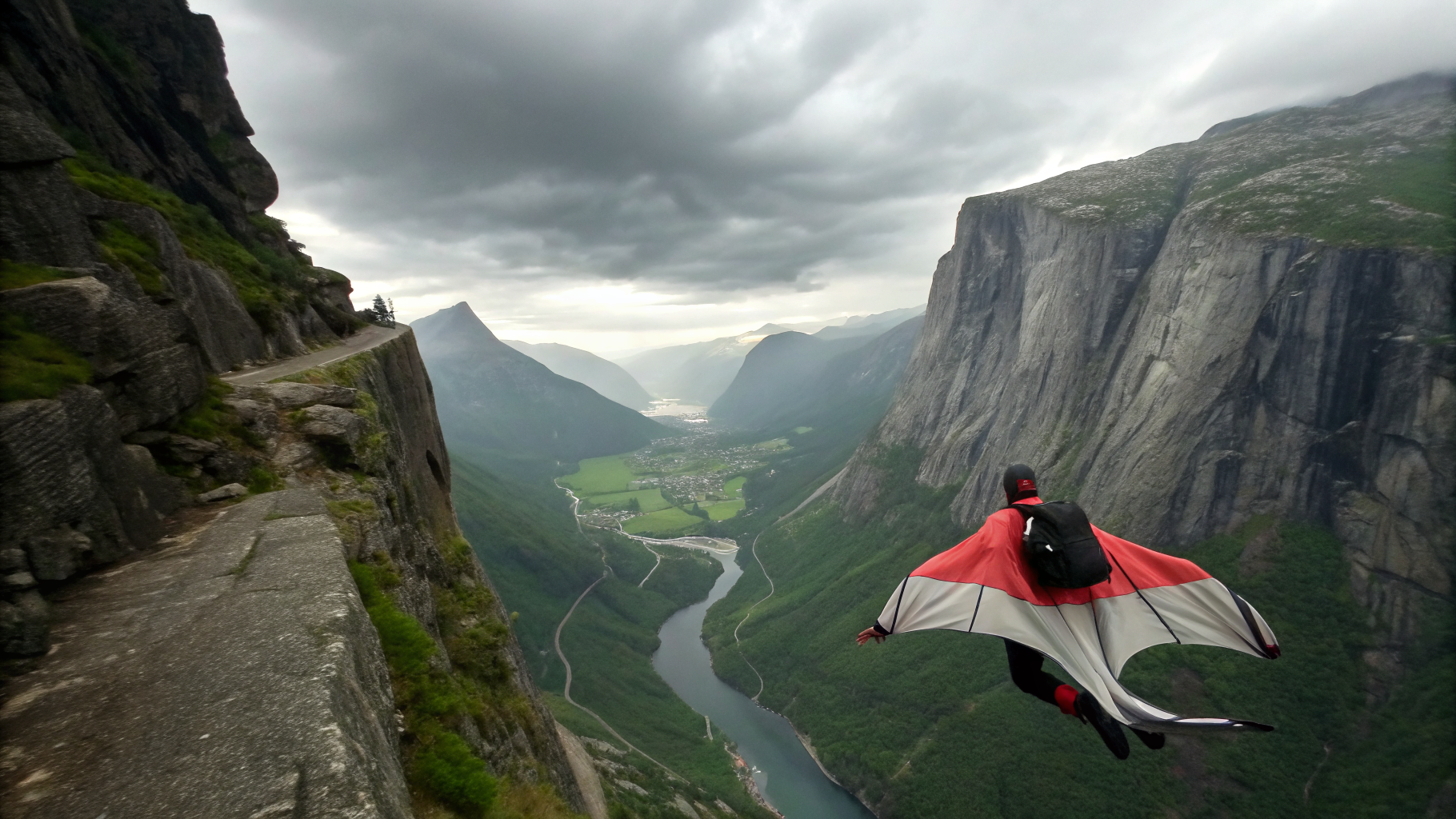
I’ve been writing about VR long enough to remember when “immersion” meant strapping a phone to your face and hoping for the best. We’ve come a long way. And then we’ve come a little further, because Wingsuit: Romsdalen is the kind of experience that makes you forget you’re standing in your living room in socks.
This isn’t a game, not really. It’s a simulation of wingsuit gliding over the real-world cliffs and valleys of Romsdalen, Norway. You jump. You fly. You try not to splat against a rock face. That’s the pitch. But the execution? That’s where things get interesting.
No Plot, Just Physics
Let’s get the obvious out of the way: there is no story here. No villain, no collectible feathers, no NPC who needs you to fetch his lost goat. You are a human with a wingsuit, standing on a ledge. Below you, the world falls away in a steep, terrifying drop. The only objective is to fly through a series of rings (gates, really) and land safely on a target. That’s it.
And yet, I found myself holding my breath on the first jump. Not because I was nervous about missing a gate. Because my brain, that gullible lump of meat, genuinely believed I was about to hurl myself off a cliff. The vertigo hit hard. I actually stepped back from the edge the first time. Embarrassing? Absolutely. But also a sign that the developers at some studio in Oslo (credit where it’s due) understand presence better than most AAA studios.
The controls are simple. Arms out to glide. Tilt your body to steer. Pull your arms in to dive. Deploy a parachute when you’re close to the ground. That’s it. You don’t need a manual. You don’t need a tutorial. You just need a tolerance for heights and a willingness to look like an idiot flailing your arms in your living room.
The Norwegian Landscape as a Playground
Romsdalen is not a generic fantasy valley. It’s a real place, and the developers have recreated it with surprising fidelity. The cliffs are jagged, the river snakes through the valley floor, and the grass on the landing zones looks almost edible in its lushness. I’m not Norwegian, but I felt a sudden urge to buy a wool sweater and complain about the price of fish.
What struck me here was the sense of scale. VR often struggles with distance — things that should look far away often look like toys. Not here. The mountains loom. The valley stretches out for what feels like miles. When you’re diving toward a narrow gap between two rock formations, you feel the speed. The wind roars in your ears (or at least, the headphones simulate it well). Your stomach drops. It’s the closest I’ve ever come to skydiving without actually having to sign a waiver that mentions the word “death.”
There are multiple courses, each with its own layout. Some are more forgiving, with wide open spaces and gentle turns. Others thread you through caves, under bridges, and between trees. The difficulty ramps up, but never unfairly. When I failed, it was because I pulled up too late or didn’t bank hard enough. The game didn’t cheat. It just watched me crash into a pine tree and calmly offered a restart.
Motion Sickness: The Elephant in the Cockpit
Let’s talk about the thing everyone wants to know: will this make you hurl? Probably. Maybe. It depends on your tolerance.
I’ve got decent VR legs. I can play Half-Life: Alyx for hours without a wobble. But Wingsuit: Romsdalen pushed me close to the edge — and not just the cliff edge. The rapid descent, the banking turns, the sudden changes in altitude… it’s a lot. The game offers comfort settings, including vignettes that narrow your field of view during sharp movements. I used them. I’m not proud, but I used them.
If you’re new to VR, do not make this your first experience. Start with something gentle. A cooking simulator. A nice walk through a forest. Build up to this. But if you’ve got your VR legs firmly underneath you, this is a rush that few other experiences can match. It’s the kind of thing you show to friends who insist VR is just a gimmick. Then you watch them wobble and grab the sofa for balance. It’s almost worth the price of admission just for that.
How Does It Compare to Other VR Flying Games?
Good question. The VR landscape is littered with flying games. Ultrawings is charming but cartoony. VTOL VR is a hardcore sim for people who know what “trim” means. Eagle Flight was fun but made me feel like a bird with a grudge.
Wingsuit: Romsdalen sits in a different category. It’s not about combat. It’s not about exploration. It’s about the pure, unadulterated sensation of falling with style. It’s closer to Jet Island in terms of raw speed, but grounded (pun intended) in a realistic setting. There’s no grappling hook, no hoverboard. Just you, the suit, and the wind.
The lack of multiplayer surprised me. I think this would be incredible with friends, racing through the same canyon, trying to out-maneuver each other. But as it stands, it’s a solitary experience. That’s fine for a first release, but I hope the developers add some form of asynchronous ghosts or leaderboards. I want to know how badly I’m losing to the world’s best virtual wingsuiters.
The Little Things That Matter
A few details stood out during my time with the game. The sound design is excellent. The wind builds as you accelerate, then drops off when you slow down. The fabric of the wingsuit rustles. When you deploy the parachute, there’s a satisfying thump and the world suddenly goes quiet. It’s a small touch, but it sells the moment.
The haptic feedback on the controllers is used sparingly but effectively. You feel a subtle vibration when you’re near the edge of a gate, like the suit is responding to the air pressure. It’s not overdone. It doesn’t buzz constantly. It just… helps.
And the loading screens? They’re short. Thank the gods. Nothing kills immersion faster than staring at a spinning icon while you wait for the next cliff to load.
But Is It Worth It?
This is where I have to be honest with you, dear reader. Wingsuit: Romsdalen is not a deep game. You’ll see everything it has to offer in a couple of hours. The courses are varied, but there are only a handful of them. Once you’ve memorized the routes, the challenge shifts from navigation to optimization — shaving seconds off your time, hitting every gate, nailing the landing.
For some, that’s enough. Speedrunning is a legitimate form of fun. For others, the lack of content will feel like a ripoff. I land somewhere in the middle. I got about four hours of genuine enjoyment out of it before I felt like I’d seen it all. That’s not bad for the price (around $15-20, depending on your platform). But it’s not a game you’ll come back to every week.
What it does, it does well. It’s a focused, polished experience that knows exactly what it wants to be. It doesn’t try to be a flight sim, an RPG, or a social platform. It’s a wingsuit glider. That’s it. And sometimes, that’s enough.
Final Thoughts (With a Side of Existential Dread)
I think about the metaverse a lot. I write about it, I critique it, I roll my eyes at the corporate buzzwords. But experiences like this remind me why I fell in love with VR in the first place. It’s not about digital land grabs or NFT sneakers. It’s about putting someone in a place they could never otherwise go and letting them feel something real.
Wingsuit: Romsdalen made me feel the wind, the speed, the terror, and the exhilaration of flight. It made me want to go to Norway. It made me want to learn to wingsuit. It also made me realize I’m a coward who would never actually jump off a cliff, which is fine. That’s what VR is for. It’s a safe way to be brave.
So yes, I recommend it. With caveats. If you’ve got the legs for it, and you’re looking for a quick, intense shot of adrenaline, this is your game. If you need a 40-hour epic with character development and a crafting system, look elsewhere. But if you want to stand on the edge of a Norwegian mountain, take a deep breath, and leap into the void… well, you can do that now. In your living room. In socks.
And honestly? That’s kind of beautiful.
Further Reading
Original source: read the full article