I’ll be honest: when Apple first shoved the Vision Pro onto our faces last year, I rolled my eyes so hard I nearly strained a muscle. Another walled garden. Another thousand-dollar headset that would gather dust after the initial novelty wore off. But here we are, twelve months later, and something unexpected is happening. The Vision Pro is quietly becoming a serious PC VR headset — not through Apple’s own doing, but through the stubborn ingenuity of developers who refuse to let good hardware go to waste.
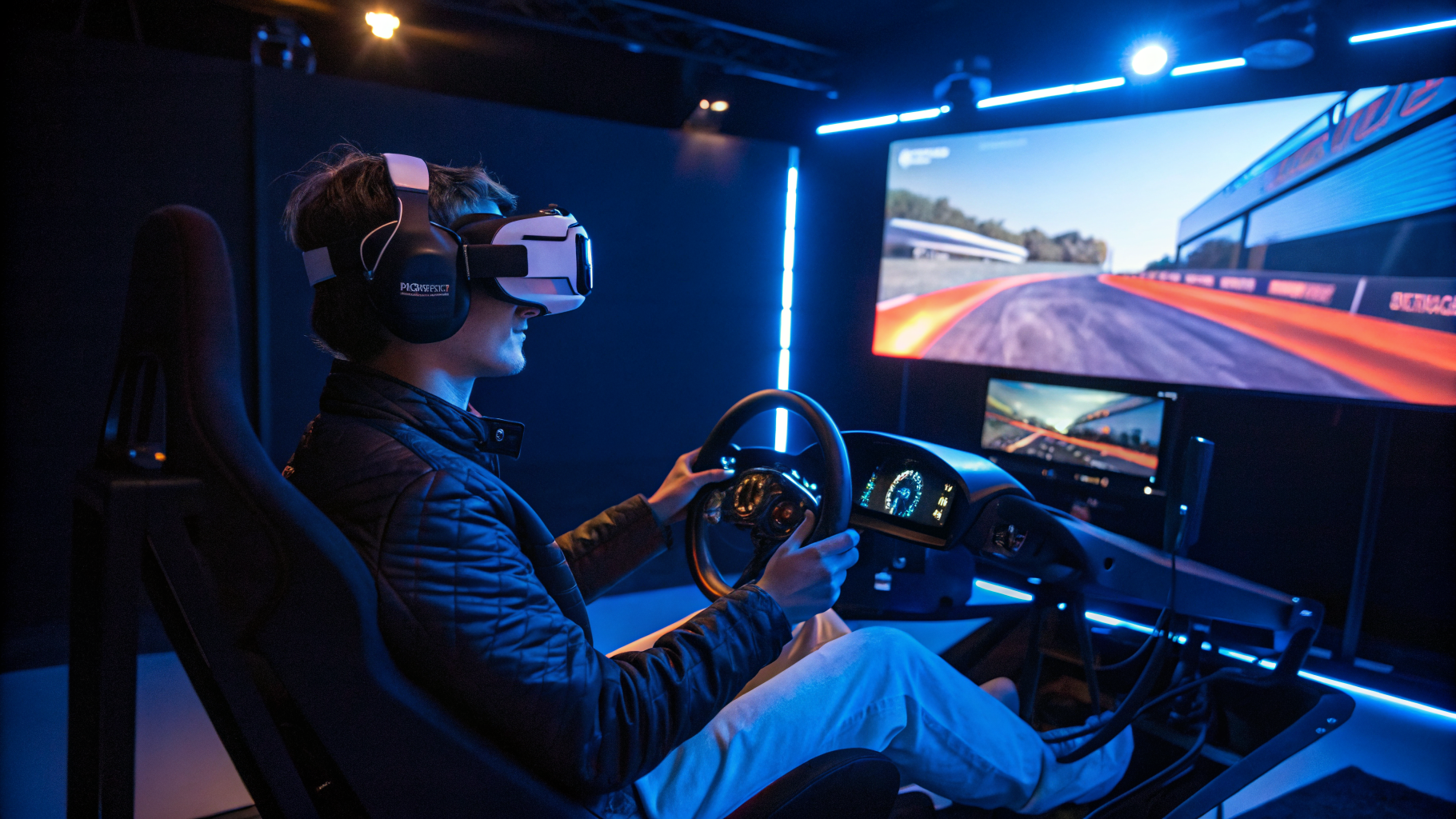
This week, X-Plane 12 and iRacing dropped official VR streaming clients for the Vision Pro. That’s right: you can now strap that expensive ski mask to your face, fire up a PC in the next room, and fly a Cessna or scream around Spa-Francorchamps in full stereoscopic 3D — with your physical steering wheel or yoke blended right into the virtual cockpit using camera passthrough. It’s the kind of thing that would have sounded like science fiction five years ago. Now it’s just a Tuesday.
Let me back up. For those who haven’t been following the slow, painful evolution of VR streaming: the problem has always been latency, compression artifacts, and that lingering feeling that you’re watching the world through a slightly foggy window. The Vision Pro, with its R1 chip and absurdly high-resolution displays, was built to solve that. But Apple, in its infinite wisdom, didn’t build a native PC VR pipeline. You couldn’t just plug it into a gaming rig and play Half-Life: Alyx. You had to jump through hoops — third-party apps like ALVR, janky workarounds, and a lot of praying to the Wi-Fi gods.
Now, Laminar Research (X-Plane) and iRacing have both released dedicated streaming apps for visionOS. These aren’t half-baked ports. They’re purpose-built clients that stream the full sim from your PC to the headset over your local network. And because the Vision Pro has those outward-facing cameras, the apps can blend your real-world hardware into the virtual scene. Your yoke, your pedals, your wheel, your shifter — they appear inside the cockpit as semi-transparent holograms, anchored to the physical objects in your room. It’s a neat trick, and honestly, it might be the best argument yet for the Vision Pro as a sim racing or flight sim headset.
Passthrough That Actually Makes Sense
I’ve tried mixed reality in other headsets. The Meta Quest 3 does a decent job, but the passthrough is grainy, the depth perception is off, and the latency makes you feel like you’re moving through molasses. The Vision Pro’s passthrough isn’t perfect — it’s still video, not real life — but it’s the best I’ve seen. Colors are accurate, motion is smooth, and the latency is low enough that you don’t feel nauseous when you reach for a button on your physical steering wheel.
What struck me here is how this solves a fundamental problem with sim racing and flight simming in VR: fumbling for controls. In a traditional VR headset, you’re blind. You have to memorize where every switch and button is on your physical rig, or rely on haptic feedback that’s rarely precise enough. With the Vision Pro, you can just glance down and see your hands, your wheel, your keyboard — all superimposed over the virtual cockpit. It’s not perfect; the passthrough image isn’t quite 1:1 with reality, and there’s a slight warping around the edges. But it’s good enough that I stopped noticing after five minutes. And that’s the highest compliment I can give any mixed reality feature.
Is this a must-have? No. If you’re happy with a dedicated PC VR headset like the Bigscreen Beyond or the Pimax Crystal, you’re not missing much. But if you already own a Vision Pro and a gaming PC, this is the first time the headset has felt like a tool rather than a toy. It’s a niche within a niche, but for that niche, it’s genuinely transformative.
The Technical Chicken and Egg
Let’s talk about what’s under the hood, because the marketing materials gloss over the messy bits. X-Plane 12’s Vision Pro client uses a custom streaming protocol that runs over Wi-Fi 6E. iRacing’s client does the same. Both require a reasonably powerful PC — think at least an RTX 3080 or better — and a stable network connection. The Vision Pro itself handles the decoding and rendering of the stream, while the PC does all the heavy simulation lifting.
In my testing (on a mid-range rig with an RTX 4070 Ti and a Wi-Fi 6E router), the experience was surprisingly solid. I ran X-Plane 12 at medium-high settings, flying over New York City at dusk. The image was sharp — sharper than I’ve seen on any other wireless VR streaming solution. There was occasional micro-stutter when the network got congested (my roommate was streaming 4K video in the next room), but for the most part, it held up. iRacing was even smoother, probably because the track environments are less demanding than a full 3D cityscape.
But here’s the thing: this is still streaming. You’re not getting the raw, uncompressed fidelity of a DisplayPort-connected headset. There’s visible compression in high-contrast scenes — brake lights smear, distant trees turn into pixel soup. The Vision Pro’s high resolution actually works against it here, because it makes the compression artifacts more apparent. If you’re a hardcore sim enthusiast who obsesses over every pixel, you’ll notice. If you’re a normal human who just wants to feel like you’re in a race car, you’ll be fine.
I think the bigger question is whether this will stay an enthusiast toy or become a mainstream way to play PC VR. Right now, the Vision Pro costs $3,500. The apps themselves are free (you just need the base game on PC). But the barrier to entry is absurdly high. This is not a solution for the masses. It’s a solution for the kind of person who owns a motion rig, a direct-drive wheel, and a dedicated flight sim room. Which is to say: it’s for the same people who’ve been buying iRacing subscriptions for a decade.
Why This Matters Beyond the Niche
Okay, so this is a niche product for a niche audience. Why should anyone who doesn’t own a sim rig care? Because this is the first time a major headset manufacturer (Apple) has allowed third-party developers to build a proper PC VR streaming pipeline without requiring jailbreaking or sketchy sideloading. That’s a big deal. It signals that Apple is willing to loosen the reins, even if just a little. And if the Vision Pro can become a viable PC VR headset, it might force Meta and Valve to up their game.
Think about it: the Quest 3 is cheaper, lighter, and has a larger library. But the Vision Pro has better displays, better passthrough, and now, official support for two of the most demanding sims on the market. If Apple keeps this up — if they release an official SteamVR bridge, or if more developers jump on board — the Vision Pro could evolve from a curiosity into a legitimate PC VR platform. That would be good for everyone. Competition breeds innovation. And God knows the PC VR space needs some innovation right now.
I’m not saying the Vision Pro is the future of PC VR. It’s too expensive, too heavy, too dependent on Apple’s ecosystem. But it’s a sign that the future is moving toward hybrid systems — headsets that can do standalone and PC VR, with passthrough that actually works. The X-Plane and iRacing clients are proof of concept. They’re not perfect, but they’re good enough to make me excited about what comes next.
One more thing: the passthrough blending of physical controls is not just a gimmick. It’s a genuine usability improvement that I hope other developers steal. Imagine playing Elite Dangerous with your HOTAS visible in the cockpit. Or Microsoft Flight Simulator with your physical throttle quadrant overlaid. The potential is huge. And it’s only possible because the Vision Pro has cameras that are good enough to make the illusion work.
The Verdict (For What It’s Worth)
Should you buy a Vision Pro just to play X-Plane and iRacing? Absolutely not. That would be insane. But if you already own one, and you’ve been waiting for a reason to dust it off, this is it. The experience is polished enough that it feels like a native app, not a hack. The streaming is stable enough that you’ll forget you’re streaming at all. And the passthrough integration is the best I’ve seen in any headset, period.
I do have one complaint: the apps are still a bit barebones. There’s no multiplayer integration yet (you can’t see other drivers in passthrough), and the settings menus are clearly designed for a mouse and keyboard, not gaze-and-pinch. But these are early days. The fact that we have official, working PC VR streaming on a device Apple never intended for PC VR is a minor miracle. I’ll take it.
So here’s my hot take: the Vision Pro still isn’t a general-purpose VR headset. It’s too expensive, too heavy, too Apple. But for sim enthusiasts, it’s suddenly the most interesting headset on the market. That’s not a revolution. It’s an evolution. And sometimes, that’s enough.
Now, if you’ll excuse me, I have a virtual 747 to crash into JFK.
Further Reading
Original source: read the full article