
The Next Frontier: How Healthcare Innovation is Saving Lives
Imagine a world where diseases are detected before symptoms appear and treatments are tailored to your unique genetic code. This isn’t science fiction; it’s the reality being built today at the intersection of healthcare, innovation, and artificial intelligence. We are witnessing a monumental shift from reactive sick-care to proactive, predictive health management, fundamentally reshaping our relationship with medicine. This technological revolution promises a future of longer, healthier lives for everyone.
The Digital Pulse: A Background on Tech’s Evolution in Medicine
The journey of technology in medicine began long before the first line of code was written. From the invention of the stethoscope to the X-ray, innovation has always been the lifeblood of medical progress. However, the digital age has accelerated this evolution at an unprecedented rate. The sequencing of the human genome in the early 2000s, coupled with the explosion of computational power, laid the groundwork for today’s AI-driven breakthroughs. We moved from electronic health records (EHRs), which primarily digitized existing paperwork, to sophisticated systems capable of analyzing vast datasets.
This evolution is powered by machine learning algorithms that can learn from data, identify patterns invisible to the human eye, and make predictions with increasing accuracy. As detailed in groundbreaking research covered by MIT Technology Review, AI models like AlphaFold have solved decades-old biological challenges, such as predicting protein structures, which has massive implications for drug discovery and understanding diseases. This represents a quantum leap in our ability to combat illness, moving far beyond simple digitization to genuine intelligent augmentation.
Practical Applications: Where AI is Making a Difference Today
The convergence of healthcare, innovation, and AI is not just a theoretical concept; it’s delivering tangible results across various medical fields. These applications are enhancing the capabilities of medical professionals, improving patient outcomes, and paving the way for a more efficient and personalized healthcare system.
AI-Powered Diagnostics and Radiology
One of the most mature applications of AI in medicine is in diagnostic imaging. Machine learning algorithms, trained on millions of medical images (like X-rays, CT scans, and MRIs), can detect anomalies with a speed and accuracy that can match or even surpass human radiologists. These tools act as a “second pair of eyes,” flagging potential tumors, fractures, or signs of diseases like diabetic retinopathy and Alzheimer’s, often at their earliest and most treatable stages. This not only reduces the risk of human error but also helps prioritize critical cases, dramatically speeding up the diagnostic process.
Precision Medicine and Genomics
Precision medicine is a revolutionary approach that tailors disease treatment and prevention by considering individual variability in genes, environment, and lifestyle. AI is the engine that makes this possible. By analyzing a patient’s genetic data alongside clinical information, AI can predict which treatment strategies will be most effective for a specific person. In oncology, for example, this means moving away from one-size-fits-all chemotherapy to targeted therapies that attack cancer cells with specific genetic mutations, leading to better outcomes with fewer side effects. This level of personalization is a cornerstone of modern healthcare innovation.
Robotic-Assisted Surgery
Surgical robots, guided by skilled surgeons, are transforming the operating room. Systems like the da Vinci Surgical System allow for minimally invasive procedures with enhanced precision, flexibility, and control. AI is further enhancing these platforms by providing real-time data overlays, highlighting critical structures like nerves and blood vessels, and even automating certain repetitive surgical tasks. This results in smaller incisions, less pain, reduced blood loss, and faster recovery times for patients. The synergy between surgeon and smart robot embodies the collaborative future of medical practice.
Challenges and Ethical Considerations in Healthcare Innovation
While the potential of AI in medicine is immense, its implementation is not without significant hurdles and ethical dilemmas. A primary concern is algorithmic bias. If AI models are trained on data that is not diverse and representative of the entire population, they can perpetuate or even amplify existing health disparities. For example, a diagnostic tool trained predominantly on data from one demographic might be less accurate for others.
Data privacy is another paramount issue. Medical data is among the most sensitive personal information, and its use in AI systems raises complex questions about security, consent, and patient anonymity. Regulations like HIPAA in the US provide a framework, but the scale and nature of big data analysis present new challenges. Ensuring robust security measures to prevent breaches and misuse is critical for maintaining public trust. Furthermore, the “black box” nature of some complex AI models, where even their creators cannot fully explain their reasoning, poses a challenge for accountability and safety in high-stakes medical decisions.
What’s Next? The Future of Intelligent Health
The pace of healthcare innovation shows no signs of slowing down. In the short-term, we can expect wider adoption of AI in administrative tasks, freeing up clinicians to spend more time with patients. Mid-term, we’ll see more sophisticated “digital twin” models—virtual replicas of patients used to simulate treatments and predict outcomes before they are applied. Companies like Tempus are already making strides in this area, using AI to structure and analyze clinical and molecular data for personalized cancer care.
Looking further ahead, the long-term vision includes ambient clinical intelligence, where AI-powered sensors and microphones in exam rooms automatically document patient encounters, and truly predictive analytics that can forecast disease outbreaks on a population level. Startups like Butterfly Network, with its handheld, AI-powered ultrasound device, are democratizing medical imaging, hinting at a future where powerful diagnostic tools are accessible everywhere.
How to Get Involved and Stay Informed
The world of AI in healthcare is dynamic and accessible. For those interested in learning more, there are numerous resources available. Platforms like Coursera and edX offer specialized courses on topics like “AI for Medicine” from leading universities. You can join communities on Reddit, such as r/HealthIT and r/singularity, to discuss the latest trends and research. Following industry leaders and research institutions on platforms like Twitter and LinkedIn also provides a steady stream of valuable insights. To understand how these technologies connect to broader digital trends, you can explore the future of digital worlds and see where these innovations intersect.
Debunking Common Myths About AI in Medicine
Misconceptions can hinder progress and create unnecessary fear. Let’s clarify some common myths surrounding this field of healthcare, innovation.
- Myth: AI will replace doctors. Reality: AI is best viewed as an augmentation tool, not a replacement. It excels at data analysis and pattern recognition, but it lacks the empathy, ethical judgment, and complex problem-solving skills of a human clinician. The future is collaborative, with AI handling the data-intensive tasks so doctors can focus on patient care.
- Myth: AI is 100% objective and free from bias. Reality: AI is only as good as the data it’s trained on. As mentioned earlier, biased data leads to biased algorithms. Acknowledging this and actively working to create diverse, equitable datasets is a critical responsibility for developers and researchers.
- Myth: You need to be a data scientist to understand AI in healthcare. Reality: While deep technical knowledge is required to build AI models, understanding their application and implications is accessible to everyone. The focus for most professionals and patients should be on the outcomes and how these tools can improve the care process.
Top Tools & Resources for Healthcare Innovation
Staying current with the latest advancements is key. Here are a few essential resources and tools that are shaping the future of medicine.
- NVIDIA Clara: This is a powerful computational platform designed specifically for healthcare. It provides developers with tools to build and deploy AI applications for medical imaging, genomics, and drug discovery. It matters because it accelerates the development cycle for new medical AI solutions.
- Google Health AI: Google is a major player, developing AI for everything from diabetic retinopathy screening to cancer detection. Their research and tools, like the LyNA algorithm for identifying metastatic breast cancer, represent the cutting edge and push the entire industry forward.
- OpenAI’s GPT Models in Healthcare: While not a specific medical tool, large language models are being explored for tasks like summarizing patient notes, generating clinical documentation, and powering patient-facing chatbots. They hold a huge potential for reducing administrative burden.
Conclusion
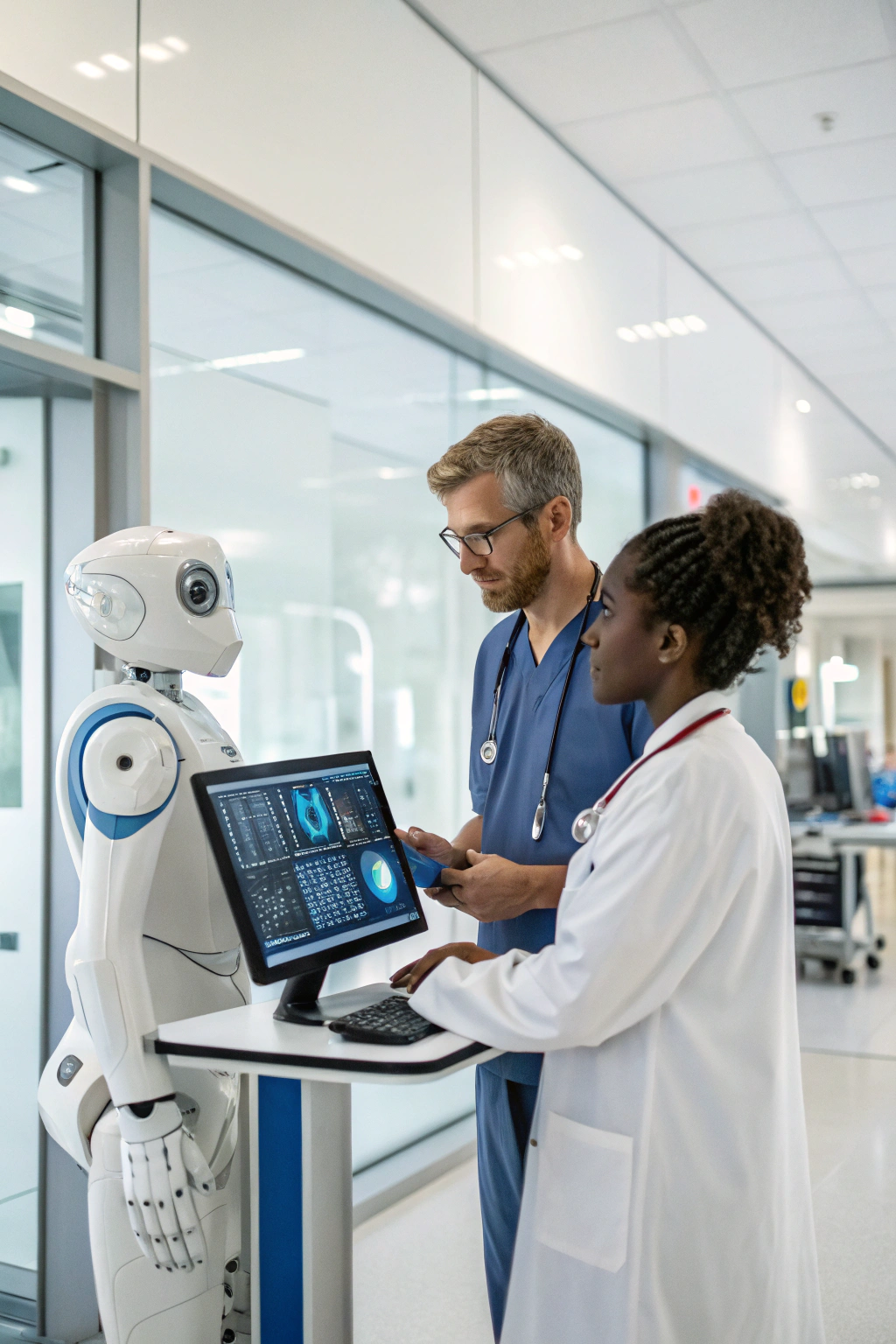
The integration of advanced technology is no longer a distant vision but a present-day catalyst for a healthier future. From diagnosing diseases earlier and more accurately to personalizing treatments down to the molecular level, the synergy of healthcare, innovation, and AI is creating a new paradigm of medicine. While significant ethical and regulatory challenges remain, the commitment to responsible development is strong. The path forward is one of collaboration, where human expertise is amplified by intelligent systems, ultimately leading to better outcomes for patients worldwide.
🔗 Discover more futuristic insights on our Pinterest!
FAQ
What is the most significant impact of AI on healthcare today?
Currently, the most significant impact is in medical imaging and diagnostics. AI’s ability to analyze scans with incredible speed and accuracy helps radiologists detect diseases like cancer earlier and more reliably, directly improving patient prognosis and treatment effectiveness. This is a mature application that is already deployed in many hospitals.
Is my personal health data safe with AI systems?
Data security is a top priority. In regulated markets like the US and EU, strict laws (like HIPAA and GDPR) govern the use of patient data. AI systems used in healthcare must comply with these regulations, which involve data anonymization, encryption, and secure storage. While no system is 100% immune to breaches, the healthcare industry employs robust cybersecurity measures to protect sensitive information.
How can healthcare innovation help with rising medical costs?
Technological innovation in healthcare can help reduce costs in several ways. By enabling earlier disease detection, it lowers the expense of treating advanced conditions. AI also streamlines administrative tasks, reducing overhead. Furthermore, by personalizing treatment, it avoids the cost of ineffective therapies and minimizes expensive side effects and complications, leading to a more efficient and cost-effective system overall.