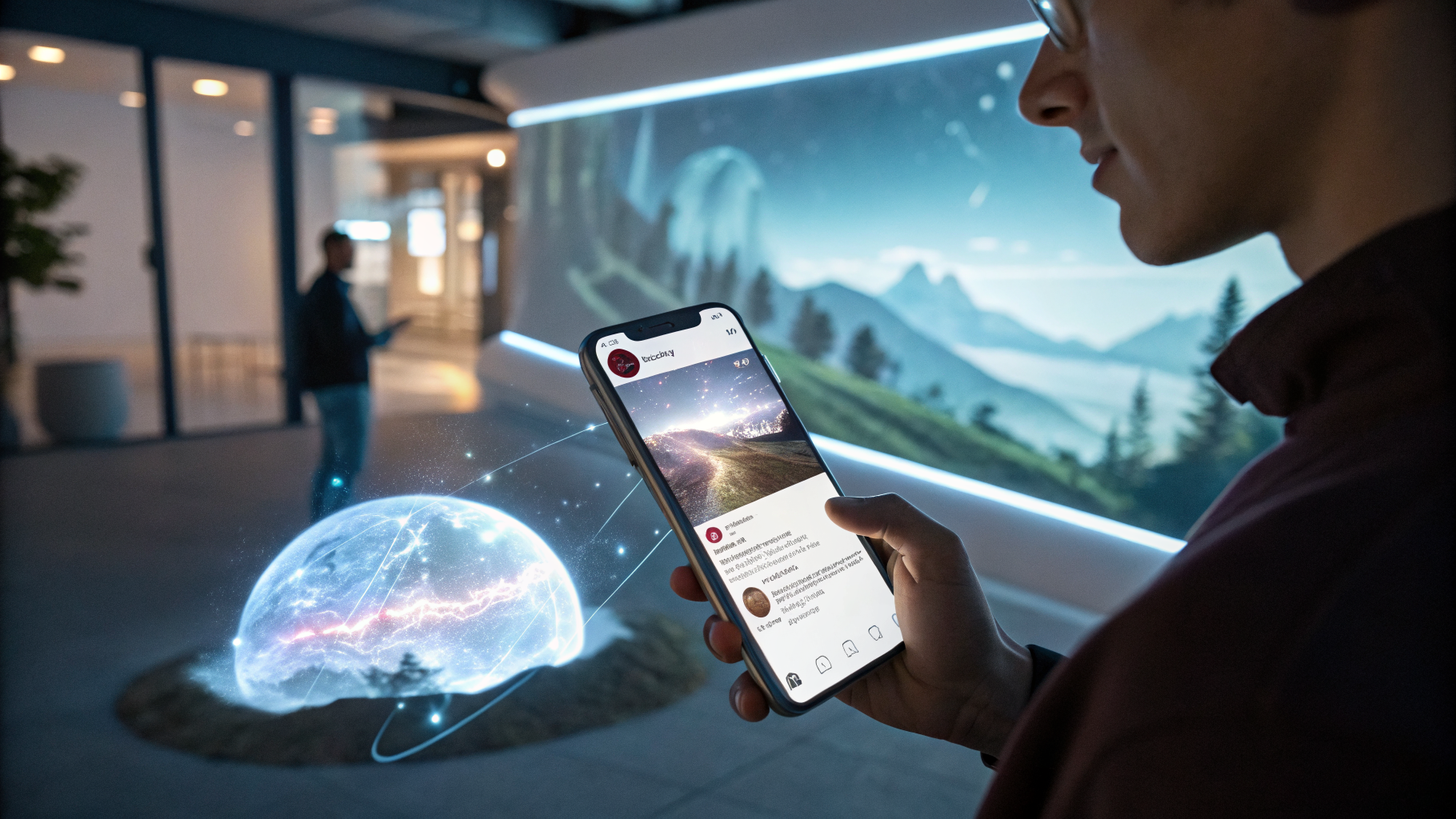
So Meta Just Turned Your Instagram Feed Into a Prompt
I’ve been covering this space long enough to know when a company is just throwing spaghetti at the wall. Meta’s new Muse image model sounds, on the surface, like yet another AI image generator. But here’s the twist: it takes your entire Instagram account — your posts, your stories, your aesthetic — and uses that as a prompt. Yes, you read that right. Your feed is now training data for a machine that spits out pictures.
This isn’t some gimmick they cooked up in a hackathon. Muse is already live in Instagram Stories effects and inside WhatsApp’s image generation tools. I tried it. It’s weird. It’s a little creepy. And honestly, it’s the most interesting thing Meta has done with generative AI since they rebranded from Facebook.
Let me be clear: I’m not here to sell you a narrative about the “democratization of creativity.” That’s corporate speak for “we want your data.” But Muse is different. It’s not just a text-to-image model. It’s a context-to-image model. It understands your visual language — the filters you use, the subjects you shoot, the color palette you lean on. And then it generates images that feel like you.
Or at least, a version of you that lives inside a GPU cluster in Menlo Park.
How Muse Actually Works (Skip the Hype, Here’s the Guts)
Most image generators, like DALL-E or Midjourney, take a text prompt. You type “a cat wearing a top hat” and get four variations. Muse throws that paradigm out the window. Instead of text, it ingests a “style reference” — in this case, your entire Instagram account. The model learns your visual signature by scanning every photo you’ve posted, every story you’ve shared, every Reel you’ve liked.
What struck me here is the scale. Meta has billions of images from Instagram alone. They didn’t need to scrape the open web like OpenAI did. They had a private, high-quality dataset sitting in their database. Muse is essentially a distillation of that visual culture, personalized for each user.
Technically, it’s a diffusion transformer — similar architecture to what Google and Stability AI use, but optimized for Meta’s infrastructure. The model runs on their custom AI chips, which they’ve been quietly developing for years. It’s fast, too. I generated a series of images in under a second each. That’s not marketing speed. That’s real-time, on-device inference.
But here’s the kicker: the model doesn’t just copy your photos. It synthesizes new ones that match your style. If you’re a photographer who shoots moody, desaturated street scenes, Muse will generate new street scenes in that exact moody style. If you’re a food blogger with bright, over-saturated flat lays, it’ll give you more of that.
Is it perfect? No. I fed it my own feed — a mix of VR headset shots, conference floors, and the occasional sunset — and it gave me some truly bizarre outputs. A sunset that looked like a conference floor. A VR headset floating in a sunset. But the style was unmistakably mine.
The Instagram Story Effects Are Already Live — And They’re Unsettling
Meta didn’t just announce Muse. They shipped it. Open Instagram right now, go to Stories, and you’ll see a new set of AI effects powered by Muse. These aren’t the standard AR filters you’re used to. They’re generative. You take a selfie, and the model transforms it into a painting that matches the aesthetic of your last ten posts. Or it generates a background that looks like a landscape from your recent vacation photos.
I tested it with a friend who posts almost exclusively black-and-white portraits. The effect turned a random selfie into a black-and-white portrait that looked like it was taken by a pro. It was good. Too good. It felt like the app knew her better than she knew herself.
Rhetorical question time: When did we start letting algorithms define our visual identity? I get that it’s convenient. I get that it’s fun. But there’s a fine line between personalization and homogenization. If everyone’s Instagram starts looking like an AI-generated version of themselves, are we still expressing individuality, or are we just feeding the machine?
WhatsApp Gets a Muse Boost — And Nobody Asked for It
Then there’s WhatsApp. Meta quietly added image generation to the messaging app, powered by Muse. You can now type something like “a birthday cake with balloons” and it’ll generate an image that looks like it came from your own photo library. If you’ve never posted a birthday cake on Instagram, it’ll generate something generic. But if you have, it’ll match your style.
This is where it gets messy. WhatsApp is supposed to be private. End-to-end encrypted. Now there’s an AI model running on Meta’s servers that has access to your Instagram feed to generate images for your private chats. Meta says the model doesn’t store your personal data permanently, and that the inference happens in a secure enclave. I’ve heard that song before.
I’m not saying it’s a privacy nightmare. Yet. But it’s worth watching. The integration feels like a Trojan horse. You get a fun image generator in WhatsApp, and Meta gets to train Muse on every image you generate. Because that’s the thing — every time you use it, you’re giving feedback. You’re telling the model what works and what doesn’t. That’s valuable training data.
Why This Matters More Than the Metaverse (Sorry, Zuck)
Let’s zoom out. Meta has been pivoting hard toward the metaverse, spending billions on Horizon Worlds and VR hardware. But Muse is a reminder that their real strength isn’t virtual reality — it’s your reality. They own the world’s largest collection of personal visual data. And now they’re using it to power AI that generates images that feel personal.
This is smarter than the metaverse play. The metaverse requires users to adopt a new platform, new hardware, new behaviors. Muse works on the apps you already use. It requires no new habits. It just sits there, inside Instagram and WhatsApp, quietly learning from you.
I think this is where the real competition will be in 2025. Not which company builds the best text-to-image model, but which company can generate images that feel yours. Google has your search history. Apple has your photos. Meta has your social life. Muse is the first product that weaponizes that social context.
The Good, The Bad, and The Weird
Let’s break it down honestly.
- The Good: Muse is genuinely impressive at capturing style. For creators who want to maintain a consistent aesthetic across posts, it’s a time-saver. The Story effects are fun, and the WhatsApp integration is smooth. It’s also fast — no waiting minutes for generation.
- The Bad: It reinforces the filter bubble. Your feed becomes a self-referential loop. You post in a certain style, Muse generates more of that style, you post those, and the model gets even better. Creatively, that’s a dead end. You’re just optimizing for the algorithm’s version of you.
- The Weird: The model sometimes hallucinates details from your feed that don’t make sense. I got an image of a beach with a laptop floating in the water, because I’d posted both beach photos and laptop photos. It’s like the model doesn’t understand context — just style.
Is This the End of Originality?
I’m going to take a position here. I think Muse is a brilliant technical achievement, but it’s creatively dangerous. We’re already in an era where social media rewards consistency over experimentation. Muse takes that to its logical extreme: why try a new style when the AI will just reinforce your old one?
For the average user, it’s harmless. A fun toy. For artists and photographers, it’s a threat. Not because it replaces them — it doesn’t — but because it flattens visual culture into a set of predictable patterns. Every Instagram feed starts to look like a curated gallery of the same aesthetic, generated by the same model, trained on the same data.
I asked Meta’s product lead about this. She said, “We see Muse as a tool for self-expression, not a replacement for it.” That’s the party line. But I’ve heard similar lines from every company that built a creative AI tool. They always say it’s about empowerment. Until it becomes about optimization.
What Comes Next?
Muse is rolling out slowly. Right now it’s US-only, English-language, and limited to certain account types. But you know how this goes. Within six months, it’ll be global. Within a year, it’ll be the default. And within two years, we’ll look back and wonder how we ever made Instagram stories without AI generating our backgrounds.
I’m not saying don’t use it. I’m saying use it with your eyes open. Every image you generate is a data point. Every style you train is a lock-in. Meta wants you to depend on Muse the way you depend on the Instagram algorithm. That’s the goal.
So go ahead. Try it. See what your feed looks like when it’s reflected back at you through a neural network. It’s beautiful, in a hollow way. It’s you, but not quite. It’s a mirror made of code.
Just remember: the mirror is watching you back.
Original source: read the full article